
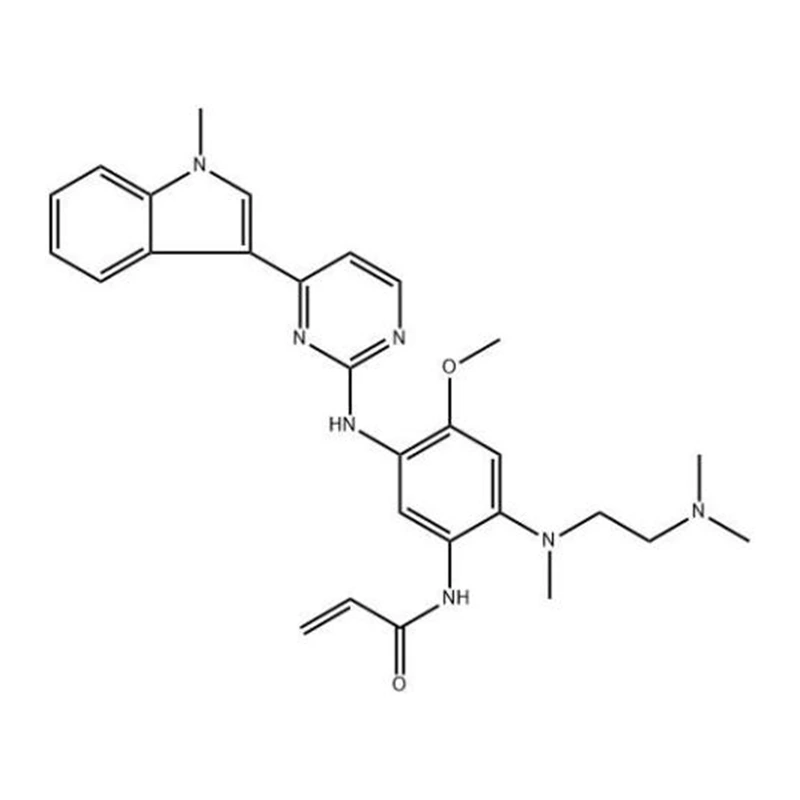
Osimertinib (CAS 1421373-65-0), marketed under the brand name Tagrisso, is a third-generation, irreversible epidermal growth factor receptor tyrosine kinase inhibitor (EGFR-TKI) developed by AstraZeneca. Since its first FDA approval in November 2015, osimertinib has fundamentally reshaped the treatment paradigm for EGFR-mutated non-small cell lung cancer (NSCLC).
The evolution of EGFR-TKI therapy tells a story of iterative innovation. First-generation TKIs (gefitinib, erlotinib) effectively target sensitizing EGFR mutations (Exon 19 deletions, L858R) but are inevitably met with acquired resistance — most commonly via the T790M gatekeeper mutation. Second-generation TKIs (afatinib, dacomitinib) offer broader but more toxic inhibition. Osimertinib was designed specifically to solve the T790M problem: it selectively and potently inhibits both sensitizing EGFR mutations and the T790M resistance mutation, with minimal activity against wild-type EGFR, delivering a superior balance of efficacy and safety.
But osimertinib‘s true breakthrough came from its clinical trajectory. Initially approved for T790M-positive patients who progressed on first-line TKIs, osimertinib later demonstrated superiority over first-generation TKIs in the first-line setting (FLAURA trial), establishing it as the standard of care for first-line EGFR-mutated NSCLC. Today, osimertinib is the only targeted therapy proven to improve outcomes across all stages of EGFR-mutated NSCLC — from early-stage (adjuvant therapy) to locally advanced (unresectable stage III) to late-stage disease.
At Cosperpharm, we produce Osimertinib API under strict GMP conditions, achieving ≥99% purity by HPLC. We hold a valid pharmaceutical export license, ensuring smooth customs clearance and providing full documentation support for your regulatory filings.
|
Parameter |
Specification |
|
CAS Number |
1421373-65-0 |
|
Molecular Formula |
C₂₈H₃₃N₇O₂ |
|
Molecular Weight |
499.62 g/mol |
|
Salt Form (Commercial) |
Osimertinib Mesylate (CAS 1421373-66-1) |
|
Purity (HPLC) |
≥99% |
|
Any single impurity |
≤0.50% |
|
Total impurities |
≤1.0% |
|
Solubility |
DMSO ≥50 mg/mL |
|
Appearance |
White to off-white crystalline powder |
|
Storage |
2-8°C (short-term) or -20°C (long-term), protected from light, air-tight |
|
Packaging |
10g, 50g, 100g, 500g, 1kg (customizable) |
The above specifications are a comprehensive reference version based on general standards of EMA (Europe) and FDA (USA).
|
Advantage |
Detail |
|
Production Strength |
GMP-certified campus spanning 100+ mu, 3 multi-purpose workshops, 6 D-grade clean zone production lines, and 150+ reactors (20L–5000L), supporting high/low temp, anaerobic & hydrogenation; kg to ton scale production |
|
Fast Delivery |
R&D samples: one week; commercial orders: 1-2 months after payment. Express (DHL/FedEx) or air/sea freight available |
|
Global Partners |
Trusted by 30+ pharmaceutical companies in USA, Europe, India, Brazil, and Southeast Asia; long-term cooperation with generic drug manufacturers and CROs |
|
Licensed Exporter |
Valid drug import/export license — no compliance delays. |
From Acquired Resistance to Comprehensive Coverage Across All Stages
Osimertinib (Tagrisso) has received regulatory approvals for the following indications:
FDA granted accelerated approval for patients with metastatic NSCLC whose tumors harbor the T790M mutation, detected by an FDA-approved test, and who have progressed on or after prior EGFR-TKI therapy.
Based on the Phase 3 FLAURA trial, osimertinib demonstrated superior progression-free survival (PFS) and overall survival (OS) compared with first-generation EGFR-TKIs (gefitinib/erlotinib), establishing osimertinib as the standard of care for first-line treatment of patients with EGFR-mutated (Exon 19 deletions or Exon 21 L858R mutations) metastatic NSCLC.
FDA approved osimertinib for the adjuvant treatment of patients with EGFR-mutated NSCLC following tumor resection. The Phase 3 ADAURA trial demonstrated significant disease-free survival (DFS) benefit in stage IB-IIIA patients.
FDA approved osimertinib in combination with pemetrexed and platinum-based chemotherapy for patients with locally advanced or metastatic EGFR-mutated NSCLC. Based on the Phase 3 FLAURA2 trial, the combination regimen significantly extended median PFS (25.5 months vs 16.7 months, HR=0.62) and demonstrated statistically significant OS improvement compared with osimertinib monotherapy.
FDA approved osimertinib for adults with locally advanced, unresectable (stage III) NSCLC whose disease has not progressed during or following chemoradiation therapy. Based on the Phase 3 LAURA trial, osimertinib is the first targeted therapy shown to improve outcomes in this setting.
Selective Targeting of Both Sensitizing and Resistance Mutations
Osimertinib is an oral, irreversible, third-generation EGFR-TKI. Unlike first-generation TKIs that reversibly bind to the ATP-binding pocket and lose activity upon T790M mutation, osimertinib overcomes this limitation through two key features:
Osimertinib forms a permanent covalent bond with the cysteine 797 (C797) residue in the ATP-binding site of the EGFR kinase domain. This irreversible engagement locks the receptor in an inactive state, delivering sustained inhibition even in the presence of the T790M mutation, which alters the ATP-binding pocket to reduce affinity for reversible inhibitors.
Osimertinib was specifically designed to selectively inhibit both EGFR sensitizing mutations (Exon 19 deletions, L858R) and the T790M resistance mutation with minimal activity against wild-type EGFR. This selectivity reduces wild-type EGFR-related toxicities — such as rash and diarrhea — which are dose-limiting for earlier-generation TKIs, enabling better tolerability and more durable treatment.
·High CNS penetration: Osimertinib effectively crosses the blood-brain barrier, demonstrating activity against brain metastases — a common complication in EGFR-mutated NSCLC.
·Superior first-line efficacy: By combining potency against activating mutations with a favorable safety profile, osimertinib replaced first-generation TKIs as the first-line standard of care.
·Third-generation, irreversible EGFR-TKI — designed to overcome T790M resistance
·Only targeted therapy proven to improve outcomes across all stages of EGFR-mutated NSCLC
·Superior CNS penetration — effective against brain metastases
·High selectivity for mutant EGFR vs wild-type EGFR — better safety profile
·Favorable safety profile compared with earlier-generation TKIs
·Valid export license — Cosperpharm is an authorized API exporter
Osimertinib has become a blockbuster drug since its launch. Global sales reached approximately $6.6 billion in China alone in 2024, and the global osimertinib market is projected to grow at a CAGR of 12.1% from 2025 to 2031. Tagrisso is expected to capture over 40% of the $4 billion EGFR-mutated NSCLC market by 2025.
The global osimertinib generics market grew from $723.50 million in 2024 to $776.97 million in 2025, with a projected CAGR of 7.69% to reach $1.30 billion by 2032. In October 2023, Jiangsu Wanbang‘s generic osimertinib received approval in China, signaling the beginning of generic entry.
Cosperpharm manufactures Osimertinib API in modern GMP multi-purpose workshops equipped with 6 D-grade clean zone production lines. Our 150+ reactors (20L–5000L) support high/low temperature, anaerobic, and hydrogenation conditions, enabling production from kilogram to metric ton scale. Each batch undergoes rigorous QC testing: HPLC, GC, LC-MS, residual solvents (ICH Q3C), heavy metals, and genotoxic impurity analysis.
Q1: What makes osimertinib different from first-generation EGFR-TKIs?
A: Osimertinib is a third-generation, irreversible EGFR-TKI specifically designed to overcome T790M resistance mutations. It selectively inhibits both sensitizing EGFR mutations and T790M with minimal activity against wild-type EGFR, offering superior efficacy and a better safety profile (less rash and diarrhea) than first-generation TKIs.
Q2: What is the T790M mutation and why is it important?
A: T790M is the most common acquired resistance mutation to first- and second-generation EGFR-TKIs, occurring in approximately 50-60% of patients who progress on these therapies. Osimertinib was specifically designed to inhibit this mutation, making it the standard of care for T790M-positive NSCLC.
Q3: What is the current patent status of osimertinib?
A: The core compound patent in China expires in 2032. US patents expire between 2027 and 2028, while EMA patents remain active with generics pending expiration. Generic versions have already entered the Chinese market (Jiangsu Wanbang, October 2023).
Q4: What is your MOQ for Osimertinib API?
A: R&D samples: 10g. Commercial orders: 100g–1kg. Larger quantities available upon request.
Q5: What is your typical lead time?
A: In-stock R&D samples: 7 days. Bulk orders: 1-2 months after payment confirmation.
Q6: Which countries have you exported to?
A: USA, Canada, Germany, UK, Spain, India, Brazil, South Korea, Japan, and more. We have experience with local customs and regulatory requirements.
Q7: Can you provide third-party testing or audit?
A: Yes. We welcome customer audits or SGS/BV inspections. Third-party testing can be arranged at buyer‘s cost.
Q8: What certificates do you hold?
A: GMP certificate (ISO 9001:2015), pharmaceutical import/export license, and COA for each batch.
Q9: Do you offer customized packaging?
A: Yes. We can customize packaging size, labeling, and even inner lining materials per your request.
Q10: How do you control nitrosamine impurities in Osimertinib API?
A: We employ a multi-pronged control strategy including optimized synthetic routes to eliminate nitrosating reagents, validated purification and desalting steps, and orthogonal analytical methods (LC-HRMS, LC-MS/MS) for accurate detection and quantification of all potential nitrosamine impurities.
Q11: Is Osimertinib API stable for long-term storage?
A: Yes. When stored at -20°C (long-term) or 2-8°C (short-term) in an air-tight container protected from light, Osimertinib API remains stable for 36 months. We provide accelerated and long-term stability data upon request.
Ready to buy Osimertinib API? Contact Cosperpharm today for a sample or quote. We look forward to becoming your long-term China Osimertinib supplier.
Address
No. 2 Yangguang 3rd Road, Duodao Chemical Cycle Industrial Park, Jingmen City, Hubei Province, China
Tel