
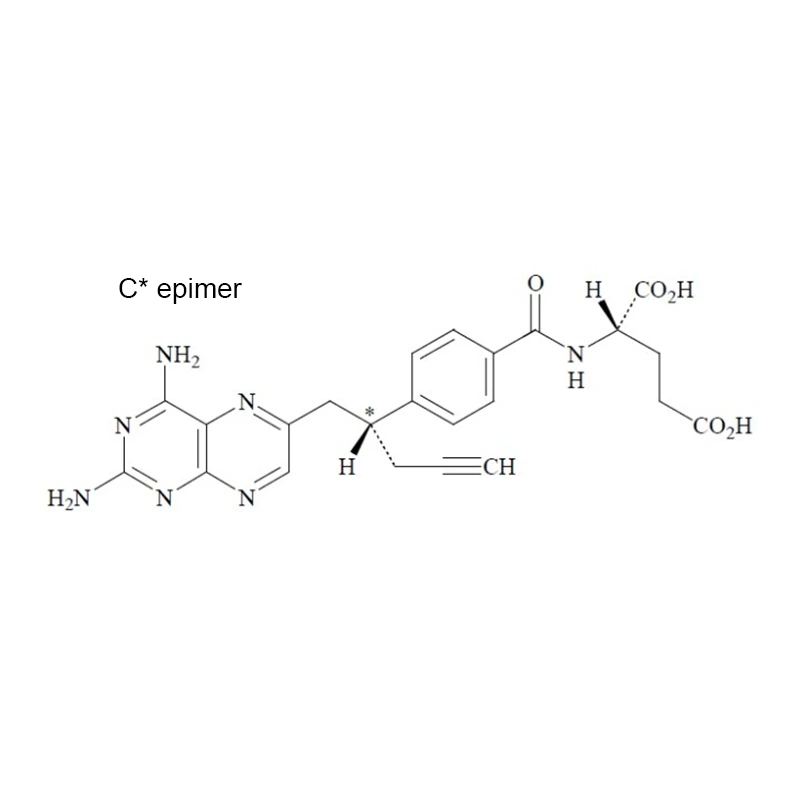
Pralatrexate (CAS 146464-95-1), marketed under the brand name Folotyn, is a novel antifolate antineoplastic agent. It was first approved by the U.S. Food and Drug Administration (FDA) on September 24, 2009, making it the first drug specifically approved for the treatment of relapsed or refractory peripheral T-cell lymphoma (PTCL).
PTCL is an aggressive subtype of non-Hodgkin lymphoma. According to the 2025 Chinese expert guiding principles, PTCL accounts for approximately 25%–30% of all non-Hodgkin lymphomas in China, significantly higher than the 10%–15% reported in Western countries, highlighting the urgent clinical need for effective treatments in the Chinese market.
Unlike traditional chemotherapeutics, Pralatrexate is structurally engineered to achieve superior tumor cell selectivity. It targets the reduced folate carrier (RFC-1), which is overexpressed in malignant cells, thereby achieving higher intracellular accumulation and more sustained anti-tumor activity compared to methotrexate.
At Cosperpharm, we produce Pralatrexate API under strict GMP conditions, achieving ≥98% purity by HPLC. We hold a valid pharmaceutical export license, ensuring smooth customs clearance and providing full documentation support for your regulatory filings.
|
Parameter |
Specification |
|
CAS Number |
146464-95-1 |
|
Molecular Formula |
C₂₃H₂₃N₇O₅ |
|
Molecular Weight |
477.47 g/mol |
|
Purity (HPLC) |
≥98% |
|
Any single impurity |
≤0.50% |
|
Total impurities |
≤1.50% |
|
Particle Size (D90) |
≤20 µm (customizable) |
|
Appearance |
White to off-white crystalline powder |
|
Storage |
2-8°C, protected from light, air-tight |
|
Packaging |
10g, 50g, 100g, 500g, 1kg (customizable) |
The above specifications are a comprehensive reference version based on general standards of EMA (Europe) and FDA (USA).
·Targeted Cellular Uptake: Pralatrexate exhibits high affinity for the reduced folate carrier type 1 (RFC-1), which is significantly overexpressed on the surface of various cancer cells. This allows the drug to be efficiently internalized by malignant cells while minimizing uptake by normal cells.
·DHFR Inhibition: Once inside the cell, Pralatrexate potently inhibits dihydrofolate reductase (DHFR), a key enzyme in folate metabolism, with a Ki value of 13.4 pM. This inhibits the synthesis of tetrahydrofolate, blocking the production of nucleotide precursors essential for DNA synthesis.
·Intracellular Retention: Pralatrexate serves as a substrate for folylpolyglutamate synthetase (FPGS). Upon polyglutamylation, it becomes trapped inside the cell, achieving higher intracellular concentrations compared to other antifolates such as methotrexate, leading to sustained drug action and prolonged anti-tumor activity.
|
Feature |
Pralatrexate (2nd Generation) |
Methotrexate (1st Generation) |
|
RFC-1 Affinity |
Higher — selective for cancer cells |
Lower — more uptake by normal cells |
|
Intracellular Retention |
Enhanced via polyglutamylation |
Less retained |
|
Antitumor Activity |
More potent (Ki 13.4 pM vs μM range) |
Less potent |
|
Approved Indication |
R/R PTCL |
Broad (autoimmune, various cancers) |
|
Advantage |
Details |
|
Production Strength |
GMP-certified campus spanning 100+ mu, 3 multi-purpose workshops, 6 D-grade clean zone production lines, and 150+ reactors (20L–5000L), supporting high/low temp, anaerobic, and hydrogenation; kg to ton scale production |
|
Fast Delivery |
R&D samples: one week; commercial orders: 1-2 months after payment. Express (DHL/FedEx) or air/sea freight available |
|
Global Partners |
Trusted by 30+ pharmaceutical companies in USA, Europe, India, Brazil, and Southeast Asia; long-term cooperation with generic drug manufacturers and CROs |
|
Licensed Exporter |
Valid drug import/export license — no compliance delays. |
`Relapsed or refractory peripheral T-cell lymphoma (PTCL)
`It was the first drug specifically approved by the FDA for R/R PTCL, receiving accelerated approval based on overall response rate (September 2009), with continued approval contingent on confirmatory trials
`Subsequently approved in Japan (2017) and China (2020)
PTCL is a group of heterogeneous, aggressive T-cell malignancies with historically poor outcomes. In China, PTCL accounts for a higher proportion of non-Hodgkin lymphoma cases (25%–30%) compared to Western countries (10%–15%), underscoring the significant unmet medical need for effective PTCL treatments.
|
Study |
Population |
Objective Response Rate (ORR) |
Median PFS |
Median OS |
|
PROPEL (Pivotal FDA trial, n=111) |
R/R PTCL |
29% |
3.5 months |
14.5 months |
|
China Registration Study (n=78) |
Chinese R/R PTCL |
52% |
4.8 months |
-- |
|
Pooled Analysis (4 trials, n=221) |
R/R PTCL |
40.7% |
4.6 months |
16.3 months |
China Registration Study (Published in Targeted Oncology, 2019): The single-arm, multicenter study enrolled 78 Chinese patients with R/R PTCL. The overall response rate reached 52%, with a median progression-free survival of 4.8 months.
Pooled Analysis of 4 Trials (Published in Blood Advances, March 2024): Of 221 patients (median age 59 years, 67.0% male), 48.9% had PTCL-not otherwise specified (PTCL-NOS), 21.3% angioimmunoblastic T-cell lymphoma, and 11.8% ALK-negative anaplastic large cell lymphoma. Patients received pralatrexate for a median of 2.56 months and achieved a 40.7% ORR with a median duration of response of 9.1 months, PFS of 4.6 months, and OS of 16.3 months.
The most common treatment-related adverse events were stomatitis, thrombocytopenia, white blood cell count decrease, pyrexia, and vomiting.
Pralatrexate is recommended in the 2025 Chinese Expert Guiding Principles for Pralatrexate in the Treatment of Peripheral T-Cell Lymphoma, issued by the Lymphoma Expert Committee of the Chinese Society of Clinical Oncology (CSCO). These guidelines provide clinical recommendations for the appropriate use of pralatrexate in R/R PTCL patients, including dosing (30 mg/m² intravenous push over 3–5 minutes), folic acid and vitamin B12 supplementation protocols, and management of adverse events.
`Approved API manufacturers are limited, including Baxter, Fresenius Kabi, Dr. Reddy’s, and Hetero Labs. The limited supply chain makes securing reliable API sources a critical priority for generic drug developers.
`The drug is included in China’s National Reimbursement Drug List, and a local API manufacturer (Jiangsu Hansoh Pharmaceutical Group) holds a CDE registration for Pralatrexate API.
`The 2025 FDA approval of a tablet formulation for zanubrutinib highlights the industry trend toward more patient-friendly dosage forms, which may influence future development of Pralatrexate generics.
`First FDA-approved drug for R/R PTCL — market leadership status
`Higher RFC-1 affinity than methotrexate — selective tumor targeting
`Enhanced intracellular retention via polyglutamylation — prolonged action
`Valid export license — Cosperpharm is an authorized Pralatrexate exporter
`Overcomes methotrexate resistance in certain settings
`Superior response rates in Chinese patient population (52% ORR)
`Backed by robust clinical data (pooled analysis of 221 patients, 40.7% ORR)
Cosperpharm manufactures Pralatrexate API in modern GMP multi-purpose workshops equipped with 6 D-grade clean zone production lines. Our 150+ reactors (20L–5000L) support high/low temperature, anaerobic, and hydrogenation conditions, enabling production from kilogram to metric ton scale. Each batch undergoes rigorous QC testing: HPLC, GC, LC-MS, residual solvents (ICH Q3C), heavy metals, and genotoxic impurity analysis.
Q1: What is your MOQ for Pralatrexate API?
A: R&D samples: 10g. Commercial orders: 100g–1kg. Larger quantities available upon request.
Q2: What is your typical lead time?
A: In-stock R&D samples: one week. Bulk orders: 1-2 months after payment confirmation.
Q3: Which countries have you exported to?
A: USA, Canada, Germany, UK, Spain, India, Brazil, South Korea, Japan, and more. We have experience with local customs and regulatory requirements.
Q4: Can you provide third-party testing or audit?
A: Yes. We welcome customer audits or SGS/BV inspections. Third-party testing can be arranged at buyer‘s cost.
Q5: What certificates do you hold?
A: GMP certificate (ISO 9001:2015), pharmaceutical import/export license, and COA for each batch.
Q6: Do you offer customized packaging?
A: Yes. We can customize packaging size, labeling, and even inner lining materials per your request.
Q7: Is Pralatrexate API stable for long-term storage?
A: Yes. When stored at 2-8°C in an air-tight container protected from light, Pralatrexate API remains stable for 24 months. We provide accelerated and long-term stability data upon request.
Q8: Why choose Pralatrexate over methotrexate?
A: Pralatrexate has higher affinity for RFC-1 (the reduced folate carrier overexpressed in cancer cells), leading to superior intracellular accumulation and retention. It also demonstrates more potent DHFR inhibition (Ki 13.4 pM vs methotrexate‘s higher Ki) and is specifically approved for R/R PTCL, whereas methotrexate is not indicated for this condition.
Ready to buy Pralatrexate API? Contact Cosperpharm today for a sample or quote. We look forward to becoming your long-term China Pralatrexate supplier.
Address
No. 2 Yangguang 3rd Road, Duodao Chemical Cycle Industrial Park, Jingmen City, Hubei Province, China
Tel