
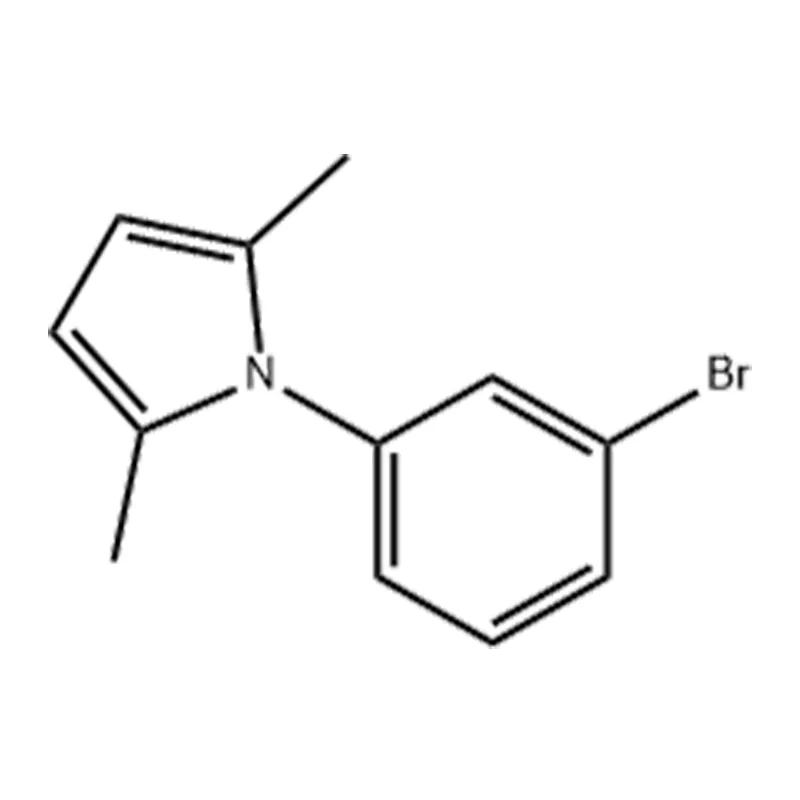
1-(3-Bromophenyl)-2,5-dimethylpyrrole (CAS 127257-87-8) is an organic compound belonging to the pyrrole family — a five-membered heteroaromatic ring containing one nitrogen atom. The molecular formula is C₁₂H₁₂BrN with a molecular weight of 250.13–250.14 g/mol, and the compound is typically supplied at a purity of ≥95% as a light brown solid. The IUPAC name is 1-(3-bromophenyl)-2,5-dimethylpyrrole, and the MDL number is MFCD04308119.
1-(3-Bromophenyl)-2,5-dimethylpyrrole is a versatile building block in medicinal chemistry. The pyrrole scaffold is widely recognized in drug discovery — it exists in many natural products, drug molecules and pesticides, and the biological relevance of pyrrole derivatives spans antiviral, antibacterial, antifungal, anticancer and anti-inflammatory activities. The presence of a bromine atom on the meta-position of the phenyl ring and two methyl groups on the pyrrole ring makes 1-(3-Bromophenyl)-2,5-dimethylpyrrole uniquely suited for fragment-based drug discovery, where the methyl groups provide steric shielding while the meta‑bromine serves as an orthogonal handle for Suzuki, Buchwald-Hartwig, and other cross‑coupling reactions.
In materials science, 1-(3-Bromophenyl)-2,5-dimethylpyrrole has been investigated for its electronic properties. The electron-rich nature of the pyrrole ring may enable charge transport, and the rigid, conjugated framework makes it a candidate monomer for constructing extended π‑systems relevant to organic light‑emitting diodes (OLEDs) and organic photovoltaics (OPVs).
|
Parameter |
Specification |
|
CAS Number |
127257-87-8 |
|
Molecular Formula |
C₁₂H₁₂BrN |
|
Molecular Weight |
250.13–250.14 g/mol |
|
Purity |
≥95% as standard; 98% available upon request |
|
Appearance |
Light brown solid |
|
Canonical SMILES |
CC1=CC=C(N1C2=CC(=CC=C2)Br)C |
|
Storage Condition |
Long-term storage: cool, dry place |
|
DOT/IATA Transport |
Not hazardous material |
|
GHS Signal Word |
Warning |
|
Solubility |
Soluble in organic solvents (EtOAc, DCM, THF, DMF) |
|
Advantage |
Detail |
|
Production Strength |
GMP-certified campus spanning 100+ mu, 3 multi-purpose workshops, 6 D-grade clean zone production lines, and 150+ reactors (20L–5000L), supporting high/low temp, anaerobic & hydrogenation; kg to ton scale production. |
|
Fast Delivery |
R&D samples: one week; commercial orders: 1–2 months after payment. Express (DHL/FedEx) or air/sea freight available. |
|
Global Partners |
Trusted by 30+ pharmaceutical companies in USA, Europe, India, Brazil, and Southeast Asia; long-term cooperation with generic drug manufacturers, CROs, and impurity standard distributors. |
|
Licensed Exporter |
Valid drug import/export license — no compliance delays. |
|
Dual Quality Grades |
Both research/pharma grade(≥98%)and high-purity impurity grade(≥99%)available to meet diverse customer needs. |
Each batch undergoes:
● Gas chromatography (GC) – purity ≥97.0%
● Non‑aqueous titration – purity ≥97.0%
● Refractive index – confirmatory analysis
● ¹H NMR – structural verification
● Appearance – colorless to light yellow to light orange clear liquid
A comprehensive COA, MSDS (with full GHS information), and certificate of origin accompany every shipment.
Q1:Why is the meta‑bromine substituent significant for this compound?
A: The meta‑bromine substituent serves as a versatile synthetic handle for transition‑metal‑catalyzed cross‑coupling reactions (Suzuki, Heck, Sonogashira, Buchwald‑Hartwig). This allows medicinal chemists to rapidly introduce diverse aryl, alkynyl, or amino groups at the meta‑position of the phenyl ring, enabling efficient structure–activity relationship (SAR) studies.
Q2: Is the compound soluble in common organic solvents?
A: Yes. The compound is likely soluble in organic solvents such as ethyl acetate, dichloromethane, THF, and DMF due to its aromatic nature.
We look forward to supporting your research and production needs.If you have any questions regarding 1-(3-Bromophenyl)-2,5-dimethylpyrrole (CAS 127257-87-8) or wish to request a quotation, please do not hesitate to reach out. Our sales and technical support teams are ready to assist you.
Address
No. 2 Yangguang 3rd Road, Duodao Chemical Cycle Industrial Park, Jingmen City, Hubei Province, China
Tel

![1-[2,3-Bis[(9Z,12Z)-octadeca-9,12-dien-1-yloxy]propyl]pyrrolidine](https://www.cosperpharma.com/upload/8820/1-2-3-bis-9z-12z-octadeca-9-12-dien-1-yloxy-propyl-pyrrolidine-349384.webp "1-[2,3-Bis[(9Z,12Z)-octadeca-9,12-dien-1-yloxy]propyl]pyrrolidine")
![1,2,4-Triazolo[4,3-a]pyridin-3(2H)-one](https://www.cosperpharma.com/upload/8820/1-2-4-triazolo-4-3-a-pyridin-3-2h-one-440735.webp "1,2,4-Triazolo[4,3-a]pyridin-3(2H)-one")