
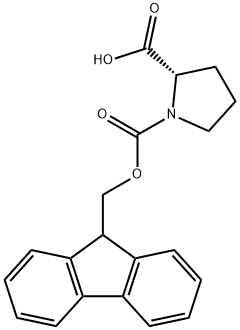
Fmoc-Pro-OH is the preferred reagent for introducing the proline amino acid residue into growing peptide chains within Fmoc-based solid-phase peptide synthesis (SPPS) workflows. As a high‑purity Fmoc‑protected amino acid, Fmoc-Pro-OH is used to construct peptides for research, drug development, and commercial production, with documented application in the synthesis of insect neuropeptide analogs of the AKH family. Due to the secondary amine structure of the proline ring, Fmoc-Pro-OH can exhibit slightly different coupling behavior compared to primary amino acid derivatives, yet under optimized conditions it serves as a standard building block for stepwise peptide chain elongation. In pharmaceutical research contexts, Fmoc-Pro-OH is an essential raw material for generating peptide-based therapeutics, collagen-derived biomaterials, and conformationally constrained peptide libraries for drug discovery screening.
Product Parameters
|
Parameter |
Specification |
|
Product Name |
Fmoc-Pro-OH |
|
CAS Number |
71989-31-6 |
|
Molecular Formula |
C₂₀H₁₉NO₄ |
|
Molecular Weight |
337.37 – 337.38 g/mol |
|
Appearance |
White to off-white solid |
|
Melting Point |
117–118 °C (lit.) |
|
Boiling Point |
473.68 °C (free base, rough estimate) |
|
Density |
1.2486 (rough estimate) |
|
pKa |
3.95 ± 0.20 (predicted) |
|
Storage Condition |
2–8 °C; also stable at room temperature (store below +30 °C) |
Physiological Action
Research on the application of Fmoc-L-proline in meat quality assessment of beef and lamb: Muscle consists of muscle fibers, muscle fat, and connective tissue. Fmoc-L-proline is a key component of collagen in connective tissue; its concentration determines the amount of muscle collagen and is closely related to tenderness. Due to differences in age and the proportion of connective tissue across various muscle regions, there are significant variations in tenderness between beef and lamb.
Synthetic Route
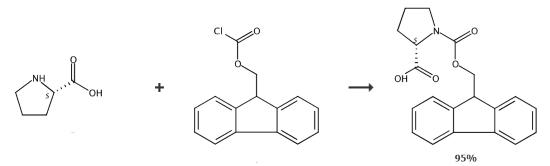
To a solution of (S)-pyrrolidine-2-carboxylic acid (1 g, 8.7 mmol) in 1,4-dioxane (4 mL) and water (15 mL), add K₂CO₃ (3.24 g, 23 mmol). Then, at 0 °C, add chloroformic acid-9-fluoromethyl ester (2.3 g, 8.3 mmol). Stir the mixture overnight at room temperature, then treat it with water (10 mL). The resulting mixture was extracted twice with ethyl ether (2 × 20 mL). The aqueous phase was acidified with 1 M HCl to pH 2–3 and extracted three times with dichloromethane (3 × 50 mL). The combined organic layers were dried with anhydrous Na₂SO₄ and concentrated to yield the desired white solid product with a yield of 2.8 g (95%).
Quality Assurance at Cosperpharm
Each batch undergoes:
Gas chromatography (GC) – purity ≥97.0%
Non‑aqueous titration – purity ≥97.0%
Refractive index – confirmatory analysis
¹H NMR – structural verification
Appearance – colorless to light yellow to light orange clear liquid
A comprehensive COA, MSDS (with full GHS information), and certificate of origin accompany every shipment.
Contact Us
Need Fmoc-Pro-OH for your peptide synthesis project? Whether you‘re scaling up to kilogram quantities or just getting started with a new peptide library, Cosperpharm provides the purity, documentation, and supply reliability you need. Contact our customer service team to discuss your requirements.
Address
No. 2 Yangguang 3rd Road, Duodao Chemical Cycle Industrial Park, Jingmen City, Hubei Province, China
Tel

![1-[2,3-Bis[(9Z,12Z)-octadeca-9,12-dien-1-yloxy]propyl]pyrrolidine](https://www.cosperpharma.com/upload/8820/1-2-3-bis-9z-12z-octadeca-9-12-dien-1-yloxy-propyl-pyrrolidine-349384.webp "1-[2,3-Bis[(9Z,12Z)-octadeca-9,12-dien-1-yloxy]propyl]pyrrolidine")
![1,2,4-Triazolo[4,3-a]pyridin-3(2H)-one](https://www.cosperpharma.com/upload/8820/1-2-4-triazolo-4-3-a-pyridin-3-2h-one-440735.webp "1,2,4-Triazolo[4,3-a]pyridin-3(2H)-one")