
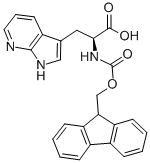
Fmoc-AzaTrp-OH is an intricate tryptophan derivative featuring a distinctive azanine ring structure that facilitates the study of protein conformations and folding mechanisms. As a specialized non‑natural amino acid building block, Fmoc-AzaTrp-OH is integral to peptide synthesis applications where the native indole functionality of tryptophan requires modification for probe development or property optimization. The Fmoc protective group allows Fmoc-AzaTrp-OH to be directly incorporated into peptide chains using standard Fmoc SPPS protocols, offering versatility in synthetic workflows. In biochemical research, Fmoc-AzaTrp-OH demonstrates broad application prospects, primarily used to construct novel peptides or peptidomimetics with enhanced properties compared to their tryptophan‑containing counterparts.
Product Parameters
|
Parameter |
Specification |
|
Product Name |
Fmoc-AzaTrp-OH |
|
CAS Number |
737007-45-3 |
|
Molecular Formula |
C₂₅H₂₁N₃O₄ |
|
Molecular Weight |
427.45 g/mol |
|
Appearance |
White Solid |
|
Density |
1.382 g/cm³ |
|
Melting Point |
229-234℃ |
|
pKa |
3.50±0.10 |
|
Storage Condition |
2-8℃ |
Synthetic Route
Preparation via Multi‑Step Synthesis from Tryptophan Derivatives
The synthesis of Fmoc-AzaTrp-OH involves a multi‑step sequence that includes alkylation, disassembly, and Fmoc protection. A representative procedure has been described achieving over 49% yield with excellent diastereoselectivity using nickel(II) complexes as powerful tools for the synthesis of structurally diverse tailor‑made amino acids.
Synthesis overview: The key steps involve (1) construction of the 7‑aza‑indole core or introduction of the aza‑indole side chain, (2) alkylation to attach the side chain to the amino acid backbone, (3) disassembly or deprotection steps, and (4) final Fmoc protection of the α‑amino group.
FAQ
A: AzaTrp is an abbreviation for azatryptophan. Fmoc-AzaTrp-OH refers to Fmoc‑protected L‑7‑azatryptophan, where a nitrogen atom replaces a carbon in the indole ring system of tryptophan (at the 7‑position of the indole).
Q2: What is the difference between Fmoc-AzaTrp-OH and Fmoc-Trp-OH?
A: Fmoc-AzaTrp-OH contains a 7‑azaindole ring (a pyridine fused to a pyrrole) instead of the standard indole ring of tryptophan. This modification introduces an additional nitrogen atom, altering the electronic properties, hydrogen‑bonding capability, and fluorescence characteristics of the side chain compared to Fmoc‑Trp‑OH.
Application Scenarios
1. Peptide Synthesis with Non‑Natural Amino Acids
Fmoc-AzaTrp-OH is directly incorporated into peptide chains using standard Fmoc SPPS protocols, enabling the introduction of the 7‑azatryptophan residue at any position within the peptide sequence.
2. Protein Conformation and Folding Studies
The distinctive azanine ring structure of Fmoc-AzaTrp-OH facilitates the study of protein conformations and folding mechanisms, as the aza‑indole can engage in unique hydrogen bonding not possible with standard tryptophan.
3. Peptidomimetic Development
Fmoc-AzaTrp-OH is primarily used to construct novel peptides or peptidomimetics with enhanced properties, including improved metabolic stability and altered receptor selectivity, compared to tryptophan‑containing analogs.
4.Structure‑Activity Relationship (SAR) Studies
As a non‑natural amino acid, Fmoc-AzaTrp-OH expands the SAR toolbox beyond the proteinogenic amino acids, allowing systematic exploration of side chain electronic effects on peptide bioactivity.
5.Fluorescent Probe Development
The aza‑indole ring system has unique fluorescence properties that can be exploited for developing peptide‑based fluorescent sensors. Fmoc-AzaTrp-OH is incorporated into peptides to create probes for real‑time monitoring of protein‑protein interactions or enzymatic activities.
6. Drug Discovery for Peptide Therapeutics
Peptide therapeutics containing aza‑tryptophan residues have been investigated for enhanced stability and target specificity. Fmoc-AzaTrp-OH enables the synthesis of these next‑generation peptide drug candidates.
7. Combinatorial Chemistry and Peptide Libraries
Fmoc-AzaTrp-OH is utilized in combinatorial chemistry and drug development studies, enabling the generation of diverse peptide libraries with non‑natural side chains for high‑throughput screening.
8. Biosynthesis and Enzymatic Processing Studies
The compound plays a role in providing insights into biosynthesis and enzymatic processing, serving as a substrate analog for studying tryptophan‑utilizing enzymes.
9. Research into Protein‑Protein Interactions
The altered hydrogen‑bonding profile of the aza‑indole makes Fmoc-AzaTrp-OH valuable for probing protein‑protein interaction interfaces where tryptophan residues play critical roles.
10. cGMP Peptide Manufacturing for Specialized APIs
For pharmaceutical customers developing peptide APIs containing non‑natural amino acids, Cosperpharm supplies Fmoc-AzaTrp-OH with enhanced documentation packages, stability data, and custom quality agreements to support regulatory filings.
Contact Us
Searching for a reliable source of Fmoc-AzaTrp-OH for your specialized peptide synthesis project? Cosperpharm offers this unique Fmoc‑protected aza‑tryptophan building block with the purity, documentation, and supply flexibility that researchers demand.
Get in touch with our team to request a quote, discuss custom packaging options, or ask about our technical support services. We are ready to assist with your peptide engineering needs.
Address
No. 2 Yangguang 3rd Road, Duodao Chemical Cycle Industrial Park, Jingmen City, Hubei Province, China
Tel

![1-[2,3-Bis[(9Z,12Z)-octadeca-9,12-dien-1-yloxy]propyl]pyrrolidine](https://www.cosperpharma.com/upload/8820/1-2-3-bis-9z-12z-octadeca-9-12-dien-1-yloxy-propyl-pyrrolidine-349384.webp "1-[2,3-Bis[(9Z,12Z)-octadeca-9,12-dien-1-yloxy]propyl]pyrrolidine")
![1,2,4-Triazolo[4,3-a]pyridin-3(2H)-one](https://www.cosperpharma.com/upload/8820/1-2-4-triazolo-4-3-a-pyridin-3-2h-one-440735.webp "1,2,4-Triazolo[4,3-a]pyridin-3(2H)-one")