
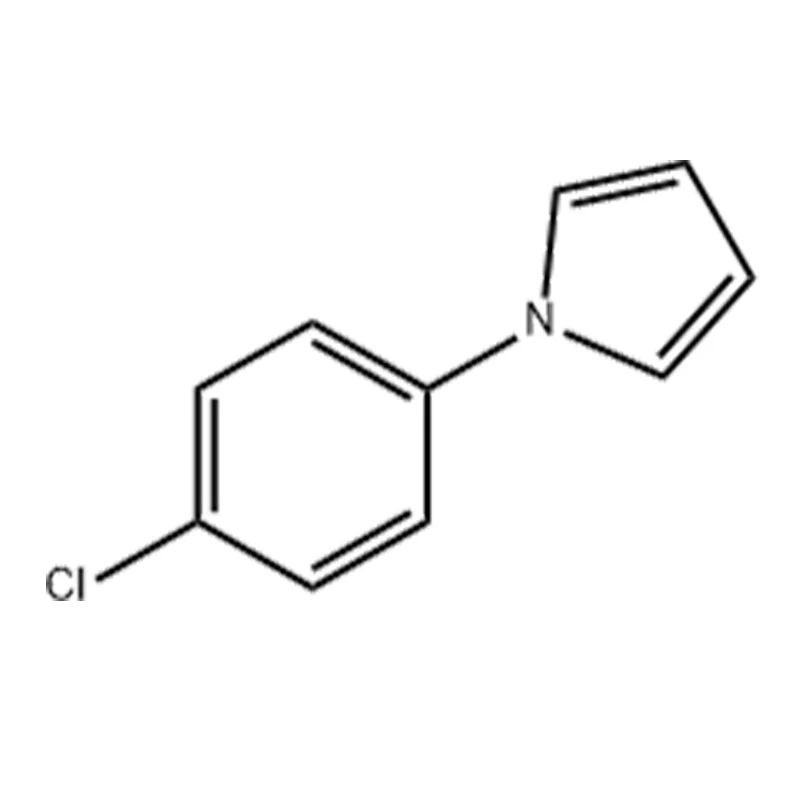
1-(4-Chlorophenyl)-1H-pyrrole (CAS 5044-38-2) is a heterocyclic aromatic compound belonging to the pyrrole family — a five-membered ring structure containing one nitrogen atom — with a 4-chlorophenyl substituent directly attached to the pyrrole nitrogen. The molecular formula is C₁₀H₈ClN, with a molecular weight of 177.63 g/mol, and the compound is supplied at purities ranging from 95% to 98%.
In medicinal chemistry, 1-(4-chlorophenyl)-1H-pyrrole is a highly versatile building block. As a fragment molecule, 1-(4-chlorophenyl)-1H-pyrrole provides a structural foundation for molecular linking, expansion, and modification in drug discovery programs, serving as a key intermediate for the synthesis of biologically active molecules, including antimicrobial, anticancer, and anti-inflammatory agents. Studies have demonstrated that 1-(4-chlorophenyl)-1H-pyrrole exhibits significant antiproliferative effects against various cancer cell lines, including liver cancer (HepG-2, IC₅₀ = 5.0 μM) and breast cancer (MCF-7, IC₅₀ = 3.0 μM). Its derivatives have also shown antimicrobial activity and have been explored for their anti-inflammatory properties.
In materials science, 1-(4-chlorophenyl)-1H-pyrrole has been investigated for use in organic electronics, including organic light-emitting diodes (OLEDs) and solar cells, leveraging its conjugated π-system for charge transport properties. The 4-chlorophenyl moiety can be further functionalized, allowing the introduction of additional substituents or modifications to tailor the compound’s properties for specific applications.
1-(4-Chlorophenyl)-1H-pyrrole is also a valuable research chemical in chemical synthesis, and it is listed in the National Cancer Institute (NCI) database under NSC 116796.
|
Parameter |
Specification |
|
CAS Number |
5044-38-2 |
|
Molecular Formula |
C₁₀H₈ClN |
|
Molecular Weight |
177.63 g/mol |
|
Purity |
97–98% as standard; higher purity (99%) available upon request |
|
Appearance |
Yellowish crystalline powder |
|
Melting Point |
88–91°C (lit.) |
|
Boiling Point |
264.6 ± 23.0°C at 760 mmHg (Predicted); 200–203°C at 95.2627 mmHg |
|
Density |
1.13 g/cm³ at 20°C |
|
Flash Point |
113.8°C |
|
Refractive Index |
1.579 (Predicted) |
|
XLogP3 |
3.13 |
|
pKa |
-5.87 ± 0.70 (Predicted) |
|
Canonical SMILES |
C1=CN(C=C1)C2=CC=C(C=C2)Cl |
|
Solubility |
Poorly soluble in water; soluble in organic solvents such as dichloromethane, ethyl acetate, ethanol, and DMF |
|
Storage Condition |
Sealed in dry, room temperature; long-term storage in a cool, dry place |
|
Shelf Life |
Up to 3 years when stored as a powder at –20°C |
|
Storage Class |
11 – combustible solids |
|
WGK Germany |
3 |
|
Hazard Statements |
H315 (Skin Irrit. 2), H319 (Eye Irrit. 2), H335 (STOT SE 3) – Respiratory system |
|
Signal Word |
Warning |
A: The calculated LogP of 3.13 indicates moderate to high lipophilicity, suggesting good membrane permeability and potential oral bioavailability for drug-like applications. Compared to unsubstituted 1-phenylpyrrole (LogP = 2.53), the chlorine substitution increases the compound’s lipophilicity, which may enhance its ability to cross cell membranes and reach biological targets.
A: Yes. Studies have shown that this compound exhibits significant antiproliferative effects against various cancer cell lines, including liver cancer (HepG-2, IC₅₀ = 5.0 μM) and breast cancer (MCF-7, IC₅₀ = 3.0 μM). These findings suggest its potential as a lead scaffold for anticancer drug development.
● Avoid breathing dust/fume/gas/mist/vapours/spray
● Use only outdoors or in a well-ventilated area
● Wear protective gloves/protective clothing/eye protection/face protection
● Wash thoroughly after handling
● IF ON SKIN: Wash with plenty of water
● IF INHALED: Remove person to fresh air and keep comfortable for breathing
● IF IN EYES: Rinse cautiously with water for several minutes. Remove contact lenses if present and easy to do. Continue rinsing
● Call a POISON CENTER/doctor if you feel unwell
● Take off contaminated clothing and wash it before reuse
● Store in a well-ventilated place. Keep container tightly closed
● Store locked up
● Dispose of contents/container in accordance with local regulations
● If inhaled: Move person into fresh air. If not breathing, give artificial respiration. Consult a physician.
● In case of skin contact: Wash off with soap and plenty of water. Consult a physician if skin irritation persists.
● In case of eye contact: Rinse thoroughly with plenty of water for at least 15 minutes and consult a physician. Continue rinsing during transport to hospital.
● If swallowed: Rinse mouth with water. Never give anything by mouth to an unconscious person. Consult a physician.
Ready to advance your research? Let’s connect.At Cosperpharm, we pride ourselves on delivering high-quality chemical products with fast, responsive, and solution‑oriented service. Our technical and commercial teams are ready to assist you.
Address
No. 2 Yangguang 3rd Road, Duodao Chemical Cycle Industrial Park, Jingmen City, Hubei Province, China
Tel

![1-[2,3-Bis[(9Z,12Z)-octadeca-9,12-dien-1-yloxy]propyl]pyrrolidine](https://www.cosperpharma.com/upload/8820/1-2-3-bis-9z-12z-octadeca-9-12-dien-1-yloxy-propyl-pyrrolidine-349384.webp "1-[2,3-Bis[(9Z,12Z)-octadeca-9,12-dien-1-yloxy]propyl]pyrrolidine")
![1,2,4-Triazolo[4,3-a]pyridin-3(2H)-one](https://www.cosperpharma.com/upload/8820/1-2-4-triazolo-4-3-a-pyridin-3-2h-one-440735.webp "1,2,4-Triazolo[4,3-a]pyridin-3(2H)-one")