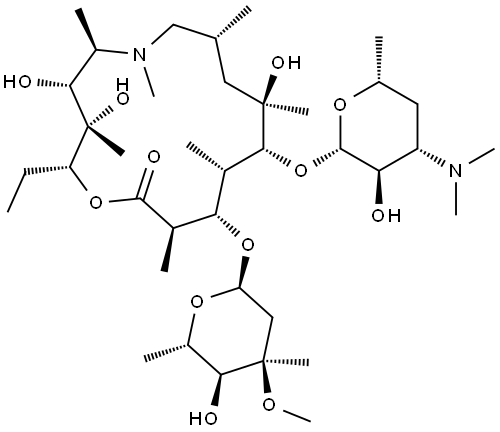
Azithromycin is a broad‑spectrum antibiotic that acts by binding to the 50S ribosomal subunit of susceptible bacteria, thereby inhibiting protein synthesis . As a member of the azalide class, Azithromycin demonstrates an extended antimicrobial spectrum and improved activity against certain Gram‑negative organisms compared to erythromycin, while also showing excellent activity against respiratory pathogens, skin and soft tissue infections, and genital chlamydia . Unlike erythromycin, Azithromycin is acid‑stable and can be administered orally without enteric coating, and it is rapidly absorbed, achieving high intracellular concentrations and extensive tissue distribution . The clinical success of Azithromycin in treating community‑acquired pneumonia, sexually transmitted diseases, acute otitis media, and acute exacerbations of COPD is a direct result of these unique structural and pharmacological features . For research and pharmaceutical development purposes, Azithromycin serves as a critical reference standard and active pharmaceutical ingredient, with rigorous quality specifications defined by pharmacopoeias such as the USP .
|
Parameter |
Specification |
|
Product Name |
Azithromycin |
|
CAS Number |
|
|
Molecular Formula |
|
|
Molecular Weight |
|
|
Physical Form |
|
|
Appearance |
|
|
Melting Point |
|
|
Boiling Point |
|
|
Density |
1.18 ± 0.1 g/cm3 |
|
Storage Condition |
2–8 °C, dry |
After oral administration, the drug is rapidly absorbed, with a bioavailability of 37%. Following a single oral dose of 0.5 g, the time to reach peak concentration (Tmax) is 2.5–2.6 hours, and the peak plasma concentration (Cmax) ranges from 0.4 to 0.45 mg/L. This drug is widely distributed in the body; its tissue concentrations can be 10–100 times higher than its corresponding plasma concentration. High concentrations are observed in macrophages and fibroblasts; the former facilitate the transport of azithromycin to inflammatory sites. According to Chemicalbook, the elimination half-life of this drug following a single dose is 35–48 hours. More than 50% of the administered dose is excreted unchanged via the biliary tract, while approximately 4.5% is excreted unchanged via the urinary route within 72 hours after administration. The serum protein binding rate of this drug decreases as the plasma concentration increases: at a plasma concentration of 0.02 μg/mL, the serum protein binding rate is 15%; at a plasma concentration of 2 μg/mL, the serum protein binding rate is 7%.
Macrolide antibiotics contain a 15-membered nitrogen-containing heterocycle; their antibacterial mechanism is similar to that of erythromycin, but they exhibit a broader antibacterial spectrum. These agents demonstrate stronger antibacterial activity against Gram-positive bacteria as well as against Gram-negative bacteria such as Haemophilus influenzae, Salmonella, Escherichia coli, and Shigella. They are acid-stable and well-tolerated. Macrolides show excellent therapeutic efficacy in treating respiratory tract infections, skin and soft tissue infections, and sexually transmitted infections caused by susceptible bacterial strains.
Starting from erythromycin A as the raw material, after oximation, the compound undergoes Beckmann rearrangement in the presence of hydrochloric acid; followed by dehydration, reduction, and methylation to yield azithromycin.
Sourcing Azithromycin for your research, analytical method development, or pharmaceutical formulation project should be straightforward. Cosperpharm delivers high‑quality antibiotics with the documentation, technical support, and supply reliability that researchers and pharmaceutical professionals depend on. Contact our team today — we‘re ready to support your next scientific breakthrough.
/upload/8820/file/20260817/azithromycin-coa-compressed-527115.pdf
Address
No. 2 Yangguang 3rd Road, Duodao Chemical Cycle Industrial Park, Jingmen City, Hubei Province, China
Tel