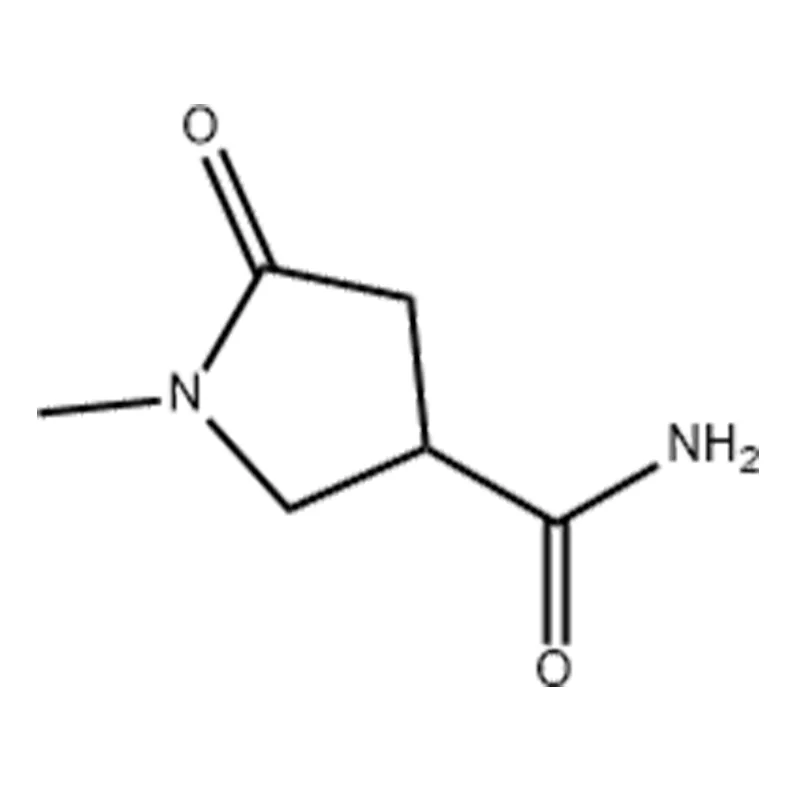
1-Methyl-2-Pyrrolidinone-4-Carboxamide (CAS 89677-16-7), also referred to as 1-Methyl-2-Pyrrolidinone-4-Carboxamide or 1-Methyl-2-Pyrrolidinone-4-Carboxamide, is a bioactive γ-lactam molecule first isolated from plant leaves and identified by GC-MS analysis, where quantitative analysis showed its presence at approximately 0.1% of the leaf extract, and it has demonstrated anti-inflammatory properties in biological assays.
In medicinal chemistry, 1-Methyl-2-Pyrrolidinone-4-Carboxamide serves as a versatile building block for the synthesis of complex organic molecules and facilitates the development of more elaborate compounds. Derivatives of 1-Methyl-2-Pyrrolidinone-4-Carboxamide have shown potential as inhibitors of enzymes involved in various metabolic pathways, and certain derivatives have effectively blocked HIV-1 cell entry by preventing receptor binding, highlighting its potential application in antiviral drug development. Recent research has also demonstrated that novel derivatives of 1-Methyl-2-Pyrrolidinone-4-Carboxamide possess structure-dependent anticancer activity against A549 lung cancer cells.
In pharmaceutical research, 1-Methyl-2-Pyrrolidinone-4-Carboxamide is recognized as a key intermediate in the synthesis of pyrrolidinone carboxamide derivatives that are useful for inhibiting the binding of ligands to the ChemR23 receptor, which is implicated in the treatment of various diseases including psoriasis, multiple sclerosis, and metabolic syndrome.
In organic synthesis, 1-Methyl-2-Pyrrolidinone-4-Carboxamide can undergo oxidation (using KMnO₄ or CrO₃ to form oxo derivatives), reduction (using NaBH₄ or LiAlH₄ to convert the keto group to a hydroxyl group), and substitution reactions (with alcohols for esterification or with amines for amidation), enabling access to a wide range of derivatives for research applications.
|
Parameter |
Specification |
|
CAS Number |
89677-16-7 |
|
MDL Number |
MFCD00043515 |
|
Molecular Formula |
C₆H₁₀N₂O₂ |
|
Molecular Weight |
142.16 g/mol |
|
Purity |
≥98% as standard; ≥95% grade also available |
|
Appearance |
Solid (white to off-white crystalline powder) |
|
Melting Point |
129.30 °C (Predicted) |
|
Boiling Point |
412.5 ± 34.0 °C at 760 mmHg (Predicted) |
|
Density |
1.2 ± 0.1 g/cm³ (Predicted) |
|
Flash Point |
203.2 ± 25.7 °C (Predicted) |
|
Canonical SMILES |
CN1CC(CC1=O)C(=O)N |
|
Solubility |
Soluble in DMSO, ethanol, and other organic solvents |
|
Storage Condition |
Sealed storage, 2–8°C, away from moisture |
|
Advantage |
Detail |
|
Production Strength |
GMP-certified campus spanning 100+ mu, 3 multi-purpose workshops, 6 D-grade clean zone production lines, and 150+ reactors (20L–5000L), supporting high/low temp, anaerobic & hydrogenation; kg to ton scale production. |
|
Fast Delivery |
R&D samples: one week; commercial orders: 1–2 months after payment. Express (DHL/FedEx) or air/sea freight available. |
|
Global Partners |
Trusted by 30+ pharmaceutical companies in USA, Europe, India, Brazil, and Southeast Asia; long-term cooperation with generic drug manufacturers, CROs, and impurity standard distributors. |
|
Licensed Exporter |
Valid drug import/export license — no compliance delays. |
|
Dual Quality Grades |
Both research/pharma grade(≥98%)and high-purity impurity grade(≥99%)available to meet diverse customer needs. |
A common synthetic route for 1-Methyl-2-Pyrrolidinone-4-Carboxamide proceeds via the reaction of 1-methylpyrrolidine-2,5-dione (1-methylsuccinimide) with ammonia or an amine under suitable conditions. The reaction typically requires a solvent such as ethanol or methanol and is carried out at elevated temperatures to facilitate the formation of the desired amide product.
1. 1-Methylpyrrolidine-2,5-dione (1-methylsuccinimide) is dissolved in ethanol.
2. Ammonia (or an amine) is added to the solution.
3. The reaction mixture is stirred under reflux conditions for several hours.
4. After completion, the solvent is removed under reduced pressure.
5. The crude product is purified by recrystallization or column chromatography to obtain pure 1-Methyl-2-Pyrrolidinone-4-Carboxamide.
Q1:What are the key chemical reactions this compound can undergo?
A: It can undergo: (1) oxidation using KMnO₄ or CrO₃ to form oxo derivatives; (2) reduction using NaBH₄ or LiAlH₄ to convert the keto group to a hydroxyl group; (3) esterification with alcohols; and (4) amidation with amines.
Q2:How should 1-Methyl-2-Pyrrolidinone-4-Carboxamide be stored?
A: Store sealed at 2–8°C (refrigerated) in a dry, airtight container, protected from moisture. For long-term storage, keep in a cool, dry place. When stored as a powder at –20°C, it remains stable for up to 3 years. Stock solutions stored at –80°C are stable for up to 6 months.
We look forward to supporting your research and development needs.If you have any questions regarding 1-Methyl-2-Pyrrolidinone-4-Carboxamide (CAS 89677-16-7) or wish to request a quotation, please do not hesitate to reach out. Our sales and technical support teams are ready to assist you.
Address
No. 2 Yangguang 3rd Road, Duodao Chemical Cycle Industrial Park, Jingmen City, Hubei Province, China
Tel

![1-[2,3-Bis[(9Z,12Z)-octadeca-9,12-dien-1-yloxy]propyl]pyrrolidine](https://www.cosperpharma.com/upload/8820/1-2-3-bis-9z-12z-octadeca-9-12-dien-1-yloxy-propyl-pyrrolidine-349384.webp "1-[2,3-Bis[(9Z,12Z)-octadeca-9,12-dien-1-yloxy]propyl]pyrrolidine")
![1,2,4-Triazolo[4,3-a]pyridin-3(2H)-one](https://www.cosperpharma.com/upload/8820/1-2-4-triazolo-4-3-a-pyridin-3-2h-one-440735.webp "1,2,4-Triazolo[4,3-a]pyridin-3(2H)-one")