
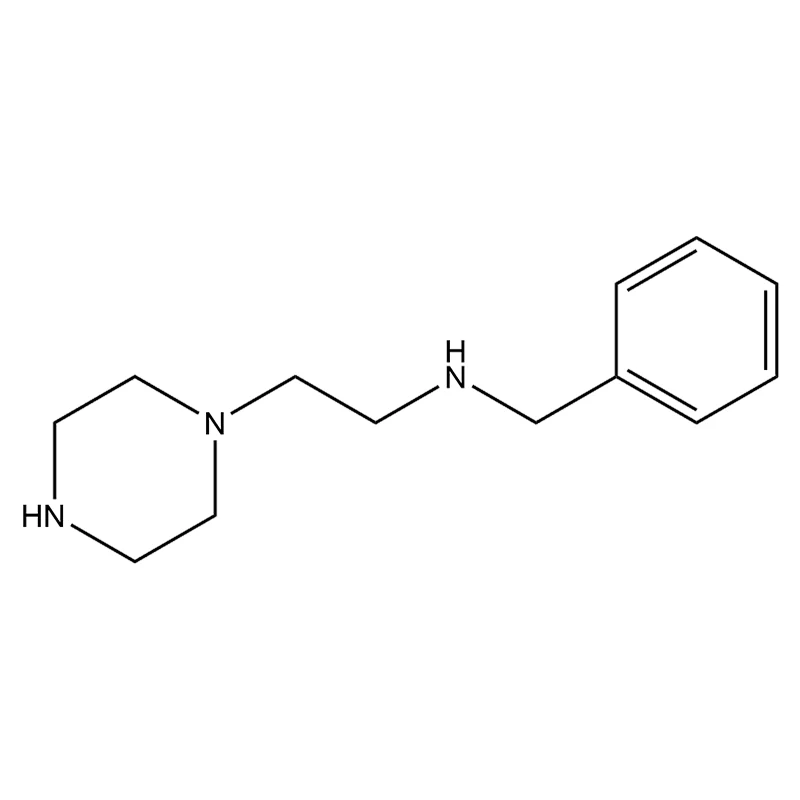
1-Piperazineethanamine, N-(phenylmethyl)- is a valuable research chemical and synthetic building block, primarily utilized in medicinal chemistry and organic synthesis. The dual secondary/tertiary amine functionality of 1-Piperazineethanamine, N-(phenylmethyl)- makes it a key intermediate for constructing more complex molecules, as the primary-like secondary amine on the ethyl linker can be selectively functionalized without disturbing the piperazine core. Chemically, 1-Piperazineethanamine, N-(phenylmethyl)- can serve as a precursor to various amides, ureas, and sulfonamides, or can be elaborated into constrained polycyclic systems. In research contexts, 1-Piperazineethanamine, N-(phenylmethyl)- functions as a scaffold for exploring chemical space around GPCR targets, particularly histamine and dopamine receptors, where the benzylpiperazine motif is a recognized pharmacophore. Supplied with rigorously controlled purity, 1-Piperazineethanamine, N-(phenylmethyl)- enables reproducible structure-activity relationship (SAR) studies and library synthesis for drug discovery programs.
|
Parameter |
Specification |
|
Product Name |
1-Piperazineethanamine, N-(phenylmethyl)- |
|
CAS Number |
135330-51-7 |
|
Molecular Formula |
C13H21N3 |
|
Molecular Weight |
219.33 g/mol |
|
Purity |
≥95% – >98% (typical, by HPLC/GC) |
|
Physical Form |
Typically a solid or viscous liquid at RT |
|
LogP |
1.34 |
|
Storage Condition |
-20°C, sealed, dry, under inert gas |
|
Shelf Life |
2 years (powder at -20°C) |
|
Advantage |
Detail |
|
Production Strength |
GMP-certified campus spanning 100+ mu, 3 multi-purpose workshops, 6 D-grade clean zone production lines, and 150+ reactors (20L–5000L), supporting high/low temp, anaerobic & hydrogenation; kg to ton scale production. |
|
Fast Delivery |
R&D samples: one week; commercial orders: 1–2 months after payment. Express (DHL/FedEx) or air/sea freight available. |
|
Dual Quality Grades |
Both research/pharma grade(≥98%)and high-purity impurity grade(≥99%)available to meet diverse customer needs. |
|
Global Partners |
Trusted by 30+ pharmaceutical companies in USA, Europe, India, Brazil, and Southeast Asia; long-term cooperation with generic drug manufacturers, CROs, and impurity standard distributors. |
|
Licensed Exporter |
Valid drug import/export license — no compliance delays. |
For long-term storage, 1-Piperazineethanamine, N-(phenylmethyl)- should be kept as a solid powder at -20°C in a tightly sealed container, protected from light and moisture, and placed under an inert atmosphere of nitrogen or argon. Under these conditions, the product is stable for up to 2 years. For short-term use in biological assays, stock solutions prepared in anhydrous DMSO can be stored for 2 weeks at 4°C, or long-term for 6 months at -80°C, preferably in single-use aliquots to prevent degradation from repeated freeze-thaw cycles. Always allow frozen containers to reach ambient temperature in a desiccator before opening to prevent water condensation. Handle the compound in a well-ventilated fume hood, as amines can be air-sensitive and are classified as aquatic toxins.
Serves as a privileged scaffold for synthesizing focused libraries targeting serotonin (5-HT) and dopamine (D2/D3) receptors, where the benzylpiperazine motif is critical for affinity.
The secondary amine on the ethyl chain provides an attachment point for recruiting ligands, while the piperazine nitrogen can link to an E3 ligase ligand, creating heterobifunctional degraders.
The dual nitrogen functionality allows two pharmacophores to be attached to the same core, enabling the exploration of bivalent binding modes for receptor dimers.
The primary-like secondary amine is easily acylated or sulfonylated to generate diverse compound arrays for high-throughput screening (HTS).
Used as a structural analog to study polyamine uptake mechanisms in cancer cells, leveraging its cationic nature at physiological pH.
Structural analogs of this compound have demonstrated histamine H3 receptor antagonism and acetylcholinesterase inhibition, making it a lead-like scaffold for CNS disorders.
Ready to incorporate 1-Piperazineethanamine, N-(phenylmethyl)- into your next chemical biology or medicinal chemistry project? Reach out to Cosperpharm to discuss your specific needs.
Address
No. 2 Yangguang 3rd Road, Duodao Chemical Cycle Industrial Park, Jingmen City, Hubei Province, China
Tel

![1-[2,3-Bis[(9Z,12Z)-octadeca-9,12-dien-1-yloxy]propyl]pyrrolidine](https://www.cosperpharma.com/upload/8820/1-2-3-bis-9z-12z-octadeca-9-12-dien-1-yloxy-propyl-pyrrolidine-349384.webp "1-[2,3-Bis[(9Z,12Z)-octadeca-9,12-dien-1-yloxy]propyl]pyrrolidine")
![1,2,4-Triazolo[4,3-a]pyridin-3(2H)-one](https://www.cosperpharma.com/upload/8820/1-2-4-triazolo-4-3-a-pyridin-3-2h-one-440735.webp "1,2,4-Triazolo[4,3-a]pyridin-3(2H)-one")