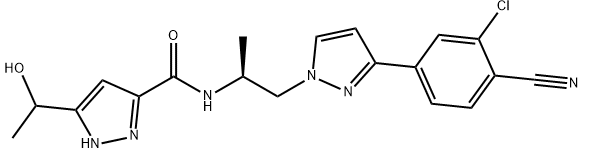
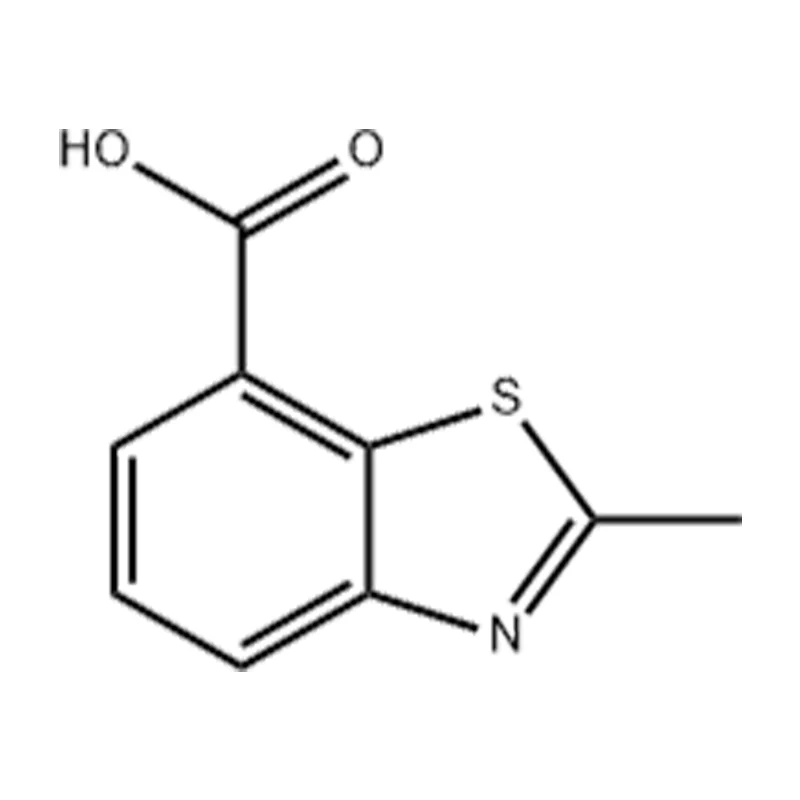
2-Methylbenzothiazole-7-Carboxylic Acid serves as a complementary building block for structure–activity relationship (SAR) studies. When a 6‑substituted benzothiazole lead compound fails to show optimal activity, 2-Methylbenzothiazole-7-Carboxylic Acid can be used to rapidly access the 7‑substituted analog, exploring alternative binding geometries. More specifically, 2-Methylbenzothiazole-7-Carboxylic Acid is a key intermediate in the synthesis of pyrazole‑based inhibitors of coactivator‑associated arginine methyltransferase 1 (CARM1), an epigenetic target implicated in breast, prostate, and colorectal cancers. Beyond oncology, 2-Methylbenzothiazole-7-Carboxylic Acid is also used in the preparation of fluorescent dyes, metal‑coordinating ligands for catalysis, and agrochemical intermediates.
Cosperpharm supplies this product as a high‑purity crystalline solid (≥95% by HPLC; ≥98% available on request), fully characterized by ¹H NMR, LC‑MS, and HPLC. It is stable when stored at 2–8 °C under dry, moisture‑protected conditions. Whether you need a few milligrams for a screening library or kilogram quantities for process development, Cosperpharm is your reliable source for this regioisomer and its 6‑carboxy counterpart.
|
Parameter |
Specification |
|
CAS Number |
1261635-97-5 |
|
IUPAC Name |
2-methyl-1,3-benzothiazole-7-carboxylic acid |
|
Synonyms |
2-Methylbenzo[d]thiazole-7-carboxylic acid; 2-Methyl-1,3-benzothiazole-7-carboxylic acid; MBTCA |
|
Molecular Formula |
C₉H₇NO₂S |
|
Molecular Weight |
193.22 g/mol |
|
Purity (HPLC) |
≥95% (research grade); ≥98% available upon request |
|
Boiling Point (Predicted) |
385.2 ± 15.0 °C |
|
Density (Predicted) |
1.430 ± 0.06 g/cm³ |
|
pKa (Predicted) |
2.34 ± 0.10 (carboxylic acid) |
|
Appearance |
White to off-white to pale yellow crystalline powder |
|
Advantage |
Detail |
|
Production Strength |
GMP-certified campus spanning 100+ mu, 3 multi-purpose workshops, 6 D-grade clean zone production lines, and 150+ reactors (20L–5000L), supporting high/low temp, anaerobic & hydrogenation; kg to ton scale production. |
|
Fast Delivery |
R&D samples: one week; commercial orders: 1–2 months after payment. Express (DHL/FedEx) or air/sea freight available. |
|
Global Partners |
Trusted by 30+ pharmaceutical companies in USA, Europe, India, Brazil, and Southeast Asia; long-term cooperation with generic drug manufacturers, CROs, and impurity standard distributors. |
|
Licensed Exporter |
Valid drug import/export license — no compliance delays. |
|
Dual Quality Grades |
Both research/pharma grade(≥98%)and high-purity impurity grade(≥99%)available to meet diverse customer needs. |
|
Feature |
6-Isomer (CAS 24851-69-2) |
7-Isomer (this product) |
|
Carboxylic acid position |
6-position (meta to thiazole S) |
7-position (ortho to ring fusion) |
|
pKa |
~3.61 |
2.34 ± 0.10 |
|
Molecular weight |
193.22 |
193.22 |
|
Uses |
Fungicidal agent research |
CARM1 inhibitor synthesis, SAR libraries |
|
Key advantage |
Well-studied, commercially established |
Complementary geometry, more acidic |
The 7-position substitution places the carboxylic acid immediately adjacent to the ring fusion point, creating a different vector for projecting the carboxylate group into protein binding pockets. This geometry can be advantageous when targeting enzymes with narrower or differently shaped active sites.
A: The only structural difference is the position of the carboxylic acid group — here at the 7‑position, versus the 6‑position in the more common isomer. This seemingly small change has significant consequences: the 7‑isomer has a lower pKa (2.34 vs. 3.61), meaning it is a stronger acid and exists predominantly as the carboxylate anion at physiological pH. It also projects the carboxyl group into a different three‑dimensional space, which can dramatically affect binding affinity and selectivity in enzyme inhibition studies.
A: SAR (structure–activity relationship) studies. If a drug candidate bearing a 6‑substituted benzothiazole shows poor activity, synthesizing the 7‑substituted analog is a standard strategy to explore whether repositioning the substituent improves target engagement. Having both isomers available allows researchers to rapidly screen both vectors without having to develop new synthetic routes.
Need both benzothiazole isomers to complete your SAR study? Cosperpharm supplies both the 6‑carboxy (CAS 24851‑69‑2) and the 7‑carboxy (CAS 1261635‑97‑5) isomers with verified purity and full documentation. Whether you need a few milligrams for screening or hundreds of grams for lead optimization, we deliver consistent quality every time.
Address
No. 2 Yangguang 3rd Road, Duodao Chemical Cycle Industrial Park, Jingmen City, Hubei Province, China
Tel

![1-[2,3-Bis[(9Z,12Z)-octadeca-9,12-dien-1-yloxy]propyl]pyrrolidine](https://www.cosperpharma.com/upload/8820/1-2-3-bis-9z-12z-octadeca-9-12-dien-1-yloxy-propyl-pyrrolidine-349384.webp "1-[2,3-Bis[(9Z,12Z)-octadeca-9,12-dien-1-yloxy]propyl]pyrrolidine")
![1,2,4-Triazolo[4,3-a]pyridin-3(2H)-one](https://www.cosperpharma.com/upload/8820/1-2-4-triazolo-4-3-a-pyridin-3-2h-one-440735.webp "1,2,4-Triazolo[4,3-a]pyridin-3(2H)-one")