
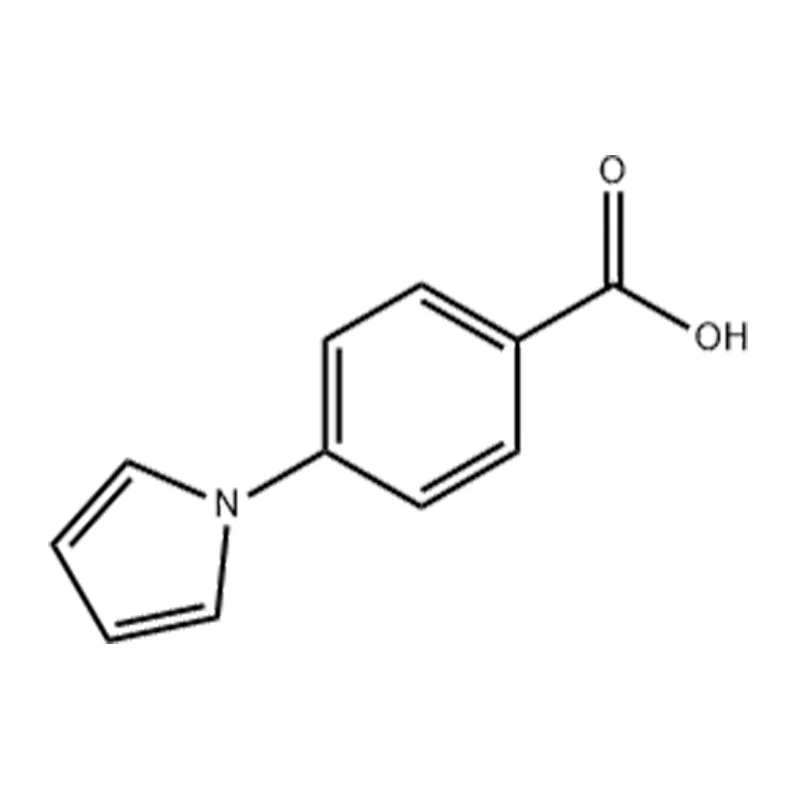
4-(1-Pyrrolyl)benzoic acid features a pyrrole ring, which is a privileged motif in natural products and pharmaceuticals — it appears in porphyrins, chlorophyll, and many drugs (e.g., atorvastatin, sunitinib, and various anticancer agents). Attaching a carboxylic acid group at the para position of the N‑phenyl ring of 4‑(1‑Pyrrolyl)benzoic acid creates a versatile handle for further functionalization. This compound is used as a building block in the synthesis of:
● Kinase inhibitors (e.g., targeting EGFR, VEGFR, or CDKs),
● Antimicrobial agents (pyrrole derivatives show activity against drug‑resistant bacteria and fungi),
● Organic semiconductors (the conjugated N‑arylpyrrole unit can transport charge),
● Fluorescent probes (the rigid structure can emit in the visible region).
4-(1-Pyrrolyl)benzoic acid is also an intermediate for more complex heterocycles and a reference standard for impurity analysis in pharmaceutical manufacturing. Cosperpharm supplies 4‑(1‑Pyrrolyl)benzoic acid with high purity (≥98% by HPLC), fully characterized, and packaged under moisture‑protective conditions. It is classified as a combustible solid (storage class 11) with hazard categories: eye irritation category 2, dermal irritation category 2, and STOT‑SE category 3 (respiratory tract irritation). Standard precautions apply.
|
Parameter |
Specification |
|
CAS Number |
22106-33-8 |
|
IUPAC Name |
4-(1H-pyrrol-1-yl)benzoic acid |
|
Synonyms |
1-(4-Carboxyphenyl)-1H-pyrrole; 4-(1-Pyrrolyl)benzoic acid; p-(1-Pyrrolyl)benzoic acid |
|
Molecular Formula |
C₁₁H₉NO₂ |
|
Molecular Weight |
187.19 g/mol |
|
Melting Point |
286–289 °C (lit.) |
|
Boiling Point (Predicted) |
355.5 ± 25.0 °C |
|
Density (Predicted) |
1.18 ± 0.1 g/cm³ |
|
pKa (Predicted) |
3.83 ± 0.10 |
|
Appearance |
White powder |
|
Sensitivity |
Moisture sensitive – store dry |
|
Storage |
Sealed in dry container, room temperature, protect from moisture |
|
Canonical SMILES |
OC(=O)c1ccc(cc1)-n2cccc2 |
|
Hazard Symbols |
Xi (Irritant) |
|
Risk Codes |
36/37/38 – Irritating to eyes, respiratory system and skin |
|
Safety Statements |
26 – In case of eye contact, rinse with plenty of water and seek medical advice; 37/39 – Wear suitable gloves and eye/face protection |
|
WGK Germany |
WGK 3 (highly hazardous to water) |
|
Storage Class |
11 – Combustible solids |
|
Hazard Categories (CLP) |
Eye irritation Category 2; Dermal irritation Category 2; STOT-SE Category 3 (respiratory tract irritation) |
|
HS Code |
2916399090 |
|
Purity (HPLC) |
≥98.0% |
|
Advantage |
What It Means for Your Research |
|
Privileged pyrrole scaffold |
Pyrrole-containingOut molecules are found in blockbuster drugs (atorvastatin, sunitinib). This building block connects your chemistry to proven pharmacophores. |
|
Conjugated N-aryl system |
The direct N-linkage allows electronic communication between the pyrrole and the benzene ring — useful for tuning optical and electronic properties in materials. |
|
Carboxylic acid handle |
The –COOH group enables amidation, esterification, or reduction, providing a direct route to diverse derivatives. |
|
High thermal stability |
Melts above 286 °C — stable under most reaction conditions. |
|
Crystalline solid |
Easy to weigh, handle, and purify. |
|
Moisture sensitive? |
Slight – but storing with desiccant solves the issue. |
Each batch undergoes:
● Gas chromatography (GC) – purity ≥97.0%
● Non‑aqueous titration – purity ≥97.0%
● Refractive index – confirmatory analysis
● ¹H NMR – structural verification
l Appearance – colorless to light yellow to light orange clear liquid
A comprehensive COA, MSDS (with full GHS information), and certificate of origin accompany every shipment.
The 4-(1-Pyrrolyl)benzoic acid motif appears in a variety of bioactive molecules:
● Kinase inhibitors: The pyrrol‑1‑yl group can occupy the hydrophobic back pocket of ATP‑binding sites. For example, sunitinib (Sutent®) contains an indolinone‑pyrrole structure; related N‑arylpyrroles have been explored as inhibitors of VEGFR, PDGFR, and c‑Kit. The carboxylic acid provides a site for attaching solubilizing groups or targeting ligands.
● Antimicrobial agents: Pyrrole derivatives show activity against Mycobacterium tuberculosis, Staphylococcus aureus, and Candida species. The carboxyl group can be converted to amides to optimize potency and pharmacokinetics.
● Anti‑inflammatory compounds: Some N‑arylpyrroles inhibit COX‑2 or 5‑lipoxygenase, offering potential for treating inflammatory diseases.
The planar, conjugated N‑arylpyrrole unit is an electron‑rich heterocycle that can act as a hole‑transporting material. Researchers have incorporated this building block into:
● Organic field‑effect transistors (OFETs) – as a component of conjugated polymers.
● Organic light‑emitting diodes (OLEDs) – the pyrrole unit can contribute to fluorescence.
● Chemical sensors – the carboxylic acid can bind metal ions or be used to immobilize the molecule on surfaces for detecting analytes.
The nitrogen of the pyrrole can coordinate to metal centers, while the carboxylate can anchor the ligand. This compound has been used to construct metal‑organic frameworks (MOFs) and coordination polymers with potential applications in gas storage, catalysis, and drug delivery. The rigid geometry (the N‑aryl bond prevents free rotation) leads to predictable network topologies.
The carboxylic acid can be transformed into a variety of functional groups (acid chloride, ester, amide, alcohol, aldehyde). Further reactions, such as cyclization of ortho‑substituted amides or cross‑coupling on the pyrrole ring (electrophilic substitution at the 2‑ and 5‑positions of pyrrole), allow access to fused heterocycles like indoles, carbazoles, and pyrrolo‑pyridines.
In the manufacturing of pyrrole‑containing pharmaceuticals, this compound may appear as a starting material residue or degradation product. Cosperpharm supplies it as a certified reference standard for HPLC method development and quality control.
Looking for a high‑purity N‑arylpyrrole building block for your next drug discovery or materials project? Cosperpharm supplies 4-(1-Pyrrolyl)benzoic acid (CAS 22106‑33‑8) with ≥98% purity, full characterization, and moisture‑protective packaging. We support research quantities from 1 g to 1 kg, and larger scales upon request.
Address
No. 2 Yangguang 3rd Road, Duodao Chemical Cycle Industrial Park, Jingmen City, Hubei Province, China
Tel

![1-[2,3-Bis[(9Z,12Z)-octadeca-9,12-dien-1-yloxy]propyl]pyrrolidine](https://www.cosperpharma.com/upload/8820/1-2-3-bis-9z-12z-octadeca-9-12-dien-1-yloxy-propyl-pyrrolidine-349384.webp "1-[2,3-Bis[(9Z,12Z)-octadeca-9,12-dien-1-yloxy]propyl]pyrrolidine")
![1,2,4-Triazolo[4,3-a]pyridin-3(2H)-one](https://www.cosperpharma.com/upload/8820/1-2-4-triazolo-4-3-a-pyridin-3-2h-one-440735.webp "1,2,4-Triazolo[4,3-a]pyridin-3(2H)-one")