
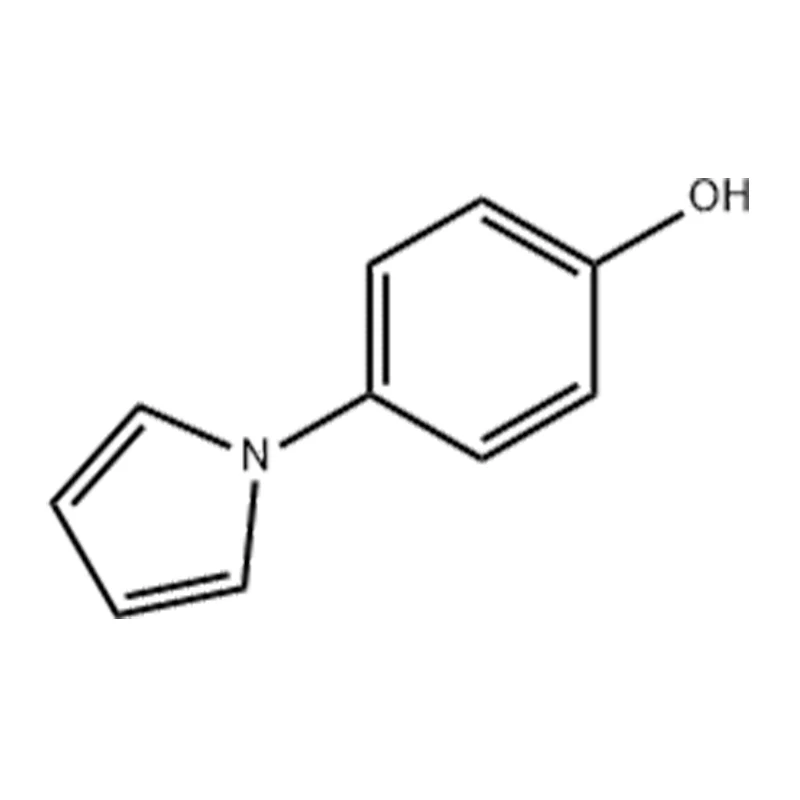
4-(1H-Pyrrol-1-yl)phenol (CAS 23351-09-9), also known as 4-pyrrolylphenol or N-(4-hydroxyphenyl)pyrrole, is a heterocyclic aromatic building block consisting of a phenol group attached to a pyrrole ring at the para position. Its structure features a pyrrole ring that contributes to its potential biological activity, while the hydroxyl group enhances its reactivity and hydrogen-bonding capabilities.
The compound typically appears as a cream to light brown powder or colorless to pale yellow solid, with a melting point of 119–122°C and a molecular weight of 159.18 g/mol. Its bifunctional nature enables broad applicability: the electron-rich pyrrole ring undergoes electrophilic substitution and participates in π-conjugated systems, while the phenolic OH provides a handle for esterification, etherification, and hydrogen-bonding interactions.
In medicinal chemistry, 4-(1H-Pyrrol-1-yl)phenol serves as the core scaffold for generating pharmacologically active molecules. A recent study synthesized a series of new 4-(1H-pyrrol-1-yl)phenyl benzoates via reaction of 4-(1H-Pyrrol-1-yl)phenol with substituted benzoyl chlorides, and these derivatives exhibited significant antimicrobial and antitubercular activities with minimum inhibitory concentration values ranging from 0.8 to 12.5 µg/mL. Moreover, 4-(1H-Pyrrol-1-yl)phenol derivatives have been incorporated into ferrocene complexes as potential chemotherapeutic drugs, with moderate anti-proliferative activity observed against the MCF-7 breast cancer cell line.
In materials science, 4-(1H-Pyrrol-1-yl)phenol has been copolymerized with pyrrole to form a cathode material for Li-ion batteries, with the resulting P(PLPY-co-Py) demonstrating a significantly improved specific capacity of 73.9 mAh·g⁻¹ compared to 21.4 mAh·g⁻¹ for pure polypyrrole. This combination of a para-phenol and an N-linked pyrrole provides a unique balance of nucleophilicity, oxidative stability, and conjugation not found in simpler substituted phenols or pyrroles.
|
Parameter |
Specification |
|
CAS Number |
23351-09-9 |
|
Molecular Formula |
C₁₀H₉NO |
|
Molecular Weight |
159.18 g/mol |
|
Purity |
≥95% (NMR/HPLC); ≥98% available upon request |
|
Appearance |
Cream to light brown powder or colorless to pale yellow solid |
|
Melting Point |
119–122°C (lit.) |
|
Boiling Point |
301.8 ± 25.0°C (Predicted) |
|
Density |
1.10 ± 0.1 g/cm³ (Predicted) |
|
pKa |
9.09 ± 0.26 (Predicted) |
|
SMILES |
OC1=CC=C(C=C1)N2C=CC=C2 |
|
Storage Condition |
Sealed in dry, room temperature |
|
Form |
Powder |
|
HS Code |
29339980 |
|
Hazard Symbols |
Xi, Xn |
|
Hazard Codes |
36/37/38 – 20/21/22 |
|
Safety Statements |
26 – 36 – 36/37/39 |
1.Bifunctional architecture – Combines an electron-rich pyrrole ring (a privileged structure in drug discovery) with a phenolic OH group, enabling dual reactivity patterns: the OH supports esterification, etherification, and hydrogen bonding, while the pyrrole participates in π-conjugated systems and electrophilic substitution.
2.Biologically privileged scaffold – Derivatives have demonstrated significant antimicrobial, antitubercular, and antifungal activities. When incorporated into ferrocene complexes, they exhibit moderate anti-proliferative activity against breast cancer cells (MCF-7).
3.Energy storage potential – Copolymers with pyrrole show specific capacity of 73.9 mAh·g⁻¹ as Li-ion battery cathode materials, significantly higher than pure polypyrrole (21.4 mAh·g⁻¹).
4.Aldose reductase inhibition – The fluorinated derivative has been identified as a submicromolar aldose reductase inhibitor (IC50 = 0.443 µM) with favorable membrane permeation (pKa 7.64).
5. High purity – ≥95% as standard; ≥98% available upon request, with single impurity ≤0.5% and total impurities ≤1.0%.
Several methods have been documented for the synthesis of 4-(1H-Pyrrol-1-yl)phenol:
A reliable approach involves the reaction of 4-aminophenol with 2,5-dimethoxytetrahydrofuran under acidic conditions. The di-carbonyl equivalent cyclizes with the primary amine to form the pyrrole ring directly onto the aromatic scaffold. This one-step method is convenient for laboratory-scale synthesis and has been used to prepare a series of p-substituted N-phenylpyrroles.
Ullmann-type coupling enables the direct N-arylation of pyrrole with 4-bromophenol or 4-iodophenol in the presence of a palladium or copper catalyst. The reaction typically occurs under mild conditions and may require a solvent such as ethanol or methanol.
Alternatively, the reaction of 4-chlorophenol with pyrrole in the presence of a copper catalyst provides another synthetic pathway. The efficiency and yield of each method vary depending on the reaction conditions and the purity of starting materials.
A: This compound is a versatile building block used in several fields: medicinal chemistry (antimicrobial, antitubercular, anticancer research), materials science (conductive polymers, Li-ion battery cathodes), and organic synthesis (ligands for metal complexes, precursors for functional materials).
A: Derivatives have demonstrated significant antimicrobial and antitubercular activities with MIC values ranging from 0.8 to 12.5 µg/mL. Derivatives have also shown antifungal activity against Candida species and moderate anti-proliferative activity against the MCF-7 breast cancer cell line when incorporated into ferrocene complexes. The fluorinated derivative (2-fluoro-4-(1H-pyrrol-1-yl)phenol) is a potent aldose reductase inhibitor (IC50 = 0.443 µM).
Cosperpharm – your trusted partner for high-purity heterocyclic building blocks.We welcome all scientific and commercial inquiries. Whether you need a sample for method development, a quote for bulk production, or technical support for your research project, our team is ready to assist.
Address
No. 2 Yangguang 3rd Road, Duodao Chemical Cycle Industrial Park, Jingmen City, Hubei Province, China
Tel

![1-[2,3-Bis[(9Z,12Z)-octadeca-9,12-dien-1-yloxy]propyl]pyrrolidine](https://www.cosperpharma.com/upload/8820/1-2-3-bis-9z-12z-octadeca-9-12-dien-1-yloxy-propyl-pyrrolidine-349384.webp "1-[2,3-Bis[(9Z,12Z)-octadeca-9,12-dien-1-yloxy]propyl]pyrrolidine")
![1,2,4-Triazolo[4,3-a]pyridin-3(2H)-one](https://www.cosperpharma.com/upload/8820/1-2-4-triazolo-4-3-a-pyridin-3-2h-one-440735.webp "1,2,4-Triazolo[4,3-a]pyridin-3(2H)-one")