
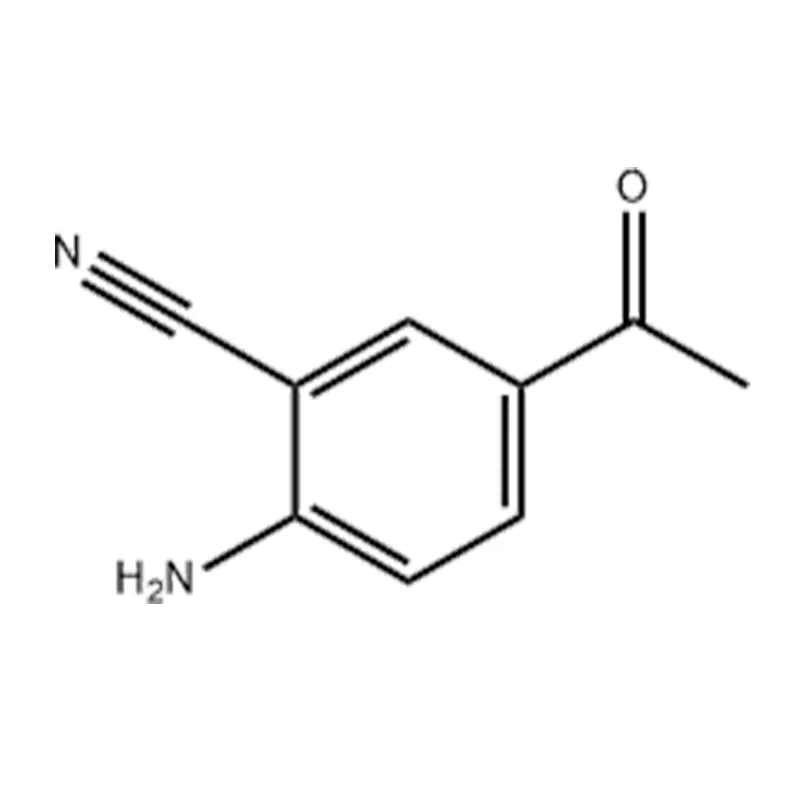
5-Acetyl-2-aminobenzonitrile (CAS 33720-71-7), also known as 4‘-amino-3’-cyanoacetophenone or 5-acetylanthranilonitrile, is a functionalized benzonitrile that features three distinct reactive handles — a primary amine at the 2-position, an acetyl group at the 5-position, and a nitrile group at the 1-position — on a single benzene ring. The molecular formula is C₉H₈N₂O with a molecular weight of 160.17 g/mol, and the compound is supplied as a light yellow to dark yellow solid at purities ranging from 95% to 98%.
In pharmaceutical chemistry, 5-acetyl-2-aminobenzonitrile is a recognized key intermediate in the synthesis of Cimaterol, a β-adrenergic agonist used in animal growth promotion and as a research tool in adrenergic receptor studies. Cimaterol functions by activating β-adrenergic receptors, leading to the activation of cyclic adenosine monophosphate (cAMP) and subsequent signaling cascades that promote protein synthesis and muscle growth.
Beyond Cimaterol synthesis, 5-acetyl-2-aminobenzonitrile serves as a versatile building block for the synthesis of a wide range of organic compounds, including other pharmaceuticals, research chemicals, and specialty chemicals. It is classified as a Building Block and Pharmaceutical/API Drug Impurity/Metabolite, and is recognized as a high-value intermediate for complex organic molecule construction. [8†L12-L13][9†L11-L14] In organic synthesis, 5-acetyl-2-aminobenzonitrile participates in multiple chemical transformations including oxidation (to quinones), reduction (to amines), and nucleophilic substitution at the amino group, which can be achieved using reagents such as potassium permanganate (oxidation), lithium aluminum hydride (reduction), and halogenating agents (substitution).
In biological research, 5-acetyl-2-aminobenzonitrile can be used in the study of enzyme interactions and metabolic pathways. Its mechanism of action involves interaction with specific molecular targets within cells, and as an intermediate in Cimaterol synthesis, it contributes to the activation of β-adrenergic receptors and downstream cAMP-mediated signaling pathways that regulate various physiological effects.
In industrial applications, 5-acetyl-2-aminobenzonitrile is utilized in the production of dyes, pigments, and other industrial chemicals, further demonstrating its versatility beyond pharmaceutical research. [5†L12-L13] The compound is also valuable for research in environmental and industrial chemistry due to its unique chemical properties.
|
Parameter |
Specification |
|
CAS Number |
33720-71-7 |
|
Molecular Formula |
C₉H₈N₂O |
|
Molecular Weight |
160.17 g/mol |
|
Purity |
95–98% as standard; higher purity available upon request |
|
Appearance |
Light yellow to dark yellow solid |
|
Melting Point |
159–161 °C (lit.); >152 °C (dec.) |
|
Boiling Point |
374.5 ± 32.0 °C at 760 mmHg (Predicted); 375 °C |
|
Density |
1.2 ± 0.1 g/cm³ (Predicted) |
|
Flash Point |
180 °C |
|
Vapor Pressure |
0.0 ± 0.8 mmHg at 25 °C |
|
Enthalpy of Vaporization |
62.2 ± 3.0 kJ/mol |
|
pKa |
-0.62 ± 0.10 (Predicted) |
|
Canonical SMILES |
CC(=O)C1=CC(=C(C=C1)N)C#N [7†L10-L11][10†L14-L15] |
|
Solubility |
Chloroform (slightly), methanol (slightly, with heating) [8†L11] |
|
Storage Condition |
Keep in dark place, inert atmosphere, room temperature; 2–8°C (refrigerated) |
|
Stability |
Light-sensitive, protect from light |
|
Safety Classification |
Irritant |
|
HS Code |
29269090 |
A documented laboratory procedure for the synthesis of 5-acetyl-2-aminobenzonitrile proceeds via a copper-mediated cyanation of 3-iodo-4-aminoacetophenone:

1.3-Iodo-4-aminoacetophenone is dissolved in 95 mL of N,N-dimethylformamide (DMF).
2.20.9 g of copper(I) cyanide (CuCN) is added to the solution.
3.The reaction mixture is stirred under reflux conditions for 6 hours.
4.After completion of the reaction, the mixture is cooled to 100 °C.
5.The reaction mixture is then slowly poured into 2 L of ice water and further cooled to room temperature.
6.The precipitated solid is collected by filtration and air-dried.
7.The dried solid is extracted with tetrahydrofuran (THF).
8.The THF extract is concentrated, and the resulting solid is washed with ethanol.
9. The product is filtered again and dried to yield 5-acetyl-2-aminobenzonitrile as yellow crystals, with a reported yield of 56.9% and a melting point of 150–152 °C.
Q1: What are the primary applications of 5-Acetyl-2-aminobenzonitrile?
A: It is primarily used as a key intermediate in the synthesis of Cimaterol (a β-adrenergic agonist), as a versatile building block in organic synthesis, as a tool compound for enzyme interaction studies, and as an industrial chemical for dyes and pigments production.
Q2:What is the solubility of this compound?
A: The compound is slightly soluble in chloroform and slightly soluble in methanol with heating. It has poor solubility in water.
Each batch undergoes:
● Gas chromatography (GC) – purity ≥97.0%
● Non‑aqueous titration – purity ≥97.0%
● Refractive index – confirmatory analysis
● ¹H NMR – structural verification
● Appearance – colorless to light yellow to light orange clear liquid
A comprehensive COA, MSDS (with full GHS information), and certificate of origin accompany every shipment.
We are here to support your research and production needs.If you have any questions regarding 5-Acetyl-2-aminobenzonitrile or wish to request a quotation, please do not hesitate to reach out. Our sales and technical support teams are ready to assist you.
Address
No. 2 Yangguang 3rd Road, Duodao Chemical Cycle Industrial Park, Jingmen City, Hubei Province, China
Tel

![1-[2,3-Bis[(9Z,12Z)-octadeca-9,12-dien-1-yloxy]propyl]pyrrolidine](https://www.cosperpharma.com/upload/8820/1-2-3-bis-9z-12z-octadeca-9-12-dien-1-yloxy-propyl-pyrrolidine-349384.webp "1-[2,3-Bis[(9Z,12Z)-octadeca-9,12-dien-1-yloxy]propyl]pyrrolidine")
![1,2,4-Triazolo[4,3-a]pyridin-3(2H)-one](https://www.cosperpharma.com/upload/8820/1-2-4-triazolo-4-3-a-pyridin-3-2h-one-440735.webp "1,2,4-Triazolo[4,3-a]pyridin-3(2H)-one")