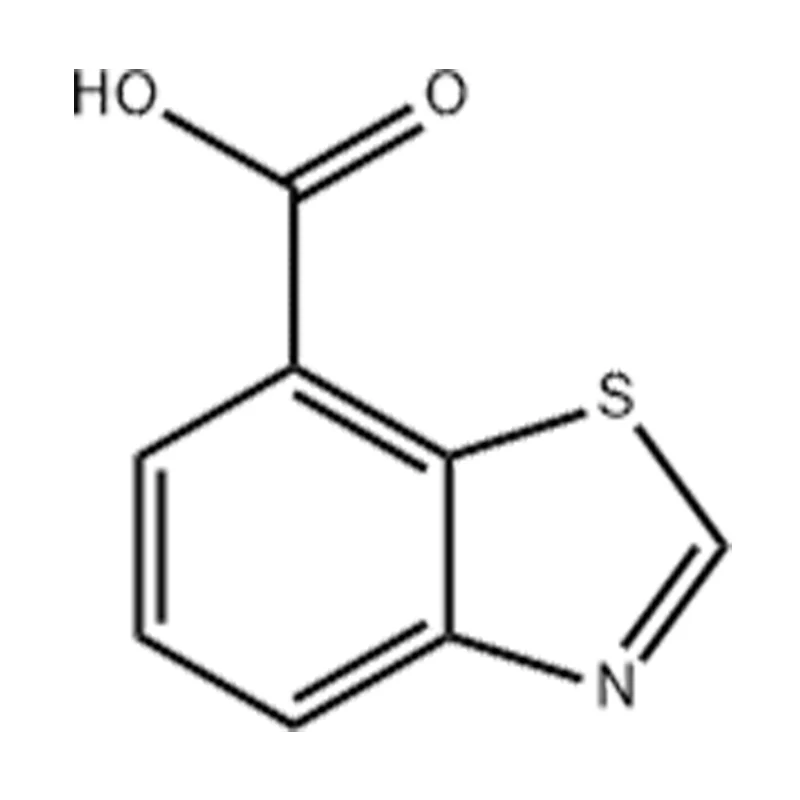
7-Benzothiazolecarboxylic acid (CAS 677304-83-5) is a heterocyclic aromatic compound featuring a benzothiazole ring system with a carboxylic acid functional group at the 7-position . As a member of the benzothiazole family, 7-Benzothiazolecarboxylic acid is recognized for its diverse biological and pharmaceutical activities, making it a valuable scaffold in drug discovery and materials science .
In pharmaceutical research, 7-Benzothiazolecarboxylic acid serves as a key intermediate in the synthesis of pyrazole inhibitors of coactivator associated arginine methyltransferase 1 (CARM1), a protein associated with transcriptional regulation and cancer progression [2†L5-L7][5†L8-L10]. Derivatives of 7-Benzothiazolecarboxylic acid have demonstrated significant anti-tubercular activity against Mycobacterium tuberculosis, with some derivatives exhibiting better inhibition than the standard reference drug isoniazid, along with promising results in Alzheimer‘s disease research as acetylcholinesterase inhibitors, with one derivative showing strong potential for therapeutic application .
Beyond biomedical applications, 7-Benzothiazolecarboxylic acid has also been explored as a plant activator in agriculture, showing efficacy in inducing systemic acquired resistance against pathogens such as powdery mildew and anthracnose, and possesses antimicrobial, anti-inflammatory, and anticancer properties with applications ranging from fungicides and anti‑tuberculosis drugs to anti‑malarials, sedatives, and diabetes treatments.
|
Parameter |
Specification |
|
CAS Number |
677304-83-5 |
|
IUPAC Name |
1,3-benzothiazole-7-carboxylic acid |
|
Molecular Formula |
C₈H₅NO₂S |
|
Molecular Weight |
179.2 g/mol |
|
Purity |
≥95% (HPLC/GC) as standard; ≥98% and 99% grades available upon request |
|
Appearance |
White solid to white to off-white powder |
|
Melting Point |
>300 °C |
|
Boiling Point |
387.7 °C at 760 mmHg (Predicted) |
|
Density |
1.508 g/cm³ |
|
Flash Point |
188.3 °C (Predicted) |
|
Refractive Index |
1.732 (Predicted) |
|
pKa |
2.9 (Predicted) |
|
Solubility |
Slightly soluble in alkaline solutions, DMSO, methanol |
Documented Laboratory Procedure:
A general synthesis of 7-Benzothiazolecarboxylic acid (also known as 7-carboxybenzothiazole or 1,3-benzothiazole-7-carboxylic acid) has been reported using ethyl 1,3-benzothiazole-7-carboxylate as the starting material.
The reaction was carried out as follows:
1.At 0 °C, a sodium hydroxide aqueous solution (50%, 10 mL) was slowly added to a mixture of ethyl 1,3-benzothiazole-7-carboxylate (3.5 g, 16.89 mmol) in methanol (65 mL) and tetrahydrofuran (20 mL), followed by the addition of water (5 mL).
2.The reaction mixture was then stirred at room temperature for 4 h.
3.After completion of the reaction, volatile solvents were removed by rotary evaporation.
4.The residue was dissolved in water (100 mL), and the pH was adjusted to 5 using concentrated hydrochloric acid.
5.The mixture was cooled to 0 °C and held for 30 min to promote precipitation of the product.
6.The solid product was collected by filtration, washed with cold water (10 mL), and dried in a vacuum oven at 70 °C overnight.
Yield: 2.75 g (91%) of the target compound 7-Benzothiazolecarboxylic acid was obtained as a white solid. The product was characterized by ¹H NMR (500 MHz, DMSO‑d₆) and mass spectrometry (APCI).
A: This compound is primarily used as a key intermediate in pharmaceutical synthesis (CARM1 inhibitors, anti‑tubercular agents, Alzheimer’s therapeutics), as a plant activator in agricultural research, and as a versatile building block in medicinal chemistry and organic synthesis.
A: The compound undergoes oxidation (to sulfoxides or sulfones using hydrogen peroxide or potassium permanganate) and reduction (to alcohols or aldehydes using LiAlH₄ or NaBH₄), enabling diverse derivatization pathways.
A cancer research laboratory is developing novel epigenetic therapeutics targeting coactivator associated arginine methyltransferase 1 (CARM1), an enzyme involved in transcriptional regulation and cancer progression. 7-Benzothiazolecarboxylic acid serves as a key intermediate for synthesizing pyrazole inhibitors of CARM1, enabling the team to generate and screen candidate compounds for their ability to inhibit CARM1 activity and suppress tumor growth.
A pharmaceutical research group is investigating new agents to combat drug‑resistant Mycobacterium tuberculosis. Using 7-Benzothiazolecarboxylic acid as a core scaffold, they synthesize a series of benzothiazole derivatives that exhibit potent anti‑tubercular activity, with some compounds demonstrating better inhibition than the standard drug isoniazid and an IC50 value of 0.15 μg/mL . The mechanism involves inhibition of specific bacterial enzymes crucial for the survival of the pathogen.
A neuroscience team is developing acetylcholinesterase inhibitors for Alzheimer’s disease therapy. Derivatives of 7-Benzothiazolecarboxylic acid are synthesized and evaluated for their ability to inhibit acetylcholinesterase, with one derivative showing an IC50 value of 2.7 μM, indicating strong potential for therapeutic application and making it a promising candidate for further optimization in the treatment of neurodegenerative disorders [9†L26-L31].
An agrochemical research center is exploring new plant activators that induce systemic acquired resistance in crops against fungal pathogens. 7-Benzothiazolecarboxylic acid derivatives demonstrate superior efficacy in protecting plants against diseases such as powdery mildew (caused by Erysiphe cichoracearum) and anthracnose (caused by Colletotrichum lagenarium), with some derivatives achieving over 85% protection, outperforming commercial plant activators .
A materials science group requires a heterocyclic building block for synthesizing functional organic materials or specialty dyes for textile and imaging applications. The benzothiazole core of 7-Benzothiazolecarboxylic acid can be incorporated into extended π‑conjugated systems with desirable optoelectronic properties, and its carboxylic acid group serves as a versatile point for further derivatization to tune solubility and processability.
Ready to take the next step? Let‘s connect!Whether you need a quote, a sample for testing, or expert advice on custom synthesis, our dedicated team is just an email away. We take pride in offering fast, clear, and helpful responses to all inquiries.
Address
No. 2 Yangguang 3rd Road, Duodao Chemical Cycle Industrial Park, Jingmen City, Hubei Province, China
Tel

![1-[2,3-Bis[(9Z,12Z)-octadeca-9,12-dien-1-yloxy]propyl]pyrrolidine](https://www.cosperpharma.com/upload/8820/1-2-3-bis-9z-12z-octadeca-9-12-dien-1-yloxy-propyl-pyrrolidine-349384.webp "1-[2,3-Bis[(9Z,12Z)-octadeca-9,12-dien-1-yloxy]propyl]pyrrolidine")
![1,2,4-Triazolo[4,3-a]pyridin-3(2H)-one](https://www.cosperpharma.com/upload/8820/1-2-4-triazolo-4-3-a-pyridin-3-2h-one-440735.webp "1,2,4-Triazolo[4,3-a]pyridin-3(2H)-one")