
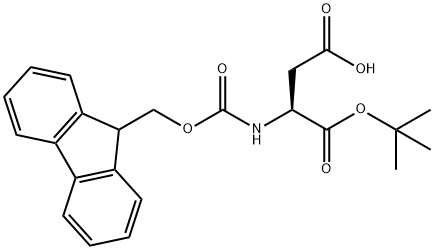
Fmoc-Asp-OtBu is the standard building block for the introduction of aspartic acid residues in Fmoc solid‑phase peptide synthesis (SPPS). The orthogonal protection strategy of Fmoc-Asp-OtBu — Fmoc on the Nα‑amine and tert‑butyl ester on the α‑carboxyl — allows the free β‑carboxylic acid to be activated and coupled to the solid support or to the N‑terminus of a growing peptide chain, while the side‑chain remains protected throughout chain assembly. Upon completion of the peptide sequence, Fmoc-Asp-OtBu is cleaved from the resin under strong acidic conditions (typically TFA) that simultaneously remove the tert‑butyl protecting group, liberating a fully deprotected aspartic acid residue with a free α‑carboxyl group. This building block is widely used in the synthesis of peptide drugs, bioactive peptides, and peptide reagents containing aspartic acid residues. With its high chiral purity and ability to effectively suppress aspartic acid imide side reactions, Fmoc-Asp-OtBu serves as a key raw material in the development of anticancer drugs, hypoglycemic peptides, and vaccine peptides, supporting both research and process production of peptides across academic, biotech, and pharmaceutical settings.
Product Parameters
|
Parameter |
Specification |
|
Product Name |
Fmoc-Asp-OtBu |
|
CAS Number |
129460 09 9 |
|
Molecular Formula |
|
|
Molecular Weight |
|
|
Physical Form |
|
|
Appearance |
|
|
Melting Point |
90-98°C (dec.) |
|
Boiling Point |
617.4±55.0℃ |
|
Density |
1.251±0.06g/cm3 |
|
pKa |
4.08±0.19 |
|
Storage Condition |
Keep in dark place,Sealed in dry,Room Temperature |
Synthetic Route
Fmoc-Asp-OtBu is prepared by selective protection of the L‑aspartic acid scaffold. The synthesis typically involves the tert‑butyl esterification of the α‑carboxylic acid (using isobutylene in the presence of an acid catalyst or via tert‑butyl acetate), followed by Fmoc protection of the Nα‑amine (using Fmoc‑OSu or Fmoc‑Cl under basic conditions). The side‑chain β‑carboxylic acid is left free. Upstream synthesis routes for Fmoc-Asp-OtBu have been documented, including references in Synthesis (1990), Tetrahedron Asymmetry (1999), and the Journal of the Chemical Society. Perkin Transactions 1 (2002). Downstream synthesis routes have also been reported, for example in Tetrahedron Letters (1992) and the Journal of Organic Chemistry (2006).
FAQ
Q1: What is the difference between Fmoc-Asp-OtBu (CAS 129460-09-9) and Fmoc-Asp(OtBu)-OH (CAS 71989-14-5)?
A: Both CAS numbers refer to the same compound — Nα‑Fmoc‑L‑aspartic acid α‑tert‑butyl ester. The difference in notation simply reflects whether the tert‑butyl ester is indicated on the side‑chain (OtBu) or included as part of the name (Fmoc-Asp-OtBu). CAS 129460‑09‑9 and CAS 71989‑14‑5 are used interchangeably across commercial and scientific databases, sometimes reflecting different specifications (e.g., purity grade, salt form, crystalline form) or supplier‑specific cataloging. Cosperpharm verifies the CAS number with each batch to ensure accurate specification matching.
Q2: What are the primary applications of Fmoc-Asp-OtBu?
A: Fmoc-Asp-OtBu is primarily used as a building block in Fmoc solid‑phase peptide synthesis (SPPS) for the introduction of aspartic acid residues into synthetic peptides. It is a standard building block for both research and process production of peptides, with applications ranging from small peptide synthesis to commercial peptide manufacturing.
Storage Conditions
Store Fmoc-Asp-OtBu in a tightly sealed, moisture‑tight container under inert atmosphere (nitrogen or argon) for optimal long‑term stability. Recommended storage temperatures: –20°C for long‑term storage (>12 months); 4°C for short‑term storage (up to 12 months); 2–30°C for short‑term storage acceptable. The compound is stable under recommended storage conditions. Protect from moisture, light, and strong oxidizing agents.
Shelf life: 3 years when stored at –20°C in a sealed container under inert atmosphere; 2 years when stored at 4°C.
Solution storage: For stock solutions, dissolve in DMSO or DMF and store at –80°C (6 months stability) or –20°C (1 month stability). Avoid repeated freeze‑thaw cycles. Allow the sealed container to reach ambient temperature before opening to minimise moisture condensation.
Handling precautions: Use only in a fume hood. Wear chemical‑resistant gloves (tested against EN 374 or equivalent), safety goggles, and a lab coat. Avoid generating dust or aerosols. Do not eat, drink or smoke in work areas. After handling, wash hands thoroughly. Contaminated clothing should be removed and washed before reuse. Refer to the Safety Data Sheet (SDS) for complete safety information.
Contact Us
From small‑scale research peptides to commercial manufacturing campaigns — Cosperpharm supplies the high‑purity Fmoc‑protected amino acid building blocks you need to advance your peptide synthesis projects. Contact us today to request a quote for Fmoc-Asp-OtBu or any other building block in our comprehensive catalogue.
Address
No. 2 Yangguang 3rd Road, Duodao Chemical Cycle Industrial Park, Jingmen City, Hubei Province, China
Tel

![1-[2,3-Bis[(9Z,12Z)-octadeca-9,12-dien-1-yloxy]propyl]pyrrolidine](https://www.cosperpharma.com/upload/8820/1-2-3-bis-9z-12z-octadeca-9-12-dien-1-yloxy-propyl-pyrrolidine-349384.webp "1-[2,3-Bis[(9Z,12Z)-octadeca-9,12-dien-1-yloxy]propyl]pyrrolidine")
![1,2,4-Triazolo[4,3-a]pyridin-3(2H)-one](https://www.cosperpharma.com/upload/8820/1-2-4-triazolo-4-3-a-pyridin-3-2h-one-440735.webp "1,2,4-Triazolo[4,3-a]pyridin-3(2H)-one")