
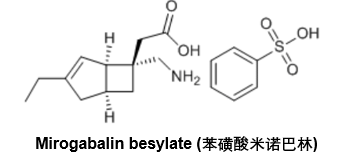
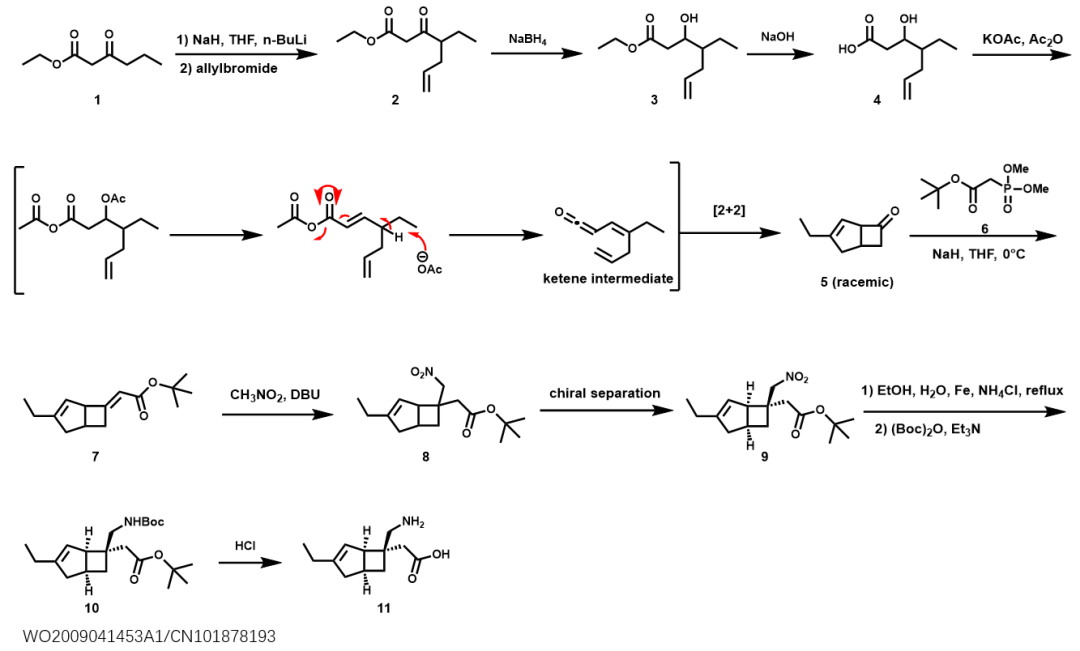
Daiichi Sankyo Co., Ltd. has disclosed synthesis routes for minobactine benzosulfonate in multiple patents: four Japanese patents (WO2009041453A1, WO2015005298A1, WO2012169474A1, WO2013154066A1), two Chinese patents (CN101878193, CN104245951), and three English patents (EP2192109A1, EP2871176A1, US20140094623A1). These synthesis routes can be categorized into two types: purely chemical synthesis routes and enzyme-assisted synthesis routes. Below is an introduction to the purely chemical synthesis routes, as illustrated in the following figure: Starting from β-carbonyl ester 1, an acetoacetic ester synthesis is performed with allyl bromide to afford compound 2; subsequent sodium borohydride reduction of the carbonyl group yields alcohol 3; hydrolysis of the ester affords carboxylic acid 4; reaction of compound 4 with acetic anhydride under basic conditions generates a ketene intermediate; followed by a [2+2] cycloaddition reaction to form the pentacyclic four-membered ring compound 5; reaction of compounds 5 and 6 via the Horner-Wadsworth-Emmons olefination reaction yields α,β-unsaturated ester 7; reaction of compound 7 with nitromethane under basic conditions results in compound 8; chiral SFC resolution affords compound 9, which possesses a single stereocenter; finally, reduction of the nitro group, Boc protection of the amine group, and deprotection of the Boc group with hydrochloric acid afford minobactine (CN10878193).
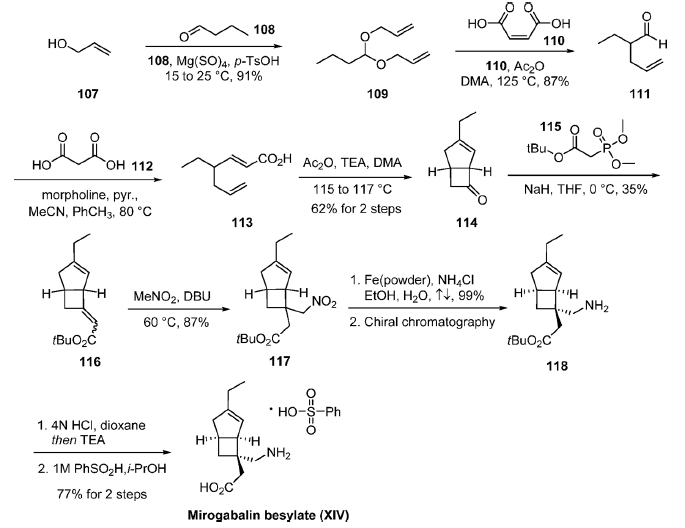
The synthetic routes summarized in the literature (J. Med. Chem. 2021,64,3604–3657) primarily encompass the following steps based on four Japanese patents: condensation of allyl alcohol 107 with n-butylaldehyde 108 to afford acetal 109; a Claisen rearrangement reaction catalyzed by maleic acid to yield aldehyde 111; and a Doebner-optimized Knoevenagel condensation between aldehyde 111 and malonic acid 112 to produce α,β-unsaturated carboxylic acid 113; the subsequent reactions are essentially identical to those described in patent CN10878193.
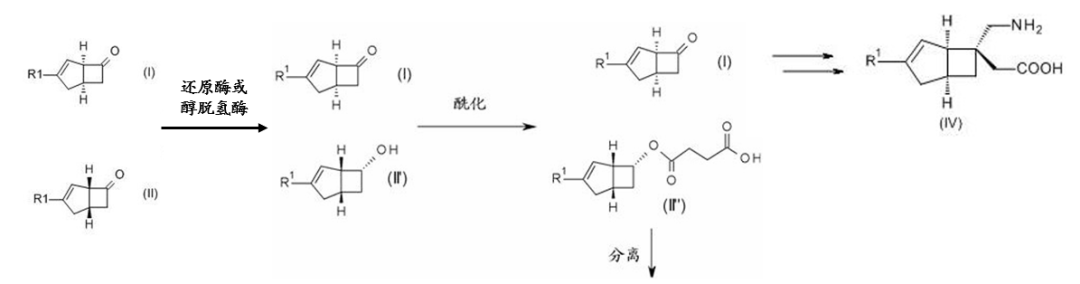
In 2013, Daiichi Sankyo Co., Ltd. reported in patent CN104245951 a method employing enzymatic resolution to obtain a single chiral pentacyclic intermediate I at an earlier synthetic step; using racemic I as the substrate, the intermediate II was selectively reduced to alcohol II 'under the action of a reductase or alcohol dehydrogenase, a coenzyme, and an appropriate buffer system; this intermediate II' was then acylated with succinic acid to afford ester II", followed by separation to isolate the desired enantiomer of the pentacyclic intermediate I; the final product, minobactam, was subsequently obtained via reactions analogous to those in conventional chemical synthesis. This enzymatic resolution approach effectively advances the resolution of the chiral FSC intermediate, thereby reducing overall production costs.
Several domestic pharmaceutical companies have applied for synthetic routes to prepare key intermediates for minoboline. Here, we share two reports on the preparation of (1R,5S)-3-ethylbicyclo[3.2.0]hept-3-en-6-one I; compared to the original research route, their primary differences lie in the chiral resolution strategies employed.
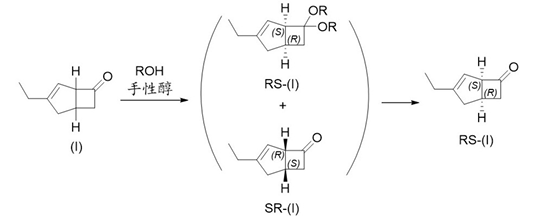
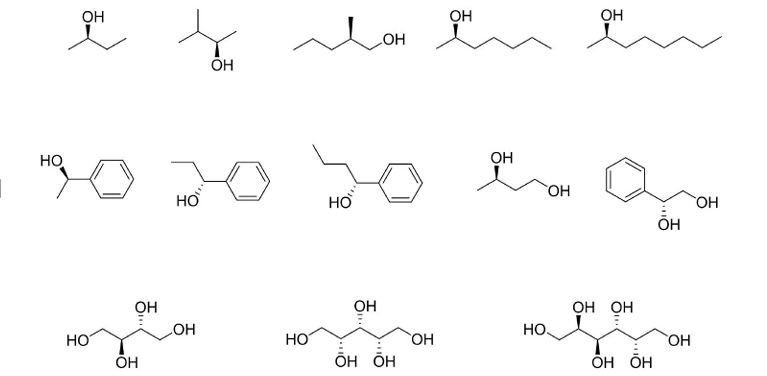
①Chongqing Huasen Pharmaceutical Co., Ltd. (CN115745764A): A racemic compound I is reacted with a chiral monoalcohol or polyalcohol to selectively form a ketal with RS-I; after separation, hydrolysis yields optically pure RS-I.
The chiral alcohols disclosed in the patent include:
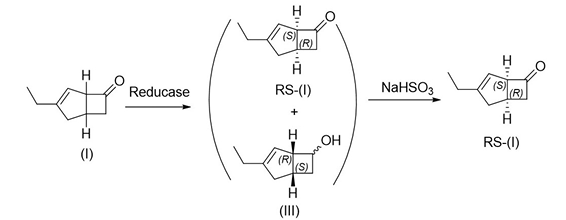
②Fenghuolun (Shanghai) Biotechnology Co., Ltd. (CN117865785A): First, a reductase is employed to selectively reduce SR-I to compound III; the unreduced RS-I then reacts with sodium bisulfite to form sodium sulfonate salts, which are subsequently isolated and purified; finally, hydrolysis under the presence of a non-chiral acid or base yields optically pure RS-I.
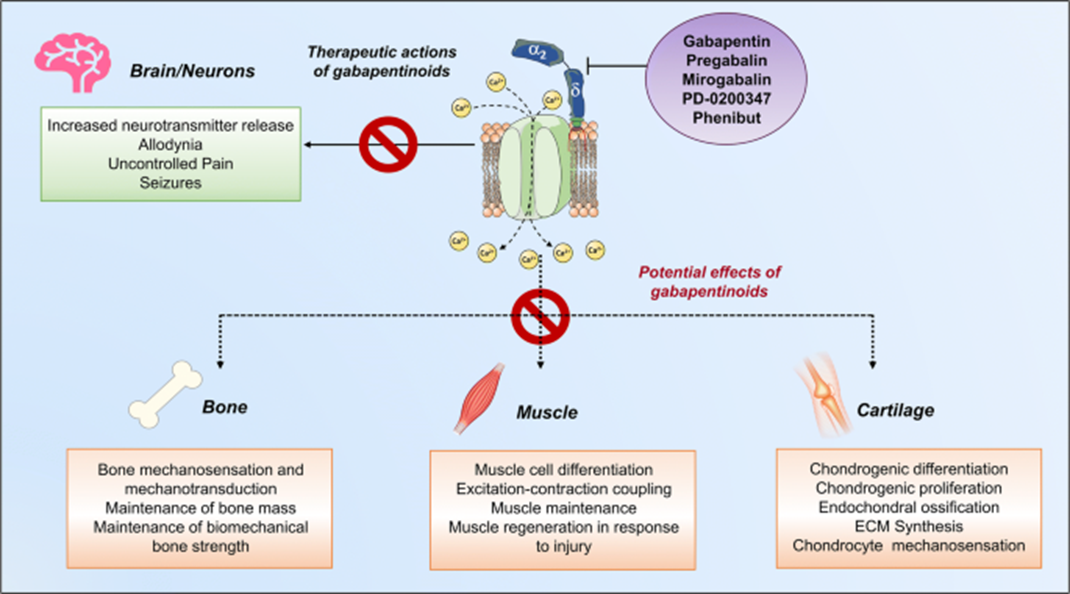
Mirogabalin besylate is a GABA analog that acts on the α2-δ subunit in the voltage-sensitive calcium channel complex, reduces calcium ion influx at presynaptic terminals, and inhibits the release of excitatory neurotransmitters, thereby exerting a therapeutic effect on chronic neuropathic pain.
①Voltage-gated calcium channel: Composed of four subunits. The α1 subunit forms a pore structure from four homologous domains, each domain containing six transmembrane segments. The β subunit is located intracellularly. The γ subunit has four transmembrane segments. The δ subunit has one transmembrane segment and is linked to the extracellular α2 subunit via a disulfide bond.
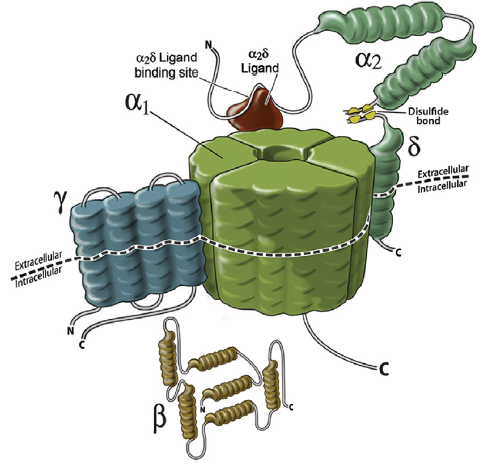
②Schematic Diagram of the Mechanism of Action of Minobalin: