
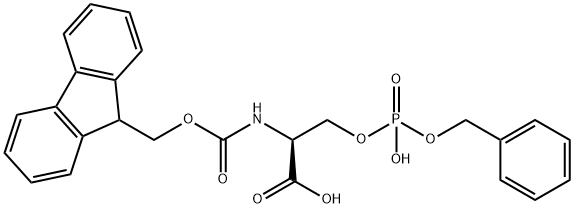
Fmoc-Ser(PO(OBzl)OH)-OH is a specialized phosphorylated amino acid building block designed for the efficient incorporation of phosphoserine residues into synthetic peptides via Fmoc solid-phase peptide synthesis. Fmoc-Ser(PO(OBzl)OH)-OH can be introduced using standard activation methods such as PyBOP and TBTU, with the monoprotected phosphoserine residue remaining stable to piperidine during Fmoc deprotection steps. Using this reagent, even peptides containing multiple phosphorylation sites can be prepared efficiently by standard Fmoc SPPS methods. Applications of Fmoc-Ser(PO(OBzl)OH)-OH include the preparation of phospholamban, a 52-residue peptide containing both phosphoserine and phosphothreonine, and human salivary statherin, a 42-residue phosphoserine peptide. However, researchers should be aware that β‑piperidinylalanine formation has been shown to occur during Fmoc deprotection of N-terminal Ser(PO(OBzl)OH), particularly under microwave conditions — a side reaction that can be eliminated by using cyclohexylamine or DBU for that specific Fmoc deprotection step. Fmoc-Ser(PO(OBzl)OH)-OH is the preferred building block for studies of protein phosphorylation, kinase substrate identification, and the development of phosphopeptide-based therapeutic agents
Product Parameters
|
Parameter |
Specification |
|
Product Name |
Fmoc-Ser(PO(OBzl)OH)-OH |
|
CAS Number |
158171-14-3 |
|
Molecular Formula |
C₂₅H₂₄NO₈P |
|
Molecular Weight |
497.43 g/mol |
|
Purity (HPLC) |
≥95.0% |
|
Appearance |
White to off-white powder |
|
Density |
1.403 ± 0.06 g/cm³ (predicted) |
|
pKa |
1.42 ± 0.50 (predicted) |
|
Solubility |
Slightly soluble in water; soluble in chloroform, dichloromethane, ethyl acetate, DMSO, acetone |
|
Storage Condition |
Store at -15°C to -25°C |
Why Cosperpharm?
When your research demands precise incorporation of phosphorylated serine residues into synthetic peptides, Cosperpharm delivers Fmoc-Ser(PO(OBzl)OH)-OH with the purity, documentation, and consistency required for reproducible results. We understand that phosphopeptide synthesis presents unique challenges — from the stability of the phosphate protecting group to the potential for side reactions such as β‑piperidinylalanine formation under microwave conditions. That is why each batch of Fmoc-Ser(PO(OBzl)OH)-OH undergoes HPLC purity verification (≥95.0%) with full chromatographic traceability, ensuring that your synthesis starts with a reliable building block. Cosperpharm supplies Fmoc-Ser(PO(OBzl)OH)-OH at multiple scales — from gram quantities for research applications such as kinase substrate studies and phosphopeptide library synthesis, to larger quantities for process development and scale-up. Our technical support team can advise on optimal activation methods (PyBOP, TBTU, HATU), deprotection strategies to minimize side reactions, and troubleshooting for peptides containing multiple phosphorylation sites. Every shipment includes a Certificate of Analysis (COA) and SDS, with DMF‑ready documentation available upon request for customers engaged in regulated research or clinical development.
FAQ
Q1: Is the benzyl phosphate protecting group removed during Fmoc deprotection?
A: No. The benzyl (OBzl) phosphate protecting group is stable under the mild basic conditions (20% piperidine in DMF) used for Fmoc removal. Global deprotection of the phosphate group occurs during the final TFA cleavage step.
Q2: What activation methods are compatible with this building block?
A: Fmoc-Ser(PO(OBzl)OH)-OH can be introduced using standard activation methods including PyBOP and TBTU. It is also compatible with HATU, HBTU, and other commonly used peptide coupling reagents.
Application Scenarios
Phosphoserine Peptide Synthesis
Fmoc-Ser(PO(OBzl)OH)-OH is the standard building block for incorporating phosphoserine residues into synthetic peptides via Fmoc SPPS, using standard activation methods such as PyBOP and TBTU.
Signaling Pathway Research
Phosphoserine‑containing peptides prepared using this building block are essential tools for studying kinase and phosphatase substrate specificity, protein‑protein interactions, and signal transduction mechanisms.
Phospholamban Synthesis
Used in the preparation of phospholamban, a 52‑residue peptide containing both phosphoserine and phosphothreonine, which is critical for studying cardiac muscle contractility and calcium homeostasis.
Human Salivary Statherin Synthesis
Employed in the synthesis of human salivary statherin, a 42‑residue phosphoserine peptide involved in oral health and enamel protection.
Multiply‑Phosphorylated Peptide Synthesis
Enables the efficient preparation of peptides containing multiple phosphorylation sites using standard Fmoc SPPS methods, as the monoprotected phosphoserine residue remains stable during chain assembly.
Kinase Substrate Identification
Phosphopeptide libraries synthesized using Fmoc-Ser(PO(OBzl)OH)-OH are used to identify kinase substrate specificity and to develop selective kinase inhibitors.
Structural Biology of Phosphoproteins
Phosphoserine‑containing peptides are used in NMR, X‑ray crystallography, and other biophysical studies to understand the structural effects of phosphorylation on protein conformation and function.
Contact Us
Ready to incorporate phosphoserine residues into your synthetic peptides? Cosperpharm provides Fmoc-Ser(PO(OBzl)OH)-OH with the quality, documentation, and supply flexibility your research demands. Our technical team can help with activation method selection, side reaction troubleshooting, and scale-up planning. Reach out today for pricing, availability, or technical support.
Address
No. 2 Yangguang 3rd Road, Duodao Chemical Cycle Industrial Park, Jingmen City, Hubei Province, China
Tel


![1-[2,3-Bis[(9Z,12Z)-octadeca-9,12-dien-1-yloxy]propyl]pyrrolidine](https://www.cosperpharma.com/upload/8820/1-2-3-bis-9z-12z-octadeca-9-12-dien-1-yloxy-propyl-pyrrolidine-349384.webp "1-[2,3-Bis[(9Z,12Z)-octadeca-9,12-dien-1-yloxy]propyl]pyrrolidine")
![1,2,4-Triazolo[4,3-a]pyridin-3(2H)-one](https://www.cosperpharma.com/upload/8820/1-2-4-triazolo-4-3-a-pyridin-3-2h-one-440735.webp "1,2,4-Triazolo[4,3-a]pyridin-3(2H)-one")