
Thermodynamic Stability
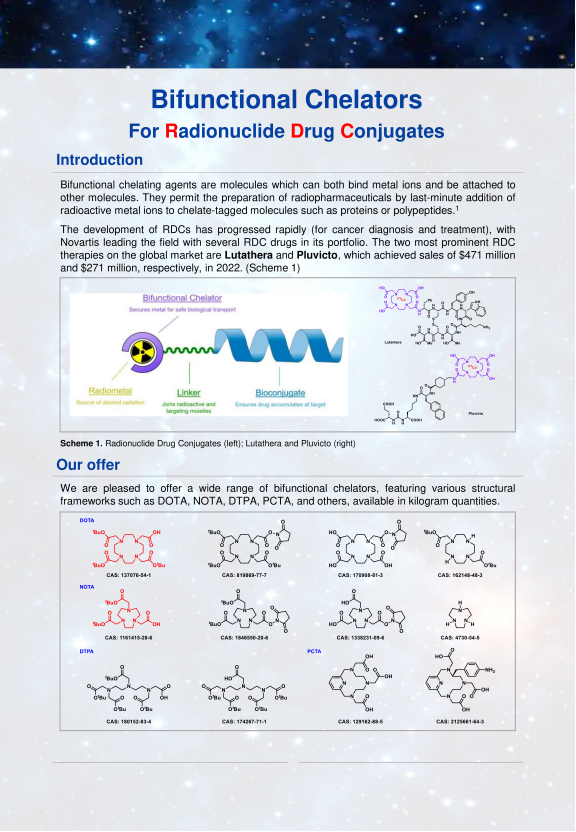
Nuclear medicine typically requires an integrated approach to diagnosis and therapy; therefore, it is advisable to design chelators that are "flexibly plug-and-play" and capable of serving both diagnostic and therapeutic purposes. However, each radionuclide exhibits distinct properties. For instance, the classical chelator DOTA demonstrates exceptional stability toward trivalent lanthanide elements (e.g., ¹⁷⁷Lu) (log K ≈ 25), but its macrocyclic structure results in slow complexation kinetics with ⁶⁸Ga³⁺ (due to its small ion radius) and necessitates high-temperature conditions for labeling. In contrast, NOTA, specifically designed for ⁶⁸Ga (with a smaller macrocycle), is thermodynamically stable; however, direct application to complex larger ions such as ²²⁵Ac³⁺ may lead to severe instability due to cavity mismatch, posing a significant risk of radionuclide leaching.
Dynamical inertia
This is one of the common reasons for clinical failure. For example, certain open-chain chelators (such as EDTA derivatives) bind rapidly to metal ions and exhibit high thermodynamic stability constants; however, due to their easily broken and reformed coordination bonds, these metal ions are readily captured by proteins such as transferrin in the bloodstream, leading to radiation accumulation in non-target organs (e.g., bone marrow, liver).
Radiochemical labeling
However, balancing stability and labeling efficiency remains challenging. Taking DOTA-labeled ⁶⁸Ga as an example, conventional methods require heating at 95 °C for 10–15 minutes to achieve high stability, which limits its direct conjugation with thermally unstable biomolecules (e.g., certain antibody fragments) and increases operational complexity. The labeling of ²²⁵Ac presents even greater difficulties due to the extremely low required amounts (at the nanomolar level) and the intricate chemical environment; any side reactions can lead to low yields and impurities.
Pharmacokinetics
The chain reaction of chemical modifications makes the design of chelators particularly challenging. For instance, to enhance water solubility and accelerate renal clearance, hydrophilic groups (such as sulfonic acid groups) may be introduced into the chelator. However, this can alter the overall charge and spatial conformation of the molecule, inadvertently affecting its affinity for the target or leading to alternative metabolic pathways. Similarly, strongly negatively charged chelators (e.g., DOTA) may prolong drug retention in the renal cortex, increasing renal radiation exposure and potentially causing dose-limiting toxicity. Therefore, precise adjustments must be made at the molecular level during design.
Irradiation Stability
This represents the most significant challenge in the targeted α therapy using ²²⁵Ac. The decay chain of ²²⁵Ac produces multiple daughter nuclides (e.g., ²²¹Fr, ²¹³Bi) accompanied by intense recoil energy (~100–200 keV), sufficient to break the majority of covalent bonds. Traditional chelators such as DOTA, after labeling with ²²⁵Ac, often fail to trap the escaping daughter nuclides (particularly ²¹³Bi), leading to their diffusion within the body and nonspecific deposition in organs such as the kidneys and spleen, resulting in severe toxic side effects. There is an urgent need to develop revolutionary chelation systems for ²²⁵Ac drugs that possess anti-recoil or in-situ retraction capabilities.
In conclusion, the design of chelating agents represents a classic multi-dimensional trade-off challenge. In our next article, we will explore how artificial intelligence conducts systematic exploration and intelligent optimization across vast chemical spaces to identify novel molecular structures that meet all stringent requirements.
Contact Us
Phone: +86-18986204913
Tel: +86-027-83338163
E-Mail: info@cosperpharma.com