
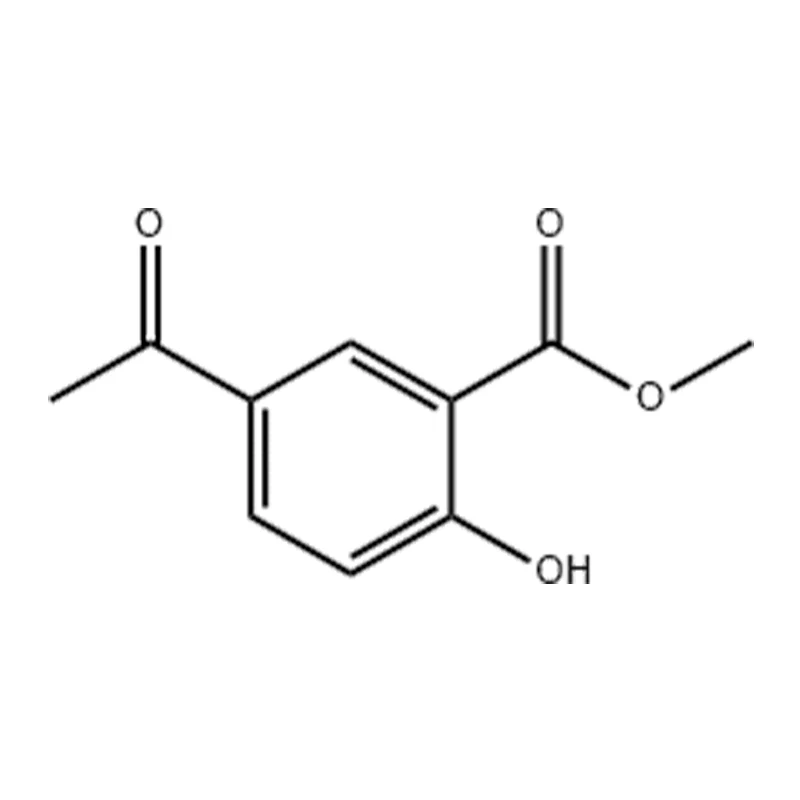
Methyl 5-acetylsalicylate combines two versatile functional handles: a methyl ester (–COOCH₃) and a free phenolic hydroxyl (–OH) at the ortho position relative to the ester, along with an acetyl group (–COCH₃) at the 5‑position. This unique substitution pattern makes Methyl 5-acetylsalicylate a valuable building block for constructing more complex pharmaceutical compounds. The phenolic hydroxyl can be acylated or alkylated, the ester can be hydrolyzed to the corresponding carboxylic acid, and the acetyl group can participate in condensation reactions or serve as a ketone handle for further derivatization (e.g., oxime formation, reduction, or aldol reactions). As a key synthetic intermediate, Methyl 5-acetylsalicylate is primarily used in the preparation of anti‑inflammatory, analgesic, and antithrombotic agents, as well as in the synthesis of various heterocyclic scaffolds. Its role in the development of novel salicylate‑based prodrugs and targeted therapeutics continues to expand, making Methyl 5-acetylsalicylate an indispensable building block in modern medicinal chemistry.
|
Parameter |
Specification |
|
CAS |
16475-90-4 |
|
EINECS |
240-532-2 |
|
Molecular Formula |
C₁₀H₁₀O₄ |
|
Molecular Weight |
194.18 g/mol |
|
Purity (HPLC) |
≥97% – ≥98% (≥99% reference grade available) |
|
Appearance |
White to off-white or pale yellow waxy/crystalline solid |
|
Melting Point |
62–64 °C (lit.) |
|
Boiling Point |
167 °C at 15 mmHg |
|
Density |
1.0583 g/cm³ (rough estimate) |
|
Refractive Index |
1.5168 (estimate) |
|
pKa (phenolic OH) |
7.96±0.18 (predicted) |
|
Solubility |
Soluble in methanol, ethanol, DMSO, DMF, and other organic solvents; sparingly soluble in water |
|
Physical Form |
Solid |
|
Color |
Off-white to pale yellow |
|
BRN |
2643824 |
|
SMILES |
COC(=O)c1cc(ccc1O)C(=O)C |
|
Storage Conditions |
Sealed in dry container, room temperature (ambient) |
|
Stability |
Stable under recommended storage conditions; avoid strong oxidizing agents and prolonged exposure to light/moisture |
|
WGK Germany |
3 |
|
Hazard Symbols |
Xi (Irritant) |
|
Risk Codes |
R36/37/38 – Irritating to eyes, respiratory system and skin |
|
Safety Statements |
S26 – In case of eye contact, rinse immediately with plenty of water and seek medical advice; S36 – Wear suitable protective clothing |
|
GHS Classification |
Eye Irrit. 2; Skin Irrit. 2; STOT SE 3 |
|
Storage Class |
11 – Combustible solid |
|
HS Code |
29189900 |
Methyl 5‑acetylsalicylate is a direct precursor in the synthesis of 5‑acetylsalicylic acid (after ester hydrolysis) and its derivatives, which have been investigated for anti‑inflammatory and analgesic properties. The acetyl group at the 5‑position allows further functionalization to produce novel salicylate‑based drug candidates with improved pharmacokinetic profiles.
The ortho‑hydroxy ester moiety is ideal for constructing various heterocyclic systems, including benzoxazoles, chromones, and coumarins, via condensation reactions with amidines, hydrazines, or other nucleophiles. These scaffolds are common in medicinal chemistry for developing kinase inhibitors, antimicrobial agents, and anticancer compounds.
The phenolic hydroxyl can be conjugated with amino acids, sugars, or other targeting groups to create prodrugs that release the active salicylate payload under specific physiological conditions. This strategy is particularly relevant in designing colon‑targeted or enzyme‑activatable therapeutics.
For analytical method development and impurity profiling, high‑purity methyl 5‑acetylsalicylate (≥99%) is supplied as a certified reference material (CRM), suitable for:
● Method validation (AMV) under ICH guidelines
● Stability studies and forced degradation testing
● Regulatory filing (IND, NDA, ANDA) support
● HPLC and GC calibration
The compound serves as a starting point for the synthesis of diverse small‑molecule libraries. The methyl ester can be reduced to the corresponding alcohol, while the acetyl group can be converted to oximes, hydrazones, or undergo halogenation and cross‑coupling reactions.
Salicylate derivatives have been studied for their effects on AMPK activation and anti‑inflammatory pathways. Methyl 5‑acetylsalicylate and its analogs are valuable tools for investigating the relationship between structure and bioactivity in this class of compounds.
This compound carries multiple hazard classifications:
|
Hazard Category |
Classification |
|
Eye irritation |
Category 2 (causes serious eye irritation) |
|
Skin irritation |
Category 2 (causes skin irritation) |
|
Skin sensitization |
Category 1 (may cause allergic skin reaction) |
|
STOT-SE |
Category 3 (may cause respiratory irritation) |
|
Storage class |
11 – Combustible solid |
● Eyes: Safety goggles (mandatory).
● Skin: Chemical-resistant gloves (nitrile). If you have a history of skin allergies, take extra precautions due to skin sensitizer classification.
● Respiratory: Use in a fume hood. Avoid breathing dust.
● First aid:
1. Eye contact – rinse with water for 15 min (S26).
2. Skin contact – wash with soap and water. If rash or irritation develops, seek medical advice (skin sensitizer).
3. Inhalation – move to fresh air.
● Storage: Keep container tightly sealed in a dry place at room temperature. Store away from ignition sources (combustible solid). Avoid contact with strong mineral acids (releases irritating free monoester).
● Disposal: Collect as chemical waste. WGK 1 indicates low water hazard, but best practice is not to flush down drains.
Methyl 5-acetylsalicylate (CAS 16475-90-4) – whether you need a small sample to validate a synthetic route, a reference standard for quality control, or bulk material for commercial manufacturing, we’re ready to support you.
Address
No. 2 Yangguang 3rd Road, Duodao Chemical Cycle Industrial Park, Jingmen City, Hubei Province, China
Tel

![1-[2,3-Bis[(9Z,12Z)-octadeca-9,12-dien-1-yloxy]propyl]pyrrolidine](https://www.cosperpharma.com/upload/8820/1-2-3-bis-9z-12z-octadeca-9-12-dien-1-yloxy-propyl-pyrrolidine-349384.webp "1-[2,3-Bis[(9Z,12Z)-octadeca-9,12-dien-1-yloxy]propyl]pyrrolidine")
![1,2,4-Triazolo[4,3-a]pyridin-3(2H)-one](https://www.cosperpharma.com/upload/8820/1-2-4-triazolo-4-3-a-pyridin-3-2h-one-440735.webp "1,2,4-Triazolo[4,3-a]pyridin-3(2H)-one")