
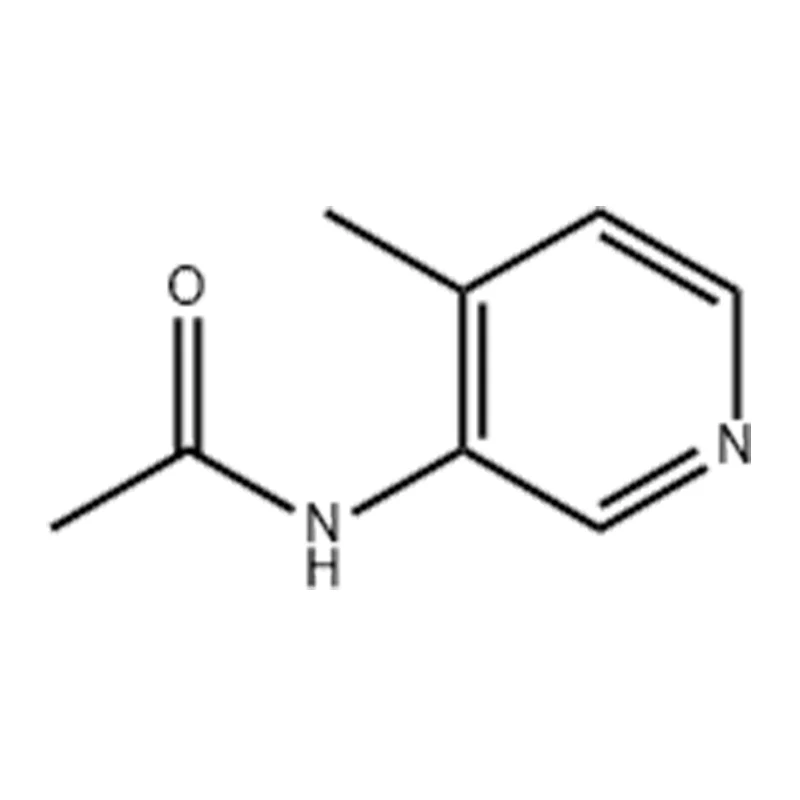
N-(4-methylpyridin-3-yl)acetamide (CAS 52090-68-3), also known as 3-acetamido-4-picoline or 3-acetylamino-4-methylpyridine, is a pyridine-based acetamide that serves as a key pharmaceutical intermediate and reference standard for drug quality control. It is a derivative of pyridine — a basic heterocyclic organic compound — and is recognized for its applications across chemistry, biology, and pharmaceutical research.
In drug development, N-(4-methylpyridin-3-yl)acetamide has been identified as a significant impurity in the manufacturing process of the Janus kinase inhibitor tofacitinib (brand name Xeljanz). Specifically, it is listed as “Tofacitinib Impurity 96” or “Tofacitinib Impurity 189,” and is used as a pharmaceutical impurity reference standard to monitor and control product quality during API manufacturing.
Beyond quality control applications, N-(4-methylpyridin-3-yl)acetamide serves as a versatile building block in organic synthesis. Its amide group can undergo reduction to yield the corresponding primary amine, while the pyridine ring can participate in electrophilic and nucleophilic substitution reactions, enabling access to more complex molecular architectures. The compound has also been registered in the FDA Global Substance Registration System under the Unique Ingredient Identifier FT569P66XQ, underscoring its regulatory relevance in pharmaceutical science.
|
Advantage |
Detail |
|
Production Strength |
GMP-certified campus spanning 100+ mu, 3 multi-purpose workshops, 6 D-grade clean zone production lines, and 150+ reactors (20L–5000L), supporting high/low temp, anaerobic & hydrogenation; kg to ton scale production. |
|
Fast Delivery |
R&D samples: one week; commercial orders: 1–2 months after payment. Express (DHL/FedEx) or air/sea freight available. |
|
Global Partners |
Trusted by 30+ pharmaceutical companies in USA, Europe, India, Brazil, and Southeast Asia; long-term cooperation with generic drug manufacturers, CROs, and impurity standard distributors. |
|
Licensed Exporter |
Valid drug import/export license — no compliance delays. |
|
Dual Quality Grades |
Both research/pharma grade(≥98%)and high-purity impurity grade(≥99%)available to meet diverse customer needs. |
1.Pharmaceutical impurity reference – Recognized as a tofacitinib impurity (Impurity 96 / Impurity 189), this compound is an essential quality control standard for generic drug manufacturers and API producers.
2.FDA-registered substance – The compound carries a UNII (Unique Ingredient Identifier) of FT569P66XQ in the FDA Global Substance Registration System, confirming its regulatory relevance.
3.High-purity reference standards – High-purity grades (≥99.54%) with traceable characterization (NMR, MS, HPLC) are available for precise analytical method validation.
4.Versatile synthetic building block – The amide group can be reduced to the primary amine (4-methylpyridin-3-amine), and the pyridine ring supports electrophilic/nucleophilic substitution for diverse derivatization.
5.Potential biological activity – Preliminary studies suggest antimicrobial properties against both Gram-positive and Gram-negative bacterial strains, as well as anti-inflammatory effects through modulation of inflammatory pathways.
6.Cytotoxicity potential – In vitro studies have shown that at 10 µM concentration, the compound inhibits 35% of PC-3 cells, 38% of MCF-7 cells, and 32% of A549 cells, indicating potential anticancer activity amenable to structural optimization.
7. Clean synthetic profile – The one-step acetylation of 3-amino-4-methylpyridine with acetic anhydride offers high yields and a straightforward purification process.
A: It is primarily used as a pharmaceutical impurity reference standard for tofacitinib (a Janus kinase inhibitor used to treat rheumatoid arthritis). It is also a versatile building block in organic synthesis and is being investigated for antimicrobial and anticancer activities.
A: It is recognized as Tofacitinib Impurity 96 (XL-TFTN29) and Tofacitinib Impurity 189, making it an essential quality control standard for tofacitinib API manufacturing.
Get in touch with Cosperpharm.Need a reliable source for N-(4-methylpyridin-3-yl)acetamide? We’re ready to support your research and production needs.
Address
No. 2 Yangguang 3rd Road, Duodao Chemical Cycle Industrial Park, Jingmen City, Hubei Province, China
Tel

![1-[2,3-Bis[(9Z,12Z)-octadeca-9,12-dien-1-yloxy]propyl]pyrrolidine](https://www.cosperpharma.com/upload/8820/1-2-3-bis-9z-12z-octadeca-9-12-dien-1-yloxy-propyl-pyrrolidine-349384.webp "1-[2,3-Bis[(9Z,12Z)-octadeca-9,12-dien-1-yloxy]propyl]pyrrolidine")
![1,2,4-Triazolo[4,3-a]pyridin-3(2H)-one](https://www.cosperpharma.com/upload/8820/1-2-4-triazolo-4-3-a-pyridin-3-2h-one-440735.webp "1,2,4-Triazolo[4,3-a]pyridin-3(2H)-one")