
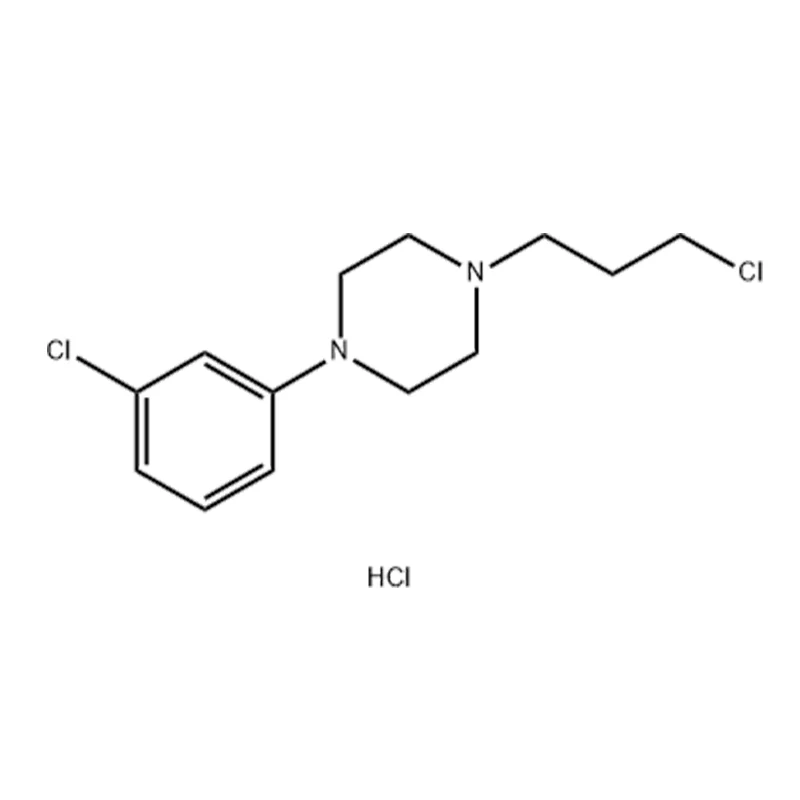
1-(3-Chlorophenyl)-4-(3-chloropropyl)piperazine hydrochloride is a critical pharmaceutical intermediate and process-related impurity widely utilized in the preparation of the antidepressant trazodone, as well as nefazodone and other CNS-active agents . As an arylpiperazine compound, 1-(3-Chlorophenyl)-4-(3-chloropropyl)piperazine hydrochloride functions as the alkylating precursor that delivers the 3-chloropropyl side chain to heterocyclic cores such as the triazolopyridinone scaffold of trazodone or the chlorophenylpiperazine unit of nefazodone. In regulatory contexts, 1-(3-Chlorophenyl)-4-(3-chloropropyl)piperazine hydrochloride is officially designated as Trazodone Impurity F in European Pharmacopoeia standards and as Nefazodone Related Compound A, serving as a mandatory reference standard for API quality control and forced degradation studies . The hydrochloride salt form of 1-(3-Chlorophenyl)-4-(3-chloropropyl)piperazine hydrochloride ensures convenient handling, with aqueous solubility enabling its use in receptor binding assays for 5-HT1A and 5-HT2A ligand screening, as well as analytical HPLC method validation for trazodone drug substance manufacturers worldwide.
|
Parameter |
Specification |
|
CAS Number |
52605-52-4 |
|
Molecular Formula |
C₁₃H₁₉Cl₃N₂ |
|
Molecular Weight |
309.66 g/mol |
|
Purity (HPLC) |
≥98% (standard); ≥97% min. available |
|
Appearance |
White to off-white powder to crystalline solid |
|
Boiling Point |
147 °C at 101,325 Pa |
|
Flash Point |
193.2 °C |
|
Vapor Pressure |
0 Pa at 25 °C |
|
Water Solubility |
3.9 g/L at 28 °C |
|
Solubility |
Slightly soluble in DMSO (with heating) and methanol (with heating) |
|
LogP (free base) |
0.301 at 28℃ |
|
Stability |
Stable under recommended conditions |
|
Storage Condition |
2–8 °C, sealed, dry, under inert atmosphere |
H315: Causes skin irritation.
H319: Causes serious eye irritation.
H335: May cause respiratory tract irritation.
H302: Harmful if swallowed (varies by formulation).
R20/21/22: Harmful by inhalation, in contact with skin, and if swallowed.
P261: Avoid breathing dust.
P264: Wash skin thoroughly after handling.
P280: Wear protective gloves / eye protection / face protection.
P305+P351+P338: IF IN EYES — rinse cautiously with water for several minutes, remove contact lenses if present, continue rinsing.
P302+P352: IF ON SKIN — wash with plenty of water.
P332+P313: If skin irritation occurs — get medical advice/attention.
P337+P313: If eye irritation persists — get medical advice/attention.
P362+P364: Take off contaminated clothing and wash before reuse.
S26: In case of contact with eyes, rinse immediately with plenty of water and seek medical advice.
S37/39: Wear suitable gloves and eye/face protection.
S24/25: Avoid contact with skin and eyes.
Cosperpharm maintains a rigorous quality assurance system for 1-(3-Chlorophenyl)-4-(3-chloropropyl)piperazine hydrochloride that meets the expectations of both pharmaceutical intermediate manufacturing and reference standard applications:
Each batch undergoes testing against established specifications: HPLC purity (≥98% for commercial grade; ≥97% for reference grade), melting point (198–203 °C, lit.), water content (Karl Fischer), residual solvent analysis (GC), and appearance verification (white to off-white powder). Where applicable, LC-MS confirmation of molecular identity is provided. Physical form verification ensures the material is crystalline powder — not oil — as required for consistent handling.
From raw material procurement (1-(3-chlorophenyl)piperazine and 1-bromo-3-chloropropane sourced from qualified suppliers) through alkylation, salt formation, crystallization, drying, and final packaging, every step is documented and fully traceable. Each batch receives a unique lot number with retention samples maintained in accordance with Cosperpharm quality procedures.
Ongoing stability studies under ICH-recommended conditions (long-term storage at 2–8 °C; accelerated at 25 °C/60% RH or 40 °C/75% RH as applicable) are conducted on representative batches. Stability summaries are updated regularly, with full data packages available to support customer regulatory submissions.
Every shipment includes a Certificate of Analysis (COA) with batch-specific purity and physical data. For customers requiring reference material certification for ANDA filings, Cosperpharm provides DMF-ready documentation packages, method validation reports, stability data, and custom quality agreements upon request. Documentation for USP and Ph. Eur. standards alignment is available.
Qualified customers are welcome to audit Cosperpharm‘s manufacturing and quality control facilities. Please contact our regulatory team to schedule an audit. ISO certification and compliance documentation are available upon request.
This compound is the essential alkylating intermediate for trazodone synthesis. The 3-chloropropyl chain is delivered to the 1,2,4-triazolo[4,3-a]pyridin-3(2H)-one core via nucleophilic substitution, establishing the N-2 alkylated product that yields trazodone after final elaboration. Cosperpharm supplies this intermediate to generic manufacturers and CMOs producing the finished API.
In nefazodone synthesis, this compound serves as the precursor to the 3-chloropropylpiperazine side chain, which undergoes subsequent coupling reactions to assemble the full molecular architecture.
Officially designated as Trazodone Impurity F (Ph. Eur.), this compound is a mandatory reference standard for impurity profiling, quality control testing (QC), and stability monitoring of trazodone drug substance and drug product. ANDA filers require this reference standard for regulatory submission.
The compound is also recognized as Nefazodone Related Compound A, serving an identical reference standard function for nefazodone hydrochloride API quality programs.
Analytical method development for HPLC/UPLC purity testing of trazodone API requires this impurity standard for method validation, specificity studies, LOD/LOQ determinations, and system suitability testing. Also used for TLC method development.
Used as an impurity marker in forced degradation studies (oxidative, thermal, photolytic, hydrolytic stress) to confirm stability-indicating power of analytical methods and to monitor impurity formation pathways during stress conditions.
Investigated for binding affinity at 5-HT1A and 5-HT2A serotonin receptors (sub-nanomolar to low nanomolar Ki values for optimized derivatives). The parent structure is also metabolized in vivo to 1-(m-chlorophenyl)piperazine (mCPP), a pharmacologically active metabolite responsible for some serotonergic effects of trazodone.
The terminal chlorine on the propyl chain undergoes nucleophilic substitution with amines, thiols, azides, and alkoxides, enabling construction of diverse piperazine-based compound libraries for CNS drug discovery. The compound is particularly valuable for generating novel 5-HT2C ligands and related serotonin receptor modulators.
Pharmaceutical process chemists use this intermediate for reaction optimization, impurity fate mapping, and commercial manufacturing route development. Cosperpharm provides characterization data and process support for seamless scale-up.
Getting 1-(3-Chlorophenyl)-4-(3-chloropropyl)piperazine hydrochloride into your lab or production line is straightforward.
Address
No. 2 Yangguang 3rd Road, Duodao Chemical Cycle Industrial Park, Jingmen City, Hubei Province, China
Tel


![1-[2,3-Bis[(9Z,12Z)-octadeca-9,12-dien-1-yloxy]propyl]pyrrolidine](https://www.cosperpharma.com/upload/8820/1-2-3-bis-9z-12z-octadeca-9-12-dien-1-yloxy-propyl-pyrrolidine-349384.webp "1-[2,3-Bis[(9Z,12Z)-octadeca-9,12-dien-1-yloxy]propyl]pyrrolidine")
![1,2,4-Triazolo[4,3-a]pyridin-3(2H)-one](https://www.cosperpharma.com/upload/8820/1-2-4-triazolo-4-3-a-pyridin-3-2h-one-440735.webp "1,2,4-Triazolo[4,3-a]pyridin-3(2H)-one")