
Project Introduction
On December 24,2020, the U.S. Food and Drug Administration (FDA) approved Vibeoglon for the treatment of patients with urge urinary incontinence (UUI), as well as those with overactive bladder (OAB) characterized by urinary urgency and frequency. This drug is a small-molecule β3-adrenergic receptor agonist that helps relax the detrusor muscle, enabling the bladder to hold more urine and thereby alleviating OAB symptoms.
Vibegron Molecular Formula: C26H28N4O3,Molecular Weight:444.53
CAS:1190389-15-1
IUPAC name:(S)-N-(4-(((2S,5R)-5-((R)-hydroxy(phenyl)methyl)pyrrolidin-2-yl)methyl)phenyl)-4-oxo-4,6,7,8-tetrahydropyrrolo[1,2-a]pyrimidine-6-carboxamide。
Synthetic Route
In 2018, Merck reported the synthetic route for Vibeiglon, which employs dynamic kinetic resolution (DKR) to efficiently produce chiral amino alcohols. For example, in the presence of a racemizing agent (such as a ruthenium catalyst), the ketone is enzymatically reduced to an alcohol, while the unreacted ketone undergoes continuous racemization until all ketones are converted into single-enantiomer alcohols, achieving a theoretical yield of 100%.
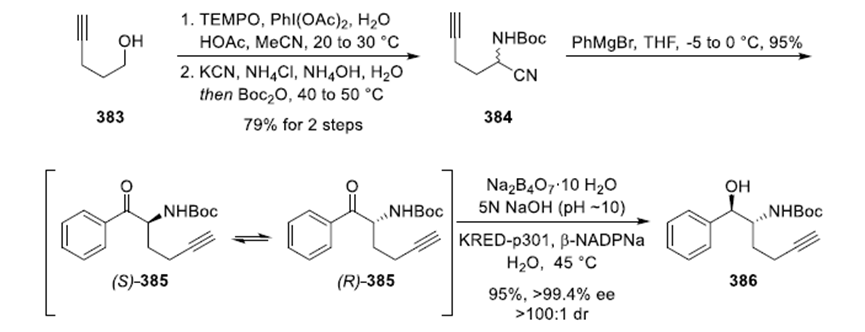
Step 1: The tetramethoxypiperidine oxide oxidizes the alcohol to an aldehyde, which is then subjected to the Strecker reaction followed by Boc protection to yield a racemic amino nitrile.
Strecker reaction: ① Condensation of aldehyde/ketone with amine: First, the aldehyde or ketone reacts with an amine to form an imine; ② Reaction with a cyanoforming reagent: The resulting imine then reacts with a cyanoforming reagent to produce α-aminoacyl chloride.
Step 2: The racemic ketone is obtained by reaction of Grignard reagent with a cyano group.
Step 3: This step involves dynamic kinetic cleavage, utilizing ketoreductase (KRED-p301) to convert (R)-385 into an amino alcohol, with a reaction yield of 95% and an enantioselectivity (ee) of up to 99.4%.
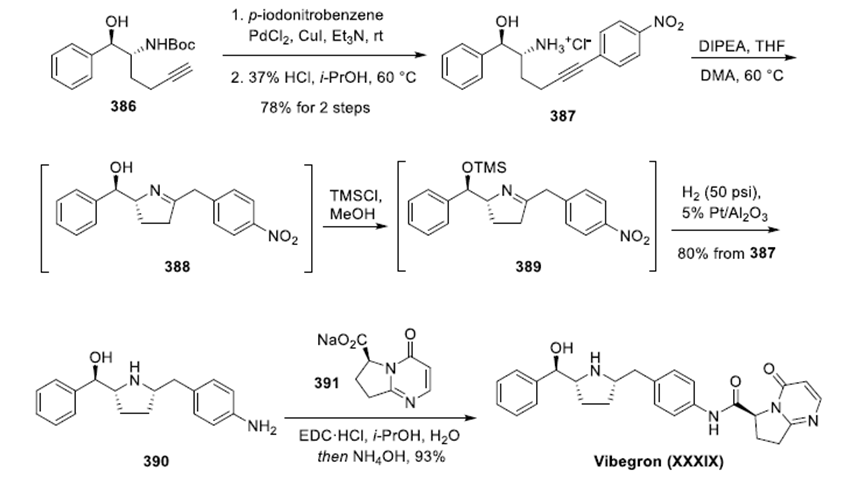
Step 4: Sonagashira Coupling
Step 5: Intramolecular ring formation under alkaline conditions, yielding crude pyrrolidine alcohol
Step 6: TMS protects the hydroxyl group to form a siloxane ether, followed by hydrogenation (during this step, the sterically hindered siloxane ether ensures excellent selectivity for imine reduction, with a yield of 95:5).
Step 7: Formation of the amide bond, yielding Vebeglong with a yield of 93%.
References
[1] Xu, F.; Kosjek, B.; Cabirol, F. L.; Chen, H.; Desmond, R.; Park, J.; Gohel, A. P.; Alvizo, O. Synthesis of Vibegron Enabled by a Ketoreductase Rationally Designed for High Ph Dynamic Kinetic Reduction. Angew. Chem., Int. Ed. 2018, 57, 6863−6867.
[2] Edmondson, S. D.; Zhu, C.; Kar, N. F.; Di Salvo, J.; Nagabukuro, H.; Sacre-Salem, B.; et al. Discovery of Vibegron: A Potent and Selective B3 Adrenergic Receptor Agonist for the Treatment of Overactive Bladder. J. Med. Chem. 2016, 59, 609−623.