
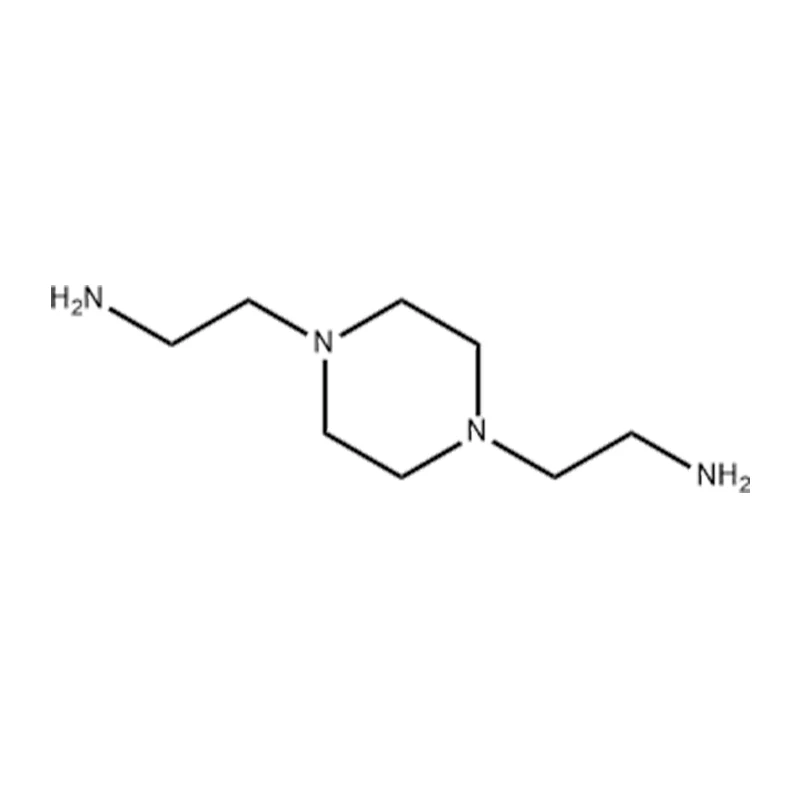
1,4-bis(2-aminoethyl)piperazine is a high-purity chemical intermediate and research reagent widely employed as a building block in medicinal chemistry, polymer science, and materials research. In drug discovery, 1,4-bis(2-aminoethyl)piperazine serves as a critical precursor, with its primary amine groups enabling facile conjugation to pharmacophores—a strategy employed in the synthesis of bis-thiazolone derivatives as CDC25 phosphatase inhibitors and bisnaphthalimides as DNA topoisomerase II inhibitors . Beyond pharmaceuticals, 1,4-bis(2-aminoethyl)piperazine functions as an effective amine cross-linker or chain extender in the production of epoxy curing agents and polyurea coatings, where its tetra-functionality creates high-density polymer networks. Supplied as a low-melting solid at ambient temperature with storage under inert gas, 1,4-bis(2-aminoethyl)piperazine offers the purity and stability essential for reproducible synthetic transformations across research and process development scales.
|
Parameter |
Specification |
|
Product Name |
1,4-bis(2-aminoethyl)piperazine |
|
CAS Number |
6531-38-0 |
|
Molecular Formula |
C8H20N4 |
|
Molecular Weight |
172.27 g/mol |
|
Purity |
≥95% (typical) |
|
Physical Form |
Solid (low-melting) |
|
Melting Point |
40 °C |
|
Boiling Point |
130 °C (at 12 Torr); 302.2 °C at 760 mmHg (estimated) |
|
Density |
0.9675 g/cm³ (Temp: 25 °C) |
|
pKa |
10.41 ± 0.10 (Predicted) |
|
Storage Condition |
Under inert gas (nitrogen or argon) at 2–8°C, protected from light |
|
Category |
Information |
|
GHS Classification |
Skin Corrosion/Irritation Category 1 (H314) |
|
Signal Word |
Danger |
|
Hazard Statements |
Causes severe skin burns and eye damage. Causes burns.Risk of serious damage to eyes. |
|
Precautionary Statements |
Wear protective gloves/protective clothing/eye protection/face protection. IF IN EYES: Rinse cautiously with water for several minutes. Remove contact lenses if present. Immediately call a POISON CENTER/doctor. |
|
Transport Information |
UN 1760 (Corrosive liquid, n.o.s.), Class 8, PG II |
|
GHS Pictograms |
GHS05 (Corrosion) |
This compound carries multiple hazard classifications:
|
Hazard Category |
Classification |
|
Eye irritation |
Category 2 (causes serious eye irritation) |
|
Skin irritation |
Category 2 (causes skin irritation) |
|
Skin sensitization |
Category 1 (may cause allergic skin reaction) |
|
STOT-SE |
Category 3 (may cause respiratory irritation) |
|
Storage class |
11 – Combustible solid |
● Eyes: Safety goggles (mandatory).
● Skin: Chemical-resistant gloves (nitrile). If you have a history of skin allergies, take extra precautions due to skin sensitizer classification.
● Respiratory: Use in a fume hood. Avoid breathing dust.
● First aid:
1. Eye contact – rinse with water for 15 min (S26).
2. Skin contact – wash with soap and water. If rash or irritation develops, seek medical advice (skin sensitizer).
3. Inhalation – move to fresh air.
● Storage: Keep container tightly sealed in a dry place at room temperature. Store away from ignition sources (combustible solid). Avoid contact with strong mineral acids (releases irritating free monoester).
● Disposal: Collect as chemical waste. WGK 1 indicates low water hazard, but best practice is not to flush down drains.
The industrial synthesis of 1,4-bis(2-aminoethyl)piperazine commonly proceeds via the alkylation of piperazine. A standard method involves reacting piperazine with ethylene oxide or ethylene dichloride under controlled temperature and pressure . Alternatively, the reaction of piperazine with aziridine or a protected 2-bromoethylamine equivalent can yield the desired bis-adduct. These processes typically target symmetrical N,N'-disubstitution and are followed by distillation or recrystallization to achieve high purity. Cosperpharm employs optimized, scalable routes with rigorous purification to ensure minimal contamination by mono-substituted byproducts or piperazine oligomers.
Your next breakthrough in anticancer research, polymer innovation, or materials chemistry can begin with a reliable source of 1,4-bis(2-aminoethyl)piperazine. Connect with Cosperpharm to explore how we can support your project with high-quality specialty amines.
Address
No. 2 Yangguang 3rd Road, Duodao Chemical Cycle Industrial Park, Jingmen City, Hubei Province, China
Tel


![1-[2,3-Bis[(9Z,12Z)-octadeca-9,12-dien-1-yloxy]propyl]pyrrolidine](https://www.cosperpharma.com/upload/8820/1-2-3-bis-9z-12z-octadeca-9-12-dien-1-yloxy-propyl-pyrrolidine-349384.webp "1-[2,3-Bis[(9Z,12Z)-octadeca-9,12-dien-1-yloxy]propyl]pyrrolidine")
![1,2,4-Triazolo[4,3-a]pyridin-3(2H)-one](https://www.cosperpharma.com/upload/8820/1-2-4-triazolo-4-3-a-pyridin-3-2h-one-440735.webp "1,2,4-Triazolo[4,3-a]pyridin-3(2H)-one")