
News

Biocatalytic cascades enable the manufacturing of the macrocyclic peptide Enlicitide

2026-05-21 0 Leave me a message
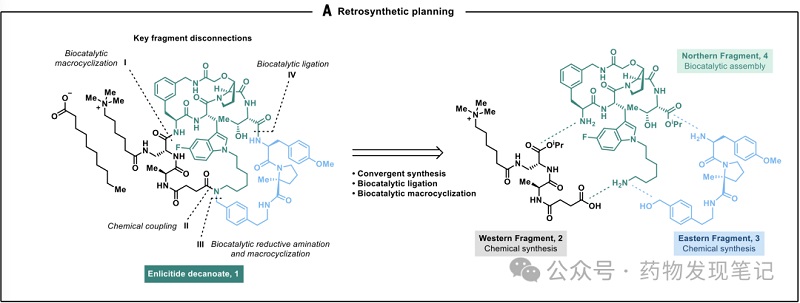
MSD’s investigational oral PCSK9 inhibitor, enlicitide decanoate (MK-0616), is the first oral macrocyclic peptide PCSK9 inhibitor to demonstrate substantial LDL-C lowering in humans. Enlicitide was developed from an mRNA display screen of monocyclic peptides and subsequently stabilized through nonpeptidic cross-links to generate a structure comprising three fused macrocycles. This complex octapeptide contains six unnatural and two proteinogenic amino acids connected by 12 amide bonds and a central, six-carbon chain linker. Traditional chemical synthesis requires 43 steps, protecting-group manipulations (nearly half of the synthetic steps), chromatographic purifications, and a highly dilute ruthenium-catalyzed ring-closure metathesis step, limiting scalability and sustainability.

Chemoenzymatic Manufacturing Development

The MSD scientists developed a concise and convergent chemoenzymatic process to manufacture enlicitide decanoate (1) enabled by the direct coupling of monomers by amino acid ligases, combined with biocatalytic peptide fragment ligation and macrocyclizations using esterases and imine reductases.

Key Achievements

Three-enzyme cascade assembly using ATP-grasp ligases

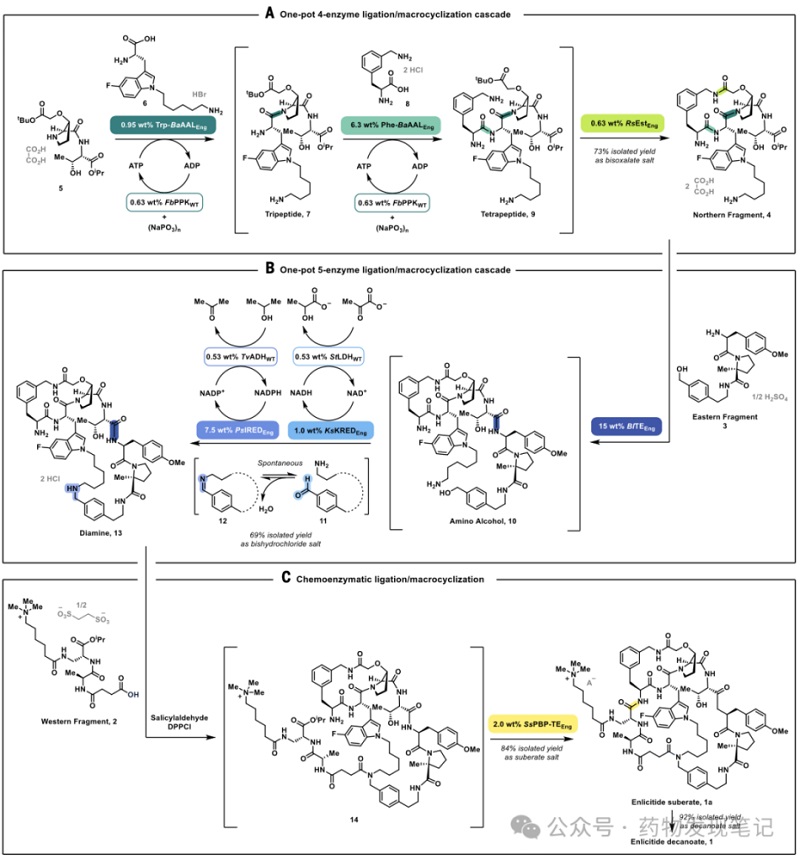
- Three-enzyme cascade (two engineered ATP-grasp ligases + ATP recycling) assembles a tetrapeptide from unprotected amino acids. ATP-grasp ligases (specifically ATP-dependent amino acid ligases, AALs) are enzymes that catalyze amide bond formation between unprotected amino acids or peptides using ATP as an energy source. Their mechanism proceeds through a mixed anhydride intermediate, which allows direct coupling without needing protecting groups on the nucleophilic amine or activated acyl donors. In this study, the researchers used an ATP-grasp ligase from Bifidobacterium adolescentis (BaAAL) and engineered variants (Trp-BaAALEng and Phe-BaAALEng) to selectively extend a dipeptide with two non-natural amino acids (tryptophan and phenylalanine analogs) in a one-pot cascade. These ligases have a narrow, buried electrophile pocket that accepts single amino acids as electrophiles (C-terminal substrates) but can accommodate longer peptides as N-nucleophiles. This selectivity makes them ideal for sequential, protecting-group-free peptide assembly from the C-terminus to the N-terminus. The ATP consumed is recycled using a polyphosphate kinase (FbPPKWT) with inexpensive hexametaphosphate as the phosphate donor.

Engineered esterase (RsEstEng) regioselective macrolactamization

- Engineered esterase (RsEstEng) catalyzes regioselective macrolactamization to form the Northern fragment (73% yield, 52-kg scale). RsEstEng is derived from a wild-type carboxylesterase (RsEst) identified from Roseibacillus sp. Its native function is hydrolysis of ester bonds. Through directed evolution, the researchers converted it into a catalyst for regioselective macrolactamization – the formation of a macrocyclic amide bond – in the synthesis of the Northern fragment (4) of enlicitide. It accepts the stable, bulky tert-butyl ester of the linear tetrapeptide (9) as the acyl donor to produce the macrocyclic peptide (4) to form an intramolecular amide bond. It achieved selective cyclization with no detectable oligomers and only 0.8% ester hydrolysis byproduct, even under the high ionic strength conditions from the prior enzymatic cascade.

Engineered thioesterase (BlTEEng) intermolecular ligation

- Engineered thioesterase (BlTEEng) performs intermolecular ligation of Northern (4) and Eastern fragments (3) without epimerization. BlTEEng is a modified version of a thioesterase (TE) domain originally excised from the nonribosomal peptide synthetase (NRPS) of Brevibacillus laterosporus (BlTE). Wild-type thioesterases in NRPS systems typically catalyze macrocyclization or release of linear peptides from a carrier protein via a thioester bond. The engineered variants of BlTE showed some activity but favored a dimeric byproducts. Enzyme engineering shifted the enzyme to catalyze intermolecular ligation using more stable isopropyl oxoesters instead of the natural, hydrolytically labile thioesters.

Four-enzyme cascade reductive amination macrocyclization

- Four-enzyme cascade (PsIREDEng, KsKREDEng, and cofactor recycling enzymes StLDHWT, TvADHWT) achieves reductive amination macrocyclization to form a bicyclic diamine (69% yield, 46-kg scale). KsKREDEng is an engineered ketoreductase from Kyrpidia sp. It catalyzes the oxidation of a benzylic alcohol compound (10) to a transient aldehyde (11) dependent on NAD+. PsIRED is an imine reductase from Pseudogymnoascus sp. It is NADPHdependent. PsIREDEng catalyzes the reductive amination of the aldehyde (11) and the existing amine to form the cyclic imine (12), followed by reduction to the secondary amine macrocycle (13). StLDHWT regenerates NAD+ for the oxidative step by reducing pyruvate to lactate, while TvADHWT regenerates NADPH for the reductive step by oxidizing isopropanol to acetone.

Final macrocyclization via engineered PBP thioesterase

- Chemical coupling with the Western fragment (2), followed by engineered penicillin-binding protein thioesterase (SsPBP-TEEng), closes the final macrocycle at high concentration (70 g/L) – overcoming the typical dilution limitation (5 g/L in traditional synthesis). The overall process includes three cascade steps, 7 engineered + 3 auxiliary enzymes, 39% overall yield, multikilogram-scale demonstration, >99% purity, no chromatography, and no protecting groups. This work provides a sustainable, scalable blueprint for manufacturing complex macrocyclic peptides, dramatically reducing step count and waste while improving efficiency and patient access.
Related News
Leave me a message
X
We use cookies to offer you a better browsing experience, analyze site traffic and personalize content. By using this site, you agree to our use of cookies. Privacy Policy
Reject Accept