
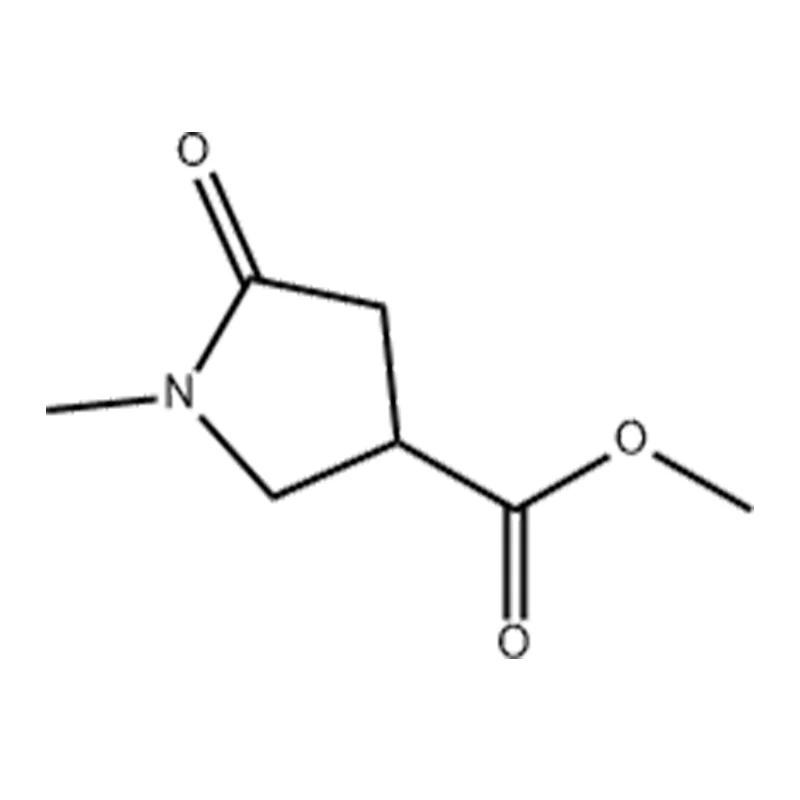
1-Methyl-5-oxo-3-pyrrolidinecarboxylic acid methyl ester (CAS 59857-86-2) is a versatile organic building block that has gained significant attention as a multifunctional intermediate in pharmaceutical R&D, drug discovery, and heterocyclic chemistry. As a fragment molecule, Methyl 1-methyl-5-oxopyrrolidine-3-carboxylate serves as a key scaffold for molecular splicing, expansion, and modification, and provides a structural foundation for the design and screening of new drug candidates.
In medicinal chemistry, 1-Methyl-5-oxo-3-pyrrolidinecarboxylic acid methyl ester as a structural anchor for developing drug-like molecules targeting intractable diseases. This compound has been incorporated into transdermal patches for ondansetron delivery, indicating its utility in pharmaceutical formulations aimed at treating chemotherapy-induced nausea, and has shown activity in bromodomain studies, binding to the active site of bromodomain 1 and inhibiting the activity of acetamide, a potent bromodomain 1 inhibitor [2†L6-L9]. Furthermore, Methyl 1-methyl-5-oxopyrrolidine-3-carboxylate has demonstrated broad-spectrum biological potential, including antioxidant properties that protect cells from oxidative stress, neuroprotective effects for conditions like Alzheimer’s disease, and significant anticancer activity via its derivatives against A549 lung adenocarcinoma cells, showing structure-dependent anticancer activity when tested using MTT assays .
In the broader field of organic synthesis, 1-Methyl-5-oxo-3-pyrrolidinecarboxylic acid methyl ester as a vital intermediate in the production of pharmaceuticals, agrochemicals, and specialty chemicals.
|
Parameter |
Specification |
|
CAS Number |
59857-86-2 |
|
IUPAC Name |
methyl 1-methyl-5-oxopyrrolidine-3-carboxylate |
|
Synonyms |
1-Methyl-5-oxo-3-pyrrolidinecarboxylic acid methyl ester; 1-Methyl-5-oxopyrrolidine-3-carboxylic acid methyl ester; 1-Methyl-4-methoxycarbonyl-2-pyrrolidone; 3-Pyrrolidinecarboxylic acid, 1-methyl-5-oxo-, methyl ester |
|
Molecular Formula |
C₇H₁₁NO₃ |
|
Molecular Weight |
157.17 g/mol |
|
Purity |
≥98% by GC (≥95% standard grade also available) |
|
Appearance |
Colorless to pale-yellow liquid |
|
Melting Point |
15 °C |
|
Boiling Point |
160–161 °C (Press: 18 Torr) |
|
Density |
1.173 ± 0.06 g/cm³ (Predicted) |
|
Flash Point |
Not determined |
|
pKa |
-1.79 ± 0.40 (Predicted) |
|
Canonical SMILES |
CN1CC(CC1=O)C(=O)OC |
|
UNII |
Not publicly available |
|
XLogP3-AA |
-0.7 |
|
Storage Condition |
Sealed in dry, 2–8°C (refrigerated), inert atmosphere recommended |
|
HS Code |
2933998090 |
|
Advantage |
Detail |
|
Production Strength |
GMP-certified campus spanning 100+ mu, 3 multi-purpose workshops, 6 D-grade clean zone production lines, and 150+ reactors (20L–5000L), supporting high/low temp, anaerobic & hydrogenation; kg to ton scale production. |
|
Fast Delivery |
R&D samples: one week; commercial orders: 1–2 months after payment. Express (DHL/FedEx) or air/sea freight available. |
|
Global Partners |
Trusted by 30+ pharmaceutical companies in USA, Europe, India, Brazil, and Southeast Asia; long-term cooperation with generic drug manufacturers, CROs, and impurity standard distributors. |
|
Licensed Exporter |
Valid drug import/export license — no compliance delays. |
|
Dual Quality Grades |
Both research/pharma grade(≥98%)and high-purity impurity grade(≥99%)available to meet diverse customer needs. |
The synthesis of Methyl 1-methyl-5-oxopyrrolidine-3-carboxylate is well-established and can be accomplished via the following documented approaches:
Synthesize the corresponding carboxylic acid via cyclization of appropriate precursors, then esterify with methanol using a strong acid catalyst (e.g., H₂SO₄) or a coupling reagent (e.g., DCC).
React dimethyl itaconate (fumarate ester derivative) with methylamine; cyclization proceeds via Michael addition and amidation to provide Methyl 1-methyl-5-oxopyrrolidine-3-carboxylate in approximately 92% yield.
Industrial production often adopts continuous flow reactors with automated systems to optimize reaction temperature, pressure, and catalyst use, ensuring consistent product quality and yield. The final purification is typically achieved through distillation under reduced pressure (160–161 °C at 18 Torr) or recrystallization.
A: It is primarily used as a fragment scaffold in drug discovery, enabling molecular splicing and expansion for designing novel drug candidates. It also has applications in transdermal formulations, bromodomain research, antioxidant studies, and antimicrobial development.
A: This compound exhibits antioxidant activity (protects cells from oxidative stress), neuroprotective effects (potential for neurodegenerative diseases like Alzheimer’s), anticancer activity (significant cytotoxicity against A549 lung adenocarcinoma cells), and antimicrobial properties against Gram-positive bacteria and drug-resistant fungal strains.
Let‘s discuss how Cosperpharm can support your next project.Thank you for considering Cosperpharm as your trusted partner for Methyl 1-methyl-5-oxopyrrolidine-3-carboxylate (CAS 59857-86-2). We look forward to hearing from you and providing the quality products and responsive service you deserve.
Address
No. 2 Yangguang 3rd Road, Duodao Chemical Cycle Industrial Park, Jingmen City, Hubei Province, China
Tel

![1-[2,3-Bis[(9Z,12Z)-octadeca-9,12-dien-1-yloxy]propyl]pyrrolidine](https://www.cosperpharma.com/upload/8820/1-2-3-bis-9z-12z-octadeca-9-12-dien-1-yloxy-propyl-pyrrolidine-349384.webp "1-[2,3-Bis[(9Z,12Z)-octadeca-9,12-dien-1-yloxy]propyl]pyrrolidine")
![1,2,4-Triazolo[4,3-a]pyridin-3(2H)-one](https://www.cosperpharma.com/upload/8820/1-2-4-triazolo-4-3-a-pyridin-3-2h-one-440735.webp "1,2,4-Triazolo[4,3-a]pyridin-3(2H)-one")