
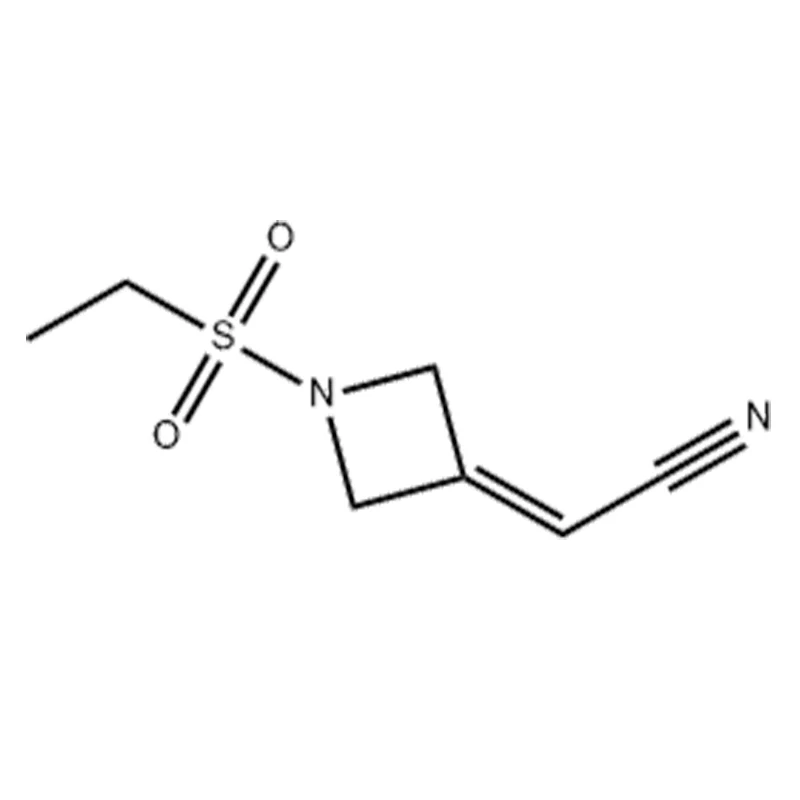
2-(1-(Ethylsulfonyl)azetidin-3-ylidene)acetonitrile is a pivotal pharmaceutical intermediate and process-related impurity in the industrial synthesis of baricitinib (Olumiant®), a selective oral inhibitor of Janus kinase 1 (JAK1) and JAK2 approved for the treatment of rheumatoid arthritis, atopic dermatitis, and alopecia areata . In the baricitinib manufacturing route, 2-(1-(Ethylsulfonyl)azetidin-3-ylidene)acetonitrile undergoes conjugate addition with a pyrazole-containing nucleophile to install the azetidine side chain that is essential for JAK binding affinity and selectivity. As the key Michael addition partner, 2-(1-(Ethylsulfonyl)azetidin-3-ylidene)acetonitrile thus represents the chemical gateway that brings the azetidine ring system into the baricitinib molecular framework, a transformation that has been optimized for industrial scale-up using green and cost-effective synthetic routes. In regulatory contexts, 2-(1-(Ethylsulfonyl)azetidin-3-ylidene)acetonitrile is officially designated as baricitinib impurity A, baricitinib impurity 20, and baricitinib impurity 93 across multiple pharmacopeial and commercial reference standard catalogs, making it an essential reference material for analytical method development, method validation (AMV), quality control (QC) testing, forced degradation studies, and Abbreviated New Drug Application (ANDA) filings for generic baricitinib manufacturers.
|
Parameter |
Specification |
|
CAS Number |
1187595-85-2 |
|
Molecular Formula |
C₇H₁₀N₂O₂S |
|
Molecular Weight |
186.23 g/mol |
|
Purity (HPLC) |
≥98% (industrial grade); ≥95% (reference standard grade) |
|
Physical Form |
Solid |
|
Appearance |
Off-white to pale yellow crystalline solid |
|
Melting Point |
67–69 °C |
|
Boiling Point |
360.8 ± 52.0 °C (Predicted) |
|
Density |
1.33 ± 0.1 g/cm³ (Predicted) |
|
pKa |
−8.49 ± 0.20 (Predicted) |
|
Solubility |
Slightly soluble in DMSO, slightly soluble in methanol |
|
Stability |
Stable under recommended conditions |
|
Storage Condition |
Sealed in dry, room temperature, protected from light |

The synthesis of 2-(1-(Ethylsulfonyl)azetidin-3-ylidene)acetonitrile proceeds via a three‑step sequence starting from tert‑butyl 3‑oxoazetidine‑1‑carboxylate. The key transformations include Horner–Wittig (or Horner–Emmons) reaction to install the exocyclic nitrile‑alkene, deprotection of the N‑Boc group under acidic conditions, and final sulfonamidation with ethanesulfonyl chloride.
A solution of diethyl cyanomethylphosphonate is deprotonated with a suitable base (e.g., sodium hydride, potassium tert‑butoxide) in an aprotic solvent such as THF or DMF. tert‑Butyl 3‑oxoazetidine‑1‑carboxylate is added, and the reaction mixture is stirred to allow formation of the exocyclic double bond via Horner–Emmons olefination, yielding tert‑butyl 3‑(cyanomethylene)azetidine‑1‑carboxylate.
A solution of tert‑butyl 3‑(cyanomethylene)azetidine‑1‑carboxylate in acetonitrile and 3 N aqueous HCl solution is stirred at room temperature for 18 hours to effect removal of the Boc protecting group, giving the free azetidine intermediate as the hydrochloride salt.
At 0 °C to 10 °C, add N,N‑diisopropylethylamine (4.5 mL) to a solution of 3‑(cyanomethylene)azetidine hydrochloride (1.5 g) in acetonitrile (50 mL). Stir for 10 minutes. Then, add ethanesulfonyl chloride (2.22 g) dropwise over 5 minutes while maintaining the temperature between 0 °C and 5 °C. Warm the reaction mixture slowly to 20–25 °C and stir for 16 hours. Remove acetonitrile under reduced pressure at 40–45 °C. Dissolve the residue in dichloromethane (50 mL) and wash with saturated sodium chloride solution (30 mL). Remove dichloromethane under reduced pressure at 40 °C to obtain 2-(1-(Ethylsulfonyl)azetidin-3-ylidene)acetonitrile as the final product.
Store 2-(1-(Ethylsulfonyl)azetidin-3-ylidene)acetonitrile in a tightly sealed container, protected from light, placed in a dry location at room temperature. Keep the container sealed when not in use to prevent moisture ingress. Do not store near strong oxidizing agents or strong bases, which may degrade the ethylsulfonyl group or induce side reactions at the exocyclic double bond.
Shelf life: 2 years when stored as recommended in a sealed container at room temperature, protected from light.
Handling precautions: Use in a well‑ventilated area (fume hood). Wear chemical‑resistant gloves, safety goggles, and a lab coat. Avoid generating dust. After handling, wash hands thoroughly. Refer to the Safety Data Sheet (SDS) for complete safety information.
As the key electrophilic intermediate in the baricitinib synthetic route, this compound undergoes conjugate addition with a pyrazole‑containing nucleophile to install the azetidine side chain essential for JAK binding affinity. Generic manufacturers and CMOs require consistent, high‑purity material to ensure API equivalence and regulatory compliance.
This compound is officially designated as baricitinib impurity A, baricitinib impurity 20, and baricitinib impurity 93 across multiple commercial reference standard catalogs. Analytical laboratories, CROs, and generic manufacturers use it as a certified reference standard for analytical method development, method validation (AMV), quality control (QC) testing, forced degradation studies, ANDA filing, and commercial production of baricitinib.
The α,β‑unsaturated nitrile system in this compound serves as a model electrophile for studying and optimizing conjugate addition reactions. Researchers can explore nucleophile scope (amines, pyrazoles, indoles, thiols), catalyst systems, and reaction conditions, with the ethylsulfonyl group providing a built‑in handle for further functionalization.
Beyond baricitinib, this compound serves as a versatile building block for constructing azetidine‑containing small molecules targeting other kinases and therapeutic targets. The 3‑ylideneacetonitrile motif allows rapid introduction of diverse nucleophiles, while the ethylsulfonyl group can be replaced or modified to tune physicochemical properties.
For generic manufacturers filing Abbreviated New Drug Applications (ANDA) for baricitinib, this impurity reference standard is a critical component of the analytical method validation package — used in system suitability testing, specificity studies, and impurity profiling as part of ICH Q2(R1)‑compliant method validation.
Used for developing, validating, and transferring HPLC and UPLC methods for baricitinib drug substance and drug product. Supports selectivity assessment, LOD/LOQ determination, accuracy and precision studies, and robustness testing for commercial quality control.
Used as an impurity marker in forced degradation studies (oxidative, thermal, photolytic, hydrolytic, and basic/acidic stress conditions) to monitor the formation of process‑related impurities and to confirm the stability‑indicating power of analytical methods for baricitinib formulations.
Pharmaceutical process chemists use this intermediate for reaction optimization, impurity mapping, and development of scalable commercial manufacturing routes for baricitinib. Cosperpharm provides characterization data and process support for seamless scale‑up from laboratory to pilot plant.
This compound has been the subject of dedicated process development focused on green and cost‑effective synthetic routes for industrial‑scale baricitinib production. Researchers and process chemists study its synthesis as a model for optimizing multi‑step sequences with minimal environmental impact.
CROs and CDMOs conducting impurity profiling, method validation, analytical method transfer, or stability studies for baricitinib client programs rely on certified reference standards to deliver defensible data to their pharmaceutical clients.
Getting high-purity 2-(1-(Ethylsulfonyl)azetidin-3-ylidene)acetonitrile for your baricitinib program is straightforward. Cosperpharm eliminates the friction of sourcing critical intermediates and reference standards.
Address
No. 2 Yangguang 3rd Road, Duodao Chemical Cycle Industrial Park, Jingmen City, Hubei Province, China
Tel

![1-[2,3-Bis[(9Z,12Z)-octadeca-9,12-dien-1-yloxy]propyl]pyrrolidine](https://www.cosperpharma.com/upload/8820/1-2-3-bis-9z-12z-octadeca-9-12-dien-1-yloxy-propyl-pyrrolidine-349384.webp "1-[2,3-Bis[(9Z,12Z)-octadeca-9,12-dien-1-yloxy]propyl]pyrrolidine")
![1,2,4-Triazolo[4,3-a]pyridin-3(2H)-one](https://www.cosperpharma.com/upload/8820/1-2-4-triazolo-4-3-a-pyridin-3-2h-one-440735.webp "1,2,4-Triazolo[4,3-a]pyridin-3(2H)-one")