
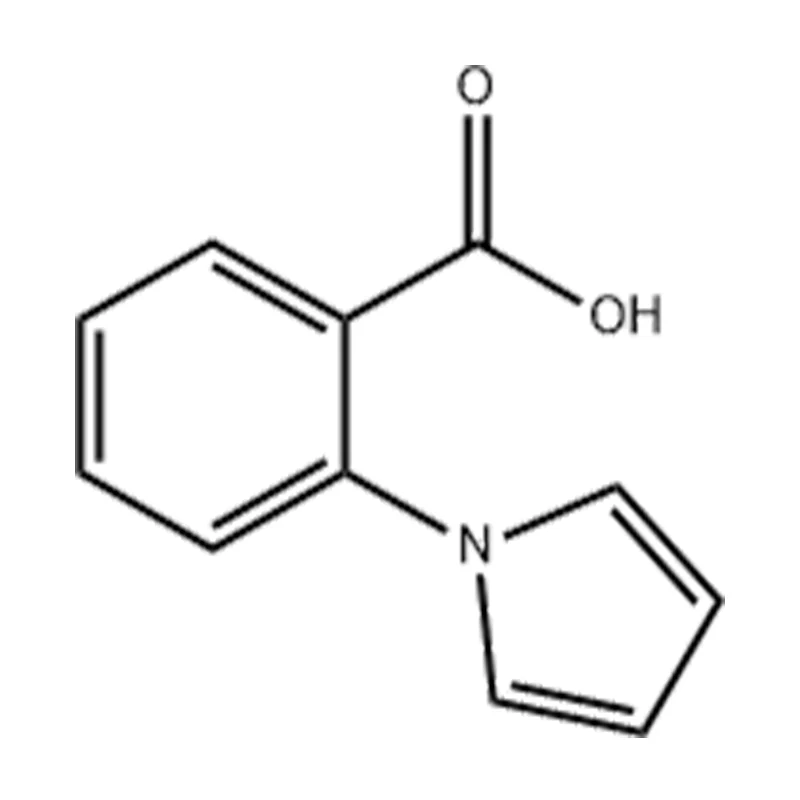
2-(1H-Pyrrol-1-yl)benzoic acid features a pyrrole ring widely regarded as a privileged heterocyclic scaffold found in numerous natural products, drug molecules, and pesticides. 2-(1H-Pyrrol-1-yl)benzoic acid’s inherent aromaticity and ability to engage in π‑stacking interactions and hydrogen bonding make it particularly attractive for enzyme inhibitor design and medicinal chemistry applications. Meanwhile, the carboxylic acid handle of 2-(1H-Pyrrol-1-yl)benzoic acid enables a wide array of transformations – esterification, amidation, decarboxylative coupling, reduction to the primary alcohol, or conversion to acid chlorides for further functionalization. These features position 2-(1H-Pyrrol-1-yl)benzoic acid as a versatile building block for drug discovery, agrochemical development, and coordination chemistry.
|
Parameter |
Specification |
|
CAS Number |
10333-68-3 |
|
Molecular Formula |
C₁₁H₉NO₂ |
|
Molecular Weight |
187.19 g/mol (exact: 187.063) |
|
Purity (HPLC) |
≥95% – ≥98% (≥99% reference grade available) |
|
Appearance |
Pale yellow to off-white crystalline powder |
|
Melting Point |
101–106 °C |
|
Boiling Point |
360.0±25.0 °C at 760 mmHg (predicted) |
|
Flash Point |
171.5 °C |
|
Density |
1.18±0.1 g/cm³ (predicted) |
|
pKa |
2.95±0.36 (predicted) |
|
SMILES |
OC(=O)C1=CC=CC=C1N2C=CC=C2 |
|
Stability |
Stable when stored as recommended; avoid exposure to strong oxidizing agents |
|
WGK Germany |
3 |
|
Hazard Symbols |
Xi (Irritant) |
|
Risk Codes |
R36/37/38 – Irritating to eyes, respiratory system and skin [9†L10-L11] |
|
Safety Statements |
S26 – In case of contact with eyes, rinse immediately with plenty of water and seek medical advice; S36 – Wear suitable protective clothing [9†L8-L9] |
|
Hazard Note |
Irritant |
|
GHS Signal Word |
Warning |
|
HS Code |
2933998090 |
|
Parameter |
Recommendation |
|
Short-term storage (≤6 months) |
0–8 °C (refrigerated), sealed, dry, protected from light [5†L20] |
|
Long-term storage (>6 months) |
–20 °C (as a powder) [6†L18] |
|
Solution storage |
–80 °C for up to 1 year [6†L18-L19] |
|
Stability period |
≥3 years when stored as a powder at –20 °C; ≥1 year for DMSO solutions at –80 °C |
|
Sensitivity |
Avoid exposure to strong oxidizing agents |
|
Handling |
Use with adequate ventilation; avoid inhalation, skin contact, and eye exposure. Wear appropriate PPE (lab coat, gloves, safety goggles). In case of eye contact, rinse immediately with plenty of water and seek medical advice (S26). |
|
Advantage |
Detail |
|
Production Strength |
GMP-certified campus spanning 100+ mu, 3 multi-purpose workshops, 6 D-grade clean zone production lines, and 150+ reactors (20L–5000L), supporting high/low temp, anaerobic & hydrogenation; kg to ton scale production. |
|
Fast Delivery |
R&D samples: one week; commercial orders: 1–2 months after payment. Express (DHL/FedEx) or air/sea freight available. |
|
Global Partners |
Trusted by 30+ pharmaceutical companies in USA, Europe, India, Brazil, and Southeast Asia; long-term cooperation with generic drug manufacturers, CROs, and impurity standard distributors. |
|
Licensed Exporter |
Valid drug import/export license — no compliance delays. |
|
Dual Quality Grades |
Both research/pharma grade(≥98%)and high-purity impurity grade(≥99%)available to meet diverse customer needs. |
A:The key difference lies in the position of the carboxylic acid group on the benzene ring relative to the pyrrole substitution. The ortho‑substituted compound (this product) is the most commonly used in research because it offers unique conformational constraints and electronic effects. The ortho arrangement restricts rotation, providing a more rigid scaffold that can engage in intramolecular hydrogen bonding and enhance binding selectivity toward biological targets. Para‑ and meta‑substituted analogues behave differently in cross‑coupling reactions and biological assays. The ortho compound is also the one most extensively documented in medicinal chemistry literature for its use in synthesizing anti‑inflammatory and analgesic drug candidates.
A:We supply 2‑(1H‑pyrrol‑1‑yl)benzoic acid in two primary grades:
● Research Grade (≥95–98% purity) – Suitable for routine organic synthesis, fragment‑based drug discovery, and medicinal chemistry research. Available in quantities from grams to kilograms.
● High‑Purity Reference Grade (≥99% purity) – Designed for analytical method development, quality control (QC) applications, and use as a certified reference standard (CRM). Each batch is released with a detailed Certificate of Analysis (CoA) including HPLC purity, residual solvents, and impurity profile. Additional characterization data (NMR, MS, FTIR) can be provided upon request.
Interested in 2-(1H-Pyrrol-1-yl)benzoic acid (CAS 10333-68-3)? We’re here to help. Request a sample, ask for a quote, or discuss custom synthesis – just reach out. Whether you need a few grams for a proof-of-concept experiment, high-purity reference standards for analytical work, or bulk quantities for commercial production, Cosperpharm is ready to support you. Contact us today and let’s see how we can move your project forward.
Address
No. 2 Yangguang 3rd Road, Duodao Chemical Cycle Industrial Park, Jingmen City, Hubei Province, China
Tel

![1-[2,3-Bis[(9Z,12Z)-octadeca-9,12-dien-1-yloxy]propyl]pyrrolidine](https://www.cosperpharma.com/upload/8820/1-2-3-bis-9z-12z-octadeca-9-12-dien-1-yloxy-propyl-pyrrolidine-349384.webp "1-[2,3-Bis[(9Z,12Z)-octadeca-9,12-dien-1-yloxy]propyl]pyrrolidine")
![1,2,4-Triazolo[4,3-a]pyridin-3(2H)-one](https://www.cosperpharma.com/upload/8820/1-2-4-triazolo-4-3-a-pyridin-3-2h-one-440735.webp "1,2,4-Triazolo[4,3-a]pyridin-3(2H)-one")