
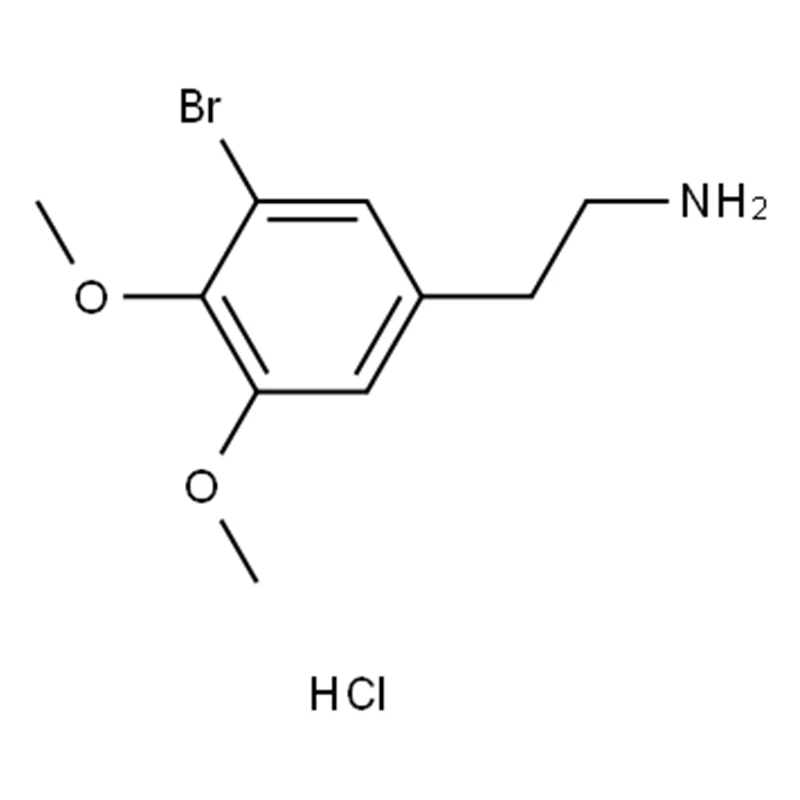
2-(3-Bromo-4,5-dimethoxyphenyl)ethan-1-amine hydrochloride serves as a versatile synthetic building block in the pharmaceutical industry, finding particular utility as a key intermediate and process-related impurity in the synthesis of baricitinib (Olumiant®), a selective Janus kinase (JAK)1/JAK2 inhibitor approved for the treatment of rheumatoid arthritis, atopic dermatitis, and alopecia areata. As a functionalized phenethylamine scaffold, 2-(3-Bromo-4,5-dimethoxyphenyl)ethan-1-amine hydrochloride offers the bromine atom as a handle for palladium‑catalyzed cross‑coupling reactions — including Suzuki–Miyaura, Buchwald–Hartwig, and Sonogashira couplings — enabling the construction of structurally diverse compound libraries for drug discovery programs. In research settings, 2-(3-Bromo-4,5-dimethoxyphenyl)ethan-1-amine hydrochloride is primarily used to investigate the pharmacology and signaling mechanisms of the serotonin receptor family, where its interaction with 5‑HT₂ receptors can provide critical insights into receptor function, G‑protein coupling, and downstream signaling pathways. As a reference standard, 2-(3-Bromo-4,5-dimethoxyphenyl)ethan-1-amine hydrochloride is employed in quality control (QC) testing for baricitinib, where it appears as a process-related impurity during API manufacturing, making it an important marker for method validation, impurity profiling, and ANDA filing.
|
Parameter |
Specification |
|
Product Name |
2-(3-Bromo-4,5-dimethoxyphenyl)ethan-1-amine hydrochloride |
|
CAS Number |
92015-18-4 |
|
Molecular Formula |
C₁₀H₁₄BrNO₂ |
|
Molecular Weight (Hydrochloride) |
296.59 g/mol |
|
Purity (HPLC) |
≥95% – ≥98% (depending on grade) |
|
Physical Form |
Crystalline solid |
|
Appearance |
White to off-white powder |
|
Melting Point |
199.7 – 200.2 °C |
2-(3-Bromo-4,5-dimethoxyphenyl)ethan-1-amine hydrochloride is a critical building block in the synthetic route to baricitinib (Olumiant®), a selective JAK1/JAK2 inhibitor used globally for rheumatoid arthritis, atopic dermatitis, and alopecia areata. The bromine atom at the 3‑position provides the handle for the key C–C bond‑forming steps that assemble the full baricitinib molecular architecture.
The bromine substituent on 2-(3-Bromo-4,5-dimethoxyphenyl)ethan-1-amine hydrochloride participates in palladium‑catalyzed cross‑coupling reactions — Suzuki–Miyaura with boronic acids, Buchwald–Hartwig for C–N bond formation, and Sonogashira for alkyne incorporation — enabling rapid diversification of the phenethylamine scaffold for medicinal chemistry hit‑to‑lead optimization.
The hydrochloride salt form offers three practical advantages over the free base: enhanced water solubility for biological assays and aqueous reaction systems, improved long‑term storage stability by protecting the primary amine from oxidation, and a non‑hygroscopic crystalline solid that is convenient to weigh and handle in the laboratory.
From 1g reference standard quantities for analytical method development to 1kg+ batches for commercial API manufacturing, Cosperpharm supplies 2-(3-Bromo-4,5-dimethoxyphenyl)ethan-1-amine hydrochloride at any scale required. R&D samples are available for route scouting and reaction optimization.
As a process‑related impurity in baricitinib manufacturing, 2-(3-Bromo-4,5-dimethoxyphenyl)ethan-1-amine hydrochloride serves as a certified reference standard for analytical method development, method validation (AMV), quality control (QC) testing, forced degradation studies, and Abbreviated New Drug Application (ANDA) filings. Cosperpharm provides DMF‑ready documentation packages and traceability support for regulatory submissions.
A: 2-(3-Bromo-4,5-dimethoxyphenyl)ethan-1-amine hydrochloride has two principal applications: as a synthetic intermediate in the manufacture of baricitinib, where the bromine atom provides the handle for key C–C bond‑forming cross‑coupling reactions; and as a process impurity reference standard for analytical method development, method validation (AMV), quality control (QC) testing, forced degradation studies, and ANDA filing for generic baricitinib manufacturers.
A: No. 2-(3-Bromo-4,5-dimethoxyphenyl)ethan-1-amine hydrochloride is supplied as a chemical intermediate for pharmaceutical synthesis and as an analytical reference standard for quality control purposes only. It is not intended for human consumption, therapeutic administration, or in vivo applications.
Ready to source 2-(3-Bromo-4,5-dimethoxyphenyl)ethan-1-amine hydrochloride for your baricitinib intermediate program, impurity profiling, or medicinal chemistry research? Cosperpharm streamlines the procurement process.
Address
No. 2 Yangguang 3rd Road, Duodao Chemical Cycle Industrial Park, Jingmen City, Hubei Province, China
Tel



![1-[2,3-Bis[(9Z,12Z)-octadeca-9,12-dien-1-yloxy]propyl]pyrrolidine](https://www.cosperpharma.com/upload/8820/1-2-3-bis-9z-12z-octadeca-9-12-dien-1-yloxy-propyl-pyrrolidine-349384.webp "1-[2,3-Bis[(9Z,12Z)-octadeca-9,12-dien-1-yloxy]propyl]pyrrolidine")
![1,2,4-Triazolo[4,3-a]pyridin-3(2H)-one](https://www.cosperpharma.com/upload/8820/1-2-4-triazolo-4-3-a-pyridin-3-2h-one-440735.webp "1,2,4-Triazolo[4,3-a]pyridin-3(2H)-one")