
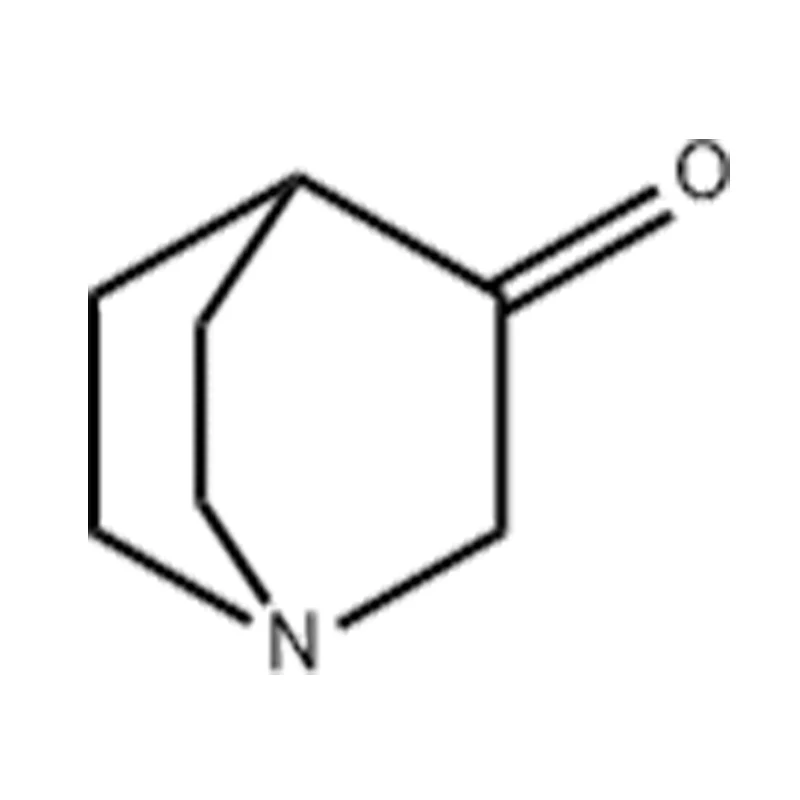
3-Quinuclidinone is a pivotal chiral building block and pharmaceutical intermediate in the industrial synthesis of several clinically approved drugs, most notably the muscarinic M₃ receptor antagonist solifenacin succinate (Vesicare®), a first‑line treatment for overactive bladder syndrome. The ketone group in 3-Quinuclidinone undergoes stereoselective enzymatic or chemical reduction to produce (R)-3-quinuclidinol with documented yields of 94–100% and enantiomeric excess exceeding 99.9%, establishing 3-Quinuclidinone as the definitive substrate for manufacturing the chiral alcohol that serves as the critical pharmacophore in solifenacin and the muscarinic antagonist revatropate. As a versatile synthetic intermediate, 3-Quinuclidinone is also employed as the key building block in the preparation of the muscarinic agonist cevimeline (Evoxac®), prescribed for xerostomia and Sjögren’s syndrome, as well as the 5‑HT₃ receptor antagonist azasetron hydrochloride and the antihistamine mequitazine. In regulatory quality control contexts, 3-Quinuclidinone is officially designated as solifenacin related compound 22, making it an essential impurity reference standard for analytical method development, method validation, quality control (QC) testing, forced degradation studies, and Abbreviated New Drug Application (ANDA) filings for generic solifenacin manufacturers. Beyond muscarinic therapeutics, 3-Quinuclidinone derivatives have been extensively studied as reactivators of mutant p53 proteins for cancer treatment and as antagonists of α7 nicotinic acetylcholine receptors (nAChRs), illustrating the broad therapeutic versatility of the rigid quinuclidine scaffold.
|
Parameter |
Specification |
|
Product Name |
3-Quinuclidinone |
|
CAS Number |
3731-38-2 |
|
Molecular Formula |
C₇H₁₁NO |
|
Molecular Weight |
125.17 g/mol |
|
Purity (HPLC) |
≥98.0% (standard grade); ≥99.0% (upon request) |
|
Physical Form |
Crystalline solid |
|
Appearance |
White to off-white to pale yellow powder / crystals |
|
Melting Point |
200 °C (lit.) |
|
Boiling Point |
204.9 ± 23.0 °C (Predicted) at 760 mmHg |
|
Density |
1.12 ± 0.1 g/cm³ (Predicted) |
|
Flash Point |
78.1 °C |
|
Vapor Pressure |
0.3 ± 0.4 mmHg at 25 °C |
|
pKa (conjugate acid) |
6.73 ± 0.20 (Predicted); 7.2 (experimental) |
Each batch undergoes:
● Gas chromatography (GC) – purity ≥97.0%
● Non‑aqueous titration – purity ≥97.0%
● Refractive index – confirmatory analysis
● ¹H NMR – structural verification
● Appearance – colorless to light yellow to light orange clear liquid
A comprehensive COA, MSDS (with full GHS information), and certificate of origin accompany every shipment.
A: 3-Quinuclidinone is the key precursor to both (R)- and (S)-3-quinuclidinol, the chiral building blocks used in multiple clinically approved drugs. (R)-3-Quinuclidinol is the essential pharmacophore in solifenacin (overactive bladder) and revatropate, while the racemic mixture is used in cevimeline (xerostomia) and azasetron (chemotherapy‑induced nausea).
A: Under recommended storage conditions (sealed, 2–8 °C, dry, under inert atmosphere), 3-Quinuclidinone has a shelf life of 2 years from the date of manufacture. For long‑term storage (>12 months), a −20 °C freezer is recommended to preserve optimal stability. Stability study data supporting this shelf life claim is available upon request.
As the definitive substrate for enantiopure (R)-3-quinuclidinol, 3-Quinuclidinone undergoes stereoselective reduction to produce the chiral alcohol that is then esterified with (S)-1‑phenyl‑1,2,3,4‑tetrahydroisoquinoline‑2‑carboxylic acid to form solifenacin succinate (Vesicare®), a first‑line treatment for overactive bladder syndrome.
The ketone group in 3-Quinuclidinone is reduced to the racemic alcohol, which is then converted to the thiol ester intermediate, ultimately yielding cevimeline hydrochloride — a muscarinic agonist prescribed for xerostomia (dry mouth) in Sjögren‘s syndrome patients and for radiation‑induced xerostomia.
3-Quinuclidinone is a key building block in the synthesis of azasetron hydrochloride, a selective 5‑HT₃ receptor antagonist used for the prevention and treatment of chemotherapy‑induced nausea and vomiting (CINV).
3-Quinuclidinone is employed as an intermediate in the synthesis of mequitazine, a long‑acting histamine H₁ receptor antagonist used in the treatment of allergic rhinitis, urticaria, and other allergic conditions.
As the official solifenacin related compound 22, 3-Quinuclidinone is used as a certified reference standard for analytical method development, method validation (AMV), quality control (QC) testing, forced degradation studies, and ANDA filing for generic solifenacin manufacturers.
3-Quinuclidinone is the starting material for the synthesis of (R)-3-quinuclidinol, the essential pharmacophore in revatropate — a muscarinic M₁/M₃ antagonist under development for chronic obstructive pulmonary disease (COPD).
Enzymatic Reduction Process Development 3-Quinuclidinone serves as the model substrate for developing and optimizing ketoreductase (KRED)‑catalyzed asymmetric reduction processes to produce (R)-3-quinuclidinol. Documented conversions achieve 94–100% yield and >99.9% ee, representing a benchmark for industrial biocatalysis.
Derivatives of 3-Quinuclidinone have been extensively studied as reactivators of mutant p53 proteins that tend to accumulate in high levels in tumors. These compounds are being investigated as novel anticancer therapeutics for patients suffering from various types of solid tumors.
3-Quinuclidinone oxime derivatives and related hydroxylamines have been synthesized and tested for muscarinic M₃ activity, while related quinuclidine compounds are known to act as antagonists of α7 nicotinic acetylcholine receptors (nAChRs), with potential applications in neuropsychiatric disorders.
For generic manufacturers filing Abbreviated New Drug Applications for solifenacin succinate, 3-Quinuclidinone (solifenacin related compound 22) is an essential impurity reference standard used in analytical method validation — including system suitability testing, specificity studies, and impurity profiling as part of ICH Q2(R1)-compliant validation. Cosperpharm provides DMF‑ready documentation packages, stability summaries, and custom quality agreements upon request.
Essential for developing, validating, and transferring HPLC and UPLC methods for solifenacin, cevimeline, and azasetron drug substance and drug product. Supports selectivity assessment, LOD/LOQ determination, accuracy and precision studies, and robustness testing for commercial quality control.
Used as an impurity marker in forced degradation studies (oxidative, thermal, photolytic, hydrolytic, and basic/acidic stress conditions) to monitor the formation of process‑related impurities and to confirm the stability‑indicating power of analytical methods for solifenacin formulations.
Pharmaceutical process chemists use this intermediate for reaction optimization, impurity mapping, and development of scalable commercial manufacturing routes for muscarinic antagonists and other quinuclidine‑based drugs. Cosperpharm provides characterization data and process support for seamless scale‑up from laboratory to pilot plant.
CROs and CDMOs conducting impurity profiling, method validation, analytical method transfer, or stability studies for solifenacin client programs rely on certified reference standards to deliver defensible data to their pharmaceutical clients.
Sourcing 3-Quinuclidinone for your solifenacin synthesis, impurity profiling program, or medicinal chemistry research should be straightforward — and at Cosperpharm, it is.
Address
No. 2 Yangguang 3rd Road, Duodao Chemical Cycle Industrial Park, Jingmen City, Hubei Province, China
Tel

![1-[2,3-Bis[(9Z,12Z)-octadeca-9,12-dien-1-yloxy]propyl]pyrrolidine](https://www.cosperpharma.com/upload/8820/1-2-3-bis-9z-12z-octadeca-9-12-dien-1-yloxy-propyl-pyrrolidine-349384.webp "1-[2,3-Bis[(9Z,12Z)-octadeca-9,12-dien-1-yloxy]propyl]pyrrolidine")
![1,2,4-Triazolo[4,3-a]pyridin-3(2H)-one](https://www.cosperpharma.com/upload/8820/1-2-4-triazolo-4-3-a-pyridin-3-2h-one-440735.webp "1,2,4-Triazolo[4,3-a]pyridin-3(2H)-one")