
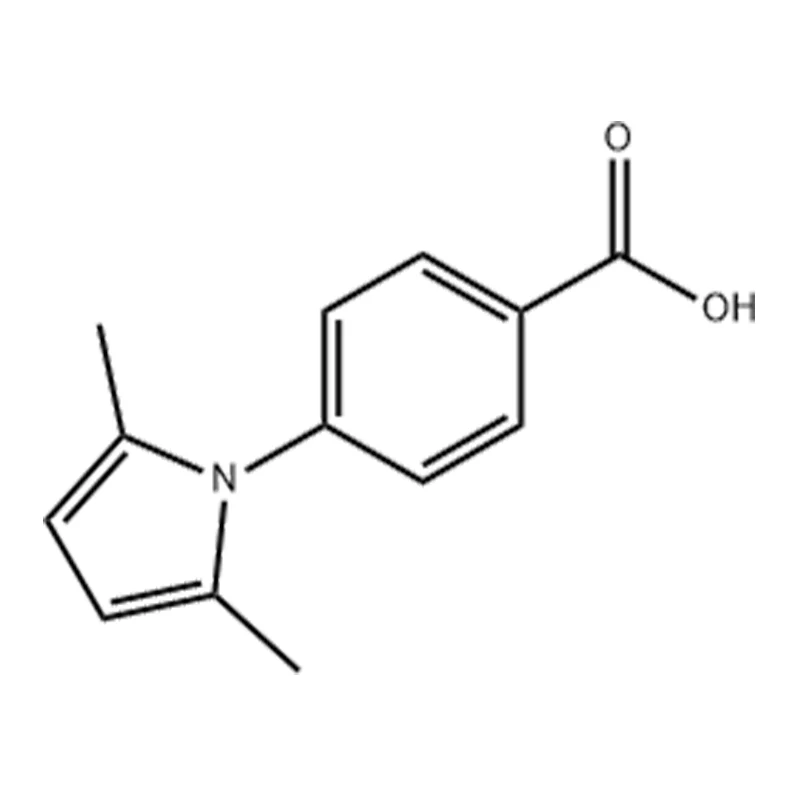
4-(2,5-Dimethyl-1H-pyrrol-1-yl)benzoic acid (CAS 15898-26-7) is a heterocyclic organic compound belonging to the class of substituted pyrroles. The molecular formula is C₁₃H₁₃NO₂ with a molecular weight of 215.25 g/mol, and the compound is typically supplied at purities ranging from 95% to 98% as a brown to orange solid.
In medicinal chemistry, 4-(2,5-dimethyl-1H-pyrrol-1-yl)benzoic acid has been recognized as a high‑value building block. A comprehensive 2013 study published in Medicinal Chemistry Research demonstrated that a series of hydrazide analogs derived from this compound, along with derived 1,3,4-oxadiazoles and 5‑substituted‑4‑amino‑1,2,4‑triazolin‑3‑thione systems, exhibited promising antibacterial, antifungal and antitubercular activities against the Mycobacterium tuberculosis H37Rv strain. Among these, twelve compounds displayed good antimicrobial activity with MIC values of 1–4 μg/mL, and several derivatives showed good in vitro antitubercular activity with MIC values of 1–2 μg/mL. Notably, these compounds exhibited antitubercular activity at non‑cytotoxic concentrations when assessed against mammalian Vero and A549 (lung adenocarcinoma) cell lines.
Beyond infectious disease research, 4-(2,5-dimethyl-1H-pyrrol-1-yl)benzoic acid has been investigated as a potential anticancer agent and a modulator of immune responses. Clinical studies have shown promising results in the treatment of certain cancers, including breast cancer and melanoma, though further studies are required to determine its safety and efficacy in humans. Its reported biological activities also include anti‑inflammatory properties.
In industrial and environmental contexts, 4-(2,5-dimethyl-1H-pyrrol-1-yl)benzoic acid has been used in the manufacturing of dyes, pigments and pharmaceuticals, and can serve as a small‑molecule ligand for affinity chromatography, protein binding studies or small‑molecule target engagement assays. Its role in pollution management and sustainability continues to be explored, as it has been found to have adverse effects on aquatic organisms and ecosystems, making it relevant for environmental toxicology studies.
|
Parameter |
Specification |
|
CAS Number |
15898-26-7 |
|
Molecular Formula |
C₁₃H₁₃NO₂ |
|
Molecular Weight |
215.25 g/mol |
|
Purity |
≥95% as standard; 97–98% available upon request |
|
Appearance |
Brown to orange solid |
|
Melting Point |
181–184 °C |
|
Boiling Point |
383.8 ± 30.0 °C at 760 mmHg (Predicted) |
|
Density |
1.14 ± 0.1 g/cm³ (Predicted) |
|
Flash Point |
185.9 °C |
|
pKa |
3.82 ± 0.10 (Predicted) |
|
Vapor Pressure |
1.41 × 10⁻⁶ mmHg at 25 °C (Predicted) |
|
Refractive Index |
1.579 (Predicted) |
|
Canonical SMILES |
CC1=CC=C(N1C2=CC=C(C=C2)C(=O)O)C |
|
Solubility |
Moderate solubility in organic solvents |
|
Storage Condition |
Store at room temperature; long-term storage in a cool, dry place |
|
GHS Signal Word |
Warning |
|
Hazard Statements |
H315 (causes skin irritation), H319 (causes serious eye irritation), H335 (may cause respiratory irritation) |
|
Hazard Symbols |
Xi (Irritant) |
Each batch undergoes:
● Gas chromatography (GC) – purity ≥97.0%
● Non‑aqueous titration – purity ≥97.0%
● Refractive index – confirmatory analysis
● ¹H NMR – structural verification
● Appearance – colorless to light yellow to light orange clear liquid
A comprehensive COA, MSDS (with full GHS information), and certificate of origin accompany every shipment.
A: It is used as a building block in antimicrobial and antitubercular drug discovery (particularly for developing hydrazide, oxadiazole and triazole derivatives with MIC values as low as 1–2 μg/mL against M. tuberculosis), as a potential anticancer agent (breast cancer and melanoma), as a protein degrader (PROTAC) building block, as an analytical reference standard in LC‑MS/MS and metabolomics, and as an intermediate in dye and pigment manufacturing.
A: The carboxylic acid group serves as a versatile synthetic handle, enabling a wide range of derivatizations including esterification (to form methyl/ethyl esters), amidation (to form hydrazides and amides), reduction (to the corresponding alcohol), and coupling reactions. This functional group is essential for accessing the biologically active hydrazide, oxadiazole and triazole derivatives reported in the literature.
● Temperature: Store at room temperature (15–25 °C). For long‑term storage, keep in a cool, dry place.
● Container: Airtight, tightly sealed container
● Protection: Store away from moisture, light and strong oxidizing agents
● Desiccation: Keep in a dry environment; the compound is stable under anhydrous conditions
● Stability: Stable under recommended storage conditions for up to 24 months
● Incompatibilities: Strong oxidizing agents, strong bases and strong acids
● DOT/IATA Transport: Not hazardous material under normal transport conditions
Handling recommendation: As a solid, the compound is easy to weigh and handle. Use in a fume hood and avoid generating dust. The compound may cause skin and eye irritation; wear appropriate PPE (gloves, goggles, lab coat). After opening, reseal the container tightly and return to storage. Safety data sheet (SDS) is available upon request.
We look forward to supporting your research and production needs.If you have any questions regarding 4-(2,5-Dimethyl-1H-pyrrol-1-yl)benzoic acid (CAS 15898-26-7) or wish to request a quotation, please do not hesitate to reach out. Our sales and technical support teams are ready to assist you.
Address
No. 2 Yangguang 3rd Road, Duodao Chemical Cycle Industrial Park, Jingmen City, Hubei Province, China
Tel


![1-[2,3-Bis[(9Z,12Z)-octadeca-9,12-dien-1-yloxy]propyl]pyrrolidine](https://www.cosperpharma.com/upload/8820/1-2-3-bis-9z-12z-octadeca-9-12-dien-1-yloxy-propyl-pyrrolidine-349384.webp "1-[2,3-Bis[(9Z,12Z)-octadeca-9,12-dien-1-yloxy]propyl]pyrrolidine")
![1,2,4-Triazolo[4,3-a]pyridin-3(2H)-one](https://www.cosperpharma.com/upload/8820/1-2-4-triazolo-4-3-a-pyridin-3-2h-one-440735.webp "1,2,4-Triazolo[4,3-a]pyridin-3(2H)-one")