
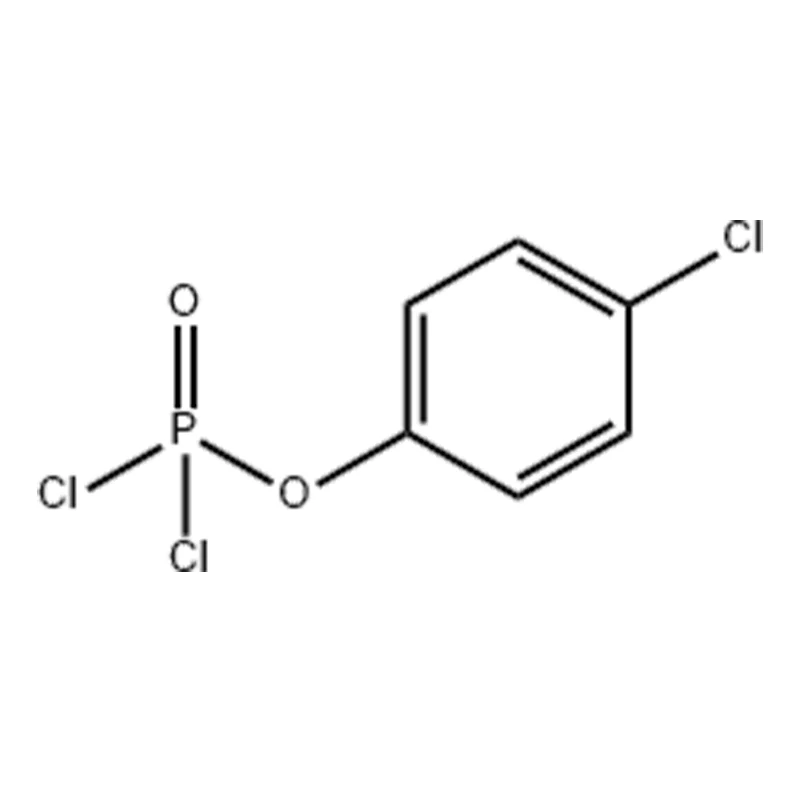
4-Chlorophenyl phosphorodichloridate (CAS 772-79-2) is an aromatic organophosphorus compound widely recognized as a versatile phosphorylating agent in organic synthesis. Its molecular formula is C₆H₄Cl₃O₂P, with a molecular weight of 245.43 g/mol, and the compound is supplied as a clear, colorless liquid with a pungent acrid odor. 4-Chlorophenyl phosphorodichloridate is extremely reactive toward nucleophiles, particularly water and alcohols, and must be handled under strictly anhydrous conditions.
As a phosphorylating agent, 4-chlorophenyl phosphorodichloridate serves as a key reagent for the preparation of antimicrobial agents, antioxidant agents, antitumor agents, and nucleotide anti‑viral prodrugs, and plays an essential role in the synthesis of nucleotide building blocks and oligonucleotides by introducing phosphate groups into organic molecules. In agrochemical research, 4-chlorophenyl phosphorodichloridate acts as an intermediate in the synthesis of various insecticides and herbicides, enhancing crop protection and serving as a starting material for pesticidal phosphoramidates. In materials science, 4-chlorophenyl phosphorodichloridate is applied in the formulation of flame retardants and other specialty chemicals, improving safety and performance in polymers and coatings. In analytical chemistry, 4-chlorophenyl phosphorodichloridate acts as a reagent in analytical methods, facilitating the detection and quantification of other chemical substances in complex mixtures, and in environmental studies, 4-chlorophenyl phosphorodichloridate is investigated for its environmental impact and degradation pathways.
4-Chlorophenyl phosphorodichloridate also has applications in the development of battery materials and can serve as a reagent in palladium-catalyzed cross‑coupling reactions, including Buchwald‑Hartwig, Heck, Hiyama, Negishi, Sonogashira, Stille, and Suzuki‑Miyaura couplings. Additionally, 4-chlorophenyl phosphorodichloridate is used in the two‑stage synthesis of pesticidal phosphoramidates (e.g., 4-tertiary‑butyl‑2-chlorophenyl methyl methyl phosphoramidate), which are effective for systemic control of parasites and as herbicides, and can be incorporated into formulations for oral administration, intra‑muscular injection, or spray applications, alone or in admixture with ethanol, water, surface‑active dispersing agents, or animal feeds.
|
Parameter |
Specification |
|
CAS Number |
772-79-2 |
|
EINECS Number |
212-254-1 |
|
Molecular Formula |
C₆H₄Cl₃O₂P |
|
Molecular Weight |
245.43 g/mol |
|
Purity |
≥97% as standard; ≥98% and ≥99% (assay by titration) available upon request |
|
Appearance |
Clear colorless liquid |
|
Odor |
Pungent, acrid |
|
Boiling Point |
142 °C at 11 mmHg; 141–143 °C at 11 mmHg |
|
Density |
1.508 g/mL at 25 °C |
|
Refractive Index |
n20/D 1.539–1.540 |
|
Flash Point |
106 °C (closed cup); 223 °F |
|
Solubility |
Reacts vigorously with water |
|
Sensitivity |
Moisture sensitive — reacts rapidly with water to release HCl gas |
|
Storage Condition |
Store at 0–5°C; under inert gas (nitrogen or argon); long-term storage in a cool, dry place away from moisture, oxidizing agents, alcohols, and bases |
|
Reaction Suitability |
Suitable for Buchwald-Hartwig, Heck, Hiyama, Negishi, Sonogashira, Stille, and Suzuki-Miyaura cross-coupling reactions |
CRITICAL SAFETY PROTOCOL — 4-Chlorophenyl phosphorodichloridate is an extremely hazardous chemical that must be handled with utmost caution. Always handle under a well‑ventilated fume hood or glove box with inert atmosphere. The compound is moisture‑sensitive and reacts vigorously with water, releasing corrosive HCl gas. Never allow contact with water, alcohols, or any protic solvents. Wear appropriate PPE: chemical‑resistant gloves (nitrile or neoprene, double‑gloving recommended), safety goggles or full‑face shield, flame‑retardant lab coat, and type ABEK respirator filter for gas protection when handling larger quantities (>25 g). Use explosion‑proof electrical equipment as the compound is combustible (flash point 106 °C). In case of skin contact, remove contaminated clothing immediately and wash with copious amounts of water for at least 15 minutes, then seek medical attention. In case of eye contact, rinse cautiously with water for at least 15 minutes, removing contact lenses if present and easy to do, and continue rinsing during transport to hospital. Emergency eyewash stations and safety showers must be readily accessible in the working area. After handling, decontaminate all equipment and surfaces that may have come into contact with the compound. Safety data sheet (SDS) is available upon request.
● If inhaled: Move person into fresh air. If not breathing, give artificial respiration. Consult a physician immediately. Do not perform mouth‑to‑mouth resuscitation without appropriate barrier protection.
● In case of skin contact: Wash off immediately with soap and plenty of water for at least 15 minutes. Remove contaminated clothing and shoes. Consult a physician immediately. Do not apply ointments or creams before medical evaluation.
● In case of eye contact: Rinse thoroughly with plenty of water for at least 15 minutes, occasionally lifting upper and lower eyelids. Remove contact lenses if present and easy to do. Consult a physician immediately. Continue rinsing during transport to hospital.
● If swallowed: Rinse mouth with water. Do NOT induce vomiting. Never give anything by mouth to an unconscious person. Consult a physician immediately. Inducing vomiting may cause aspiration pneumonia due to the compound‘s corrosive nature.
● Spill or leak: Evacuate area. Eliminate all sources of ignition. Do not touch spilled material. Stop leak if safe to do so. Do not allow water to contact spilled material. Use dry sand, vermiculite, or other non‑combustible absorbent material to contain spill. Neutralize with sodium bicarbonate or soda ash. Dispose of in accordance with local regulations. Wear full PPE including self‑contained breathing apparatus (SCBA) for large spills.
Prevent entry into waterways, sewers, basements, or confined areas. The compound is harmful to aquatic organisms and may cause long‑term adverse effects in the aquatic environment. In case of major spill, notify appropriate environmental authorities.
A: Store under inert gas (nitrogen or argon) at 0–5°C in a sealed, airtight container. For long‑term storage, keep in a cool, dry place away from moisture, oxidizing agents, alcohols, and bases. The container must be tightly sealed and purged with inert gas after each use. When stored properly, 4-chlorophenyl phosphorodichloridate remains stable for 12–24 months. The compound is classified as a combustible corrosive hazardous material (Storage Class 8A).
A: The para‑chloro substituent on the phenyl ring influences the electronic properties of the phosphorus center by withdrawing electron density through inductive effects, which modulates the reactivity of the P–Cl bonds and the leaving‑group ability of the aryloxide. This electronic tuning allows the reactivity of 4-chlorophenyl phosphorodichloridate to be balanced between stability and synthetic utility, often making it a preferred reagent over the unsubstituted phenyl analogue for specific transformations, particularly in nucleotide prodrug synthesis where controlled phosphorylation is critical.
We look forward to supporting your research and production needs.If you have any questions regarding 4-Chlorophenyl phosphorodichloridate (CAS 772-79-2) or wish to request a quotation, please do not hesitate to reach out. Our sales and technical support teams are ready to assist you.
Address
No. 2 Yangguang 3rd Road, Duodao Chemical Cycle Industrial Park, Jingmen City, Hubei Province, China
Tel

![1-[2,3-Bis[(9Z,12Z)-octadeca-9,12-dien-1-yloxy]propyl]pyrrolidine](https://www.cosperpharma.com/upload/8820/1-2-3-bis-9z-12z-octadeca-9-12-dien-1-yloxy-propyl-pyrrolidine-349384.webp "1-[2,3-Bis[(9Z,12Z)-octadeca-9,12-dien-1-yloxy]propyl]pyrrolidine")
![1,2,4-Triazolo[4,3-a]pyridin-3(2H)-one](https://www.cosperpharma.com/upload/8820/1-2-4-triazolo-4-3-a-pyridin-3-2h-one-440735.webp "1,2,4-Triazolo[4,3-a]pyridin-3(2H)-one")