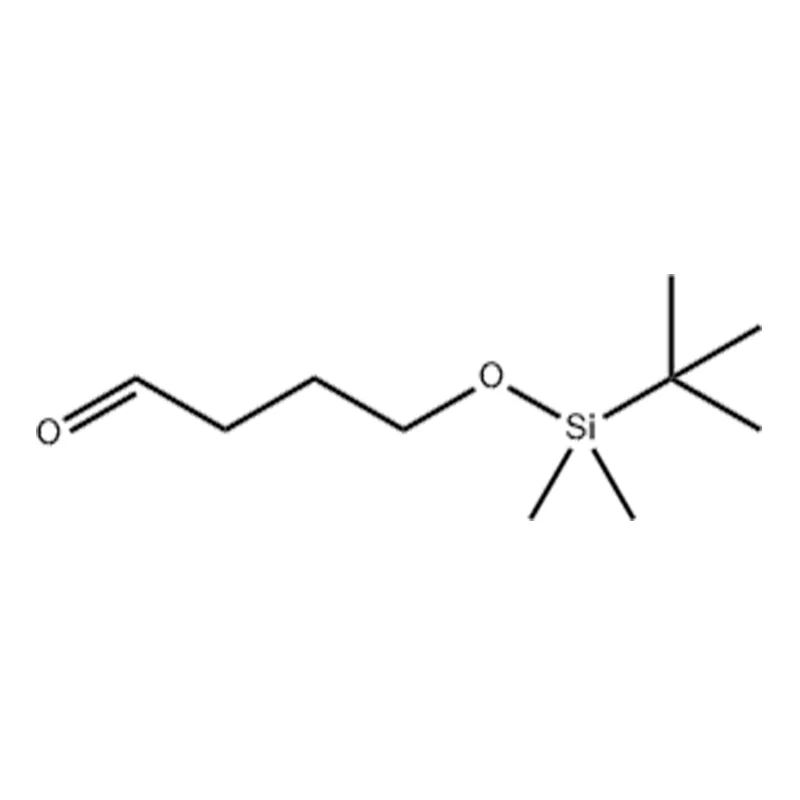
4-((tert-Butyldimethylsilyl)oxy)butanal is a silyl-protected aldehyde widely employed as a key synthetic intermediate in the preparation of complex organic molecules. The tert-butyldimethylsilyl (TBS) protecting group in 4-((tert-Butyldimethylsilyl)oxy)butanal serves to temporarily mask the hydroxyl functionality, allowing chemists to perform selective transformations on the aldehyde group without interference. The inherent stability of 4-((tert-Butyldimethylsilyl)oxy)butanal under a variety of reaction conditions, coupled with its predictable reactivity profile, makes it a popular choice in both academic research and industrial process development. The orthogonal reactivity of 4-((tert-Butyldimethylsilyl)oxy)butanal—where the TBS group can be cleanly removed under mild acidic or fluoride-mediated conditions to liberate the free alcohol—enables its use in the convergent assembly of complex molecular architectures, including those found in pharmaceuticals and natural products.
|
Parameter |
Specification |
|
Product Name |
4-((tert-Butyldimethylsilyl)oxy)butanal |
|
CAS Number |
87184-81-4 |
|
Molecular Formula |
C₁₀H₂₂O₂Si |
|
Molecular Weight |
202.37 g/mol |
|
Purity (GC/HPLC) |
≥95.0% (standard grade); 98.0%+ (high-purity grade) |
|
Physical Form |
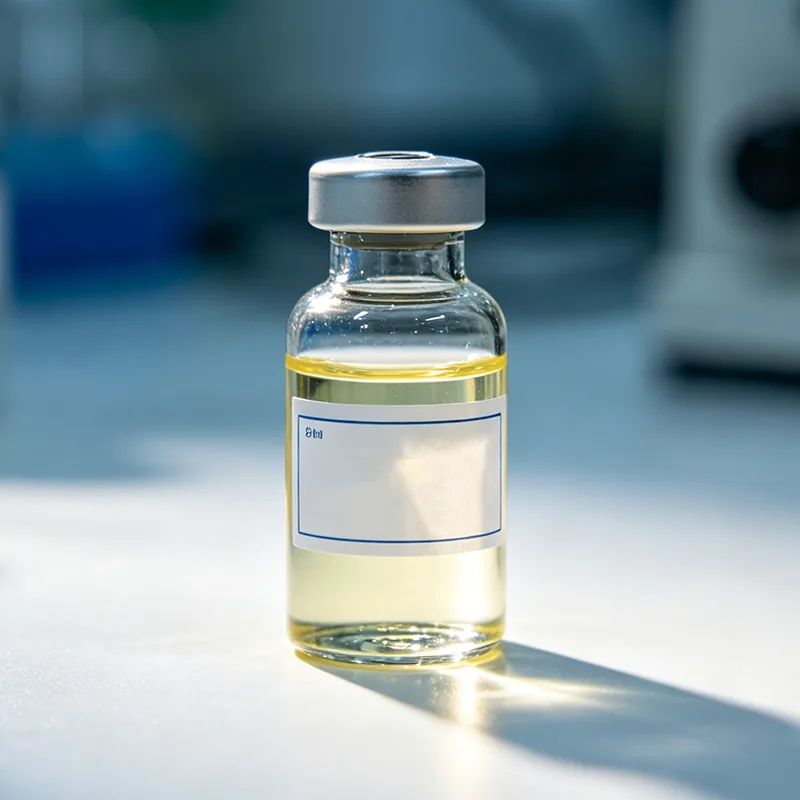
Colorless to pale yellow liquid |
|
Boiling Point |
225.3 ± 23.0 °C (Predicted, 760 Torr) |
|
Density |
0.868 ± 0.06 g/cm³ (Predicted, 25 °C) |
|
Flash Point |
74.9 ± 18.2 °C (Predicted) |
|
LogP |
1.86–3.19 (predicted, depending on model) |
|
Storage Condition |
-20°C, stored under inert atmosphere (nitrogen or argon), protected from moisture |
When your synthetic route or analytical method validation demands a high-purity, reliably sourced silyl-protected aldehyde, Cosperpharm delivers 4-((tert-Butyldimethylsilyl)oxy)butanal with the documentation depth, supply consistency, and technical guidance that synthetic chemists and QC managers expect.
Dual-grade supply for diverse applications. Cosperpharm offers 4-((tert-Butyldimethylsilyl)oxy)butanal at two quality levels: a high-purity grade (≥98%) suitable as a synthetic building block in multi-step syntheses of pharmaceutical intermediates, and a reference standard grade (≥95%) suitable for use as a process-related impurity marker in analytical method development. Both grades are accompanied by full characterization data.
Documentation aligned with your workflow. Every shipment of 4-((tert-Butyldimethylsilyl)oxy)butanal includes a comprehensive Certificate of Analysis (COA) with batch-specific purity data and analytical traces. Our documentation is structured for direct integration into your synthetic records or regulatory submissions.
Seamless scale-up from bench to pilot. Cosperpharm bridges the gap between discovery and development. You can obtain small gram quantities of 4-((tert-Butyldimethylsilyl)oxy)butanal for route scouting and feasibility studies, and then seamlessly transition to kilogram-scale quantities for process validation without changing suppliers.
Technical guidance on handling and reactivity. Our application scientists possess deep knowledge of silyl protecting group chemistry. They can provide practical guidance on storage, handling, and compatibility of 4-((tert-Butyldimethylsilyl)oxy)butanal with common synthetic transformations—including oxidation, reduction, and deprotection conditions.
Global logistics with predictable timelines. Cosperpharm maintains a robust global supply chain. Every shipment of 4-((tert-Butyldimethylsilyl)oxy)butanal is packed under controlled conditions and accompanied by comprehensive commercial invoices, packing lists, and certificates of origin to ensure smooth customs clearance worldwide.
The preparation of 4-((tert-Butyldimethylsilyl)oxy)butanal is commonly achieved via one of two complementary routes:
This straightforward approach involves the protection of commercially available 4-hydroxybutanal with tert-butyldimethylsilyl chloride (TBSCl) in the presence of a base such as imidazole or pyridine. The reaction is typically conducted in anhydrous dichloromethane at room temperature. The silyl ether forms selectively at the primary hydroxyl group, leaving the aldehyde intact. After aqueous workup and purification by distillation or column chromatography, the product is obtained as a colorless liquid.
A widely cited patent procedure describes the controlled oxidation of 4-(tert-butyldimethylsilyloxy)butan-1-ol to the corresponding aldehyde using pyridinium chlorochromate (PCC). In this protocol, 4-(tert-butyldimethylsilyloxy)butan-1-ol (102.0 g, 0.5 mol) in dichloromethane is added to a suspension of PCC (161.5 g, 0.75 mol) in DCM, stirred at 0°C for 1 hour, then warmed to room temperature and stirred for an additional 2 hours. Filtration, concentration in vacuo, and purification by silica gel column chromatography (petroleum ether/ethyl acetate 50:1) affords 4-((tert-butyldimethylsilyl)oxy)butanal as a yellow oil in 60% yield. The product is confirmed by ¹H NMR (δ 9.68, aldehyde proton) and LC-MS ([M+H]⁺ = 203).
4-((tert-Butyldimethylsilyl)oxy)butanal serves as a key protected building block in the convergent synthesis of pharmaceutical candidates, where the TBS-protected alcohol and free aldehyde provide orthogonal reactivity for sequential transformations.
The bifunctional nature of this compound makes it suitable as a starting material for constructing heterobifunctional linkers used in proteolysis-targeting chimeras (PROTACs) and antibody-drug conjugates (ADCs), where precise spacing and functional group orientation are critical.
Used as a versatile C4 synthon in the total synthesis of complex natural products, where the protected alcohol can be unmasked at a late stage to introduce a hydroxyl group required for biological activity or further elaboration.
Employed as a building block in the synthesis of agrochemical active ingredients, where the TBS-protected intermediate provides stability during multi-step manufacturing processes and can be deprotected under mild conditions to reveal the active alcohol moiety.
Used as a reference marker in HPLC and GC methods to monitor the levels of this silyl-protected intermediate as a process-related impurity in drug substances where TBS-protected alcohols are employed during synthesis.
Serves as a model compound for developing and optimizing GC and HPLC methods tailored to the analysis of silyl-protected intermediates, including assessment of column compatibility, detection sensitivity, and resolution from desilylated byproducts.
Research indicates that derivatives of this compound can be utilized to study enzyme mechanisms and develop enzyme inhibitors, providing insights into drug design.
Looking to add 4-((tert-Butyldimethylsilyl)oxy)butanal to your synthetic toolbox or impurity reference standard library? Reach out to Cosperpharm with the details below, and our team will prepare a tailored quotation without delay.
Address
No. 2 Yangguang 3rd Road, Duodao Chemical Cycle Industrial Park, Jingmen City, Hubei Province, China
Tel

![1-[2,3-Bis[(9Z,12Z)-octadeca-9,12-dien-1-yloxy]propyl]pyrrolidine](https://www.cosperpharma.com/upload/8820/1-2-3-bis-9z-12z-octadeca-9-12-dien-1-yloxy-propyl-pyrrolidine-349384.webp "1-[2,3-Bis[(9Z,12Z)-octadeca-9,12-dien-1-yloxy]propyl]pyrrolidine")
![1,2,4-Triazolo[4,3-a]pyridin-3(2H)-one](https://www.cosperpharma.com/upload/8820/1-2-4-triazolo-4-3-a-pyridin-3-2h-one-440735.webp "1,2,4-Triazolo[4,3-a]pyridin-3(2H)-one")