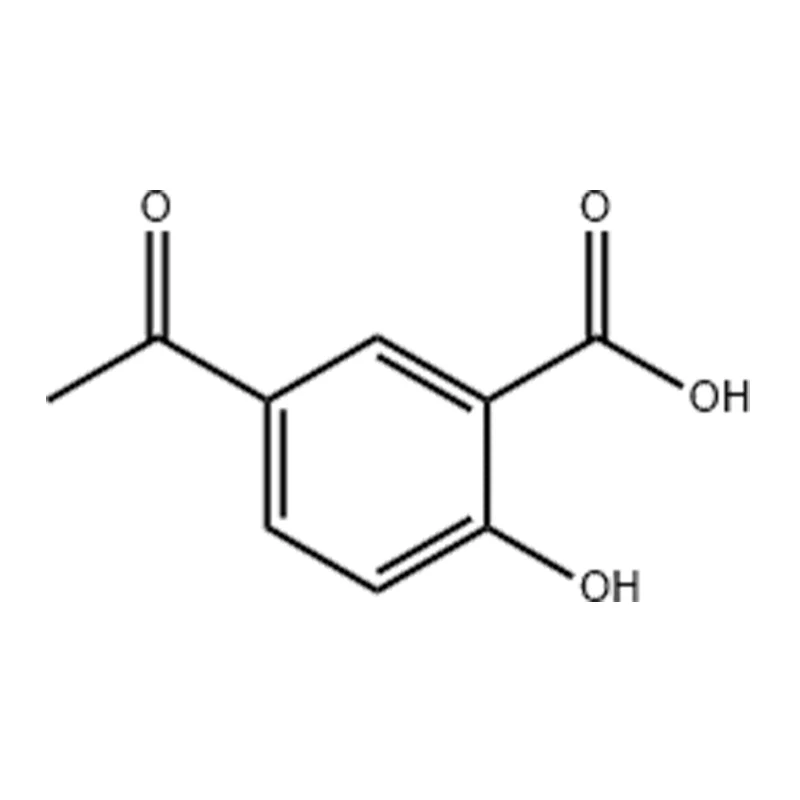
5-Acetylsalicylic Acid (CAS 13110‑96‑8; C₉H₈O₄; MW 180.16) is a functionalized salicylate derivative that bridges the worlds of anti‑inflammatory pharmacology and synthetic organic chemistry. Sometimes referred to as 5‑acetyl‑2‑hydroxybenzoic acid, 5‑Acetylsalicylic Acid is best known as the active gut‑restricted metabolite of sulfasalazine, a mainstay in the treatment of ulcerative colitis and Crohn‘s disease. Unlike its parent prodrug, 5‑Acetylsalicylic Acid remains confined to the intestinal tract after bacterial deacetylation, delivering localized anti‑inflammatory action with minimal systemic exposure — a property that has made it a research focus in inflammatory bowel disease (IBD) drug discovery.
Beyond its pharmacology, 5-Acetylsalicylic Acid serves as a valuable building block in medicinal chemistry. The ortho‑hydroxy and meta‑acetyl substituents provide orthogonal handles for further derivatization — the phenol can be alkylated or acylated, the ketone can undergo condensation (e.g., oxime formation), and the carboxylic acid is ready for amidation or esterification. This makes 5‑Acetylsalicylic Acid a versatile intermediate for the synthesis of novel anti‑inflammatory agents, salicylate‑based conjugates, and heterocyclic scaffolds. The compound is also recognised as Acetylsalicylic Acid Impurity 22 (Aspirin Impurity 12), making it a critical reference standard in quality control of aspirin‑containing drug products. With a melting point of 214–216 °C, good stability at 2–8 °C, and solubility in DMSO, it is a practical and reliable material for both discovery chemistry and analytical method development.
|
Parameter |
Specification |
|
CAS Number |
13110-96-8 |
|
IUPAC Name |
5-acetyl-2-hydroxybenzoic acid |
|
Molecular Formula |
C₉H₈O₄ |
|
Molecular Weight |
180.16 g/mol |
|
Melting Point |
214–216 °C |
|
Boiling Point (Predicted) |
413.0 ± 35.0 °C |
|
Density (Predicted) |
1.365 ± 0.06 g/cm³ |
|
Flash Point |
250 °C |
|
pKa (Predicted) |
2.62 ± 0.10 |
|
Appearance |
White to light yellow to light orange crystalline powder |
|
Solubility |
Soluble in DMSO; sparingly soluble in water |
|
Storage |
2–8 °C, sealed, dry, protect from moisture |
|
BRN |
2096968 |
|
InChI Key |
NZRDKNBIPVLNHA-UHFFFAOYSA-N |
|
Canonical SMILES |
C(O)(=O)C1=CC(C(C)=O)=CC=C1O |
|
Hazard Symbol |
Xn (Harmful) |
|
Risk Code |
R22 – Harmful if swallowed |
|
Safety Statement |
S22 – Do not breathe dust |
|
HS Code |
2918.29.7500 |
|
Purity (HPLC) |
≥98.0% |
|
Advantage |
What It Means for Your Research |
|
Three orthogonal functional groups |
Carboxylic acid, phenol, and ketone can be selectively modified. Enables divergent synthesis of libraries. |
|
Built-in anti-inflammatory activity |
The compound itself is bioactive, making it a starting point for IBD drug discovery, not just a passive intermediate. |
|
Crystalline, high-melting solid |
Easy to handle, weigh, and purify. Stable under recommended storage. |
|
Well-characterized pKa (2.62) |
Predictable ionization behavior for formulation or biological assays. |
|
Moisture sensitive? |
Slight – but a simple precaution (store with desiccant, avoid long exposure to humid air) keeps it stable. |
|
Scalable synthesis |
Can be prepared from cheap starting materials (e.g., 3-acetylphenol or salicylic acid derivatives). |
As noted in the supplied information, 5-Acetylsalicylic Acid is a carboxylic acid derivative widely used as an organic intermediate in synthetic organic chemistry. Each functional group offers a distinct reaction pathway.This combination makes it a privileged starting material for the synthesis of heterocycles (e.g., flavones, coumarins, benzofurans) and for building molecular libraries via parallel synthesis.
5‑Acetylsalicylic acid has been shown to possess anti‑inflammatory activity and is considered an active agent in inflammatory bowel disease (IBD). This finding is significant because many salicylate derivatives (like 5‑aminosalicylic acid, mesalamine) are first‑line treatments for ulcerative colitis and Crohn’s disease. The acetyl group at the 5‑position may confer distinct pharmacological properties compared to the amino or hydroxy derivatives. Researchers studying new IBD therapies can use this compound as a lead structure or as a comparator in mechanistic studies (e.g., NF‑κB inhibition, COX enzyme modulation, or gut‑restricted activity).
The compound can be prepared by one‑step procedures from several starting materials (as per supplied information):
● From 3‑acetylbenzoic acid – via a hydroxylation or rearrangement.
● From o‑hydroxybenzoic acid (salicylic acid) – via Friedel‑Crafts acylation at the 5‑position (using acetyl chloride and a Lewis acid).
● From o‑acetylsalicylic acid (aspirin) – via rearrangement or hydrolysis? Not directly; but the literature indicates multiple routes exist.
Cosperpharm can provide the synthetic details upon request. For most researchers, buying the pre‑made compound is the fastest path.
The combination of a carboxylic acid and a phenol (and a ketone) offers multiple coordination sites for metal ions. 5‑Acetylsalicylic acid has been explored as a ligand for constructing MOFs with potential applications in drug delivery, sensing, and catalysis. The acetyl group can also be used to anchor additional functionalities.
For manufacturers of salicylate‑based drugs (aspirin, mesalamine, sulfasalazine, etc.), 5‑acetylsalicylic acid may appear as a process‑related impurity or a degradation product (e.g., from oxidation of 5‑methylsalicylic acid). Cosperpharm can supply this compound as a certified reference standard for HPLC method development and quality control.
The compound can be synthesized by:
1.Friedel‑Crafts acylation of salicylic acid – Using acetyl chloride and AlCl₃ or other Lewis acids, with careful control to avoid O‑acylation.
2.From 3‑acetylphenol – via Kolbe‑Schmitt carboxylation (introducing CO₂ under high pressure and temperature to give the ortho‑carboxy product).
3.From o‑acetylsalicylic acid derivatives – through hydrolysis or rearrangement (less common).
Cosperpharm uses a scalable, chromatography‑free process that yields high‑purity product with minimal metal residues.
A: Aspirin is 2‑acetoxybenzoic acid – an acetyl group attached to the phenolic oxygen (making an ester). In contrast, 5‑acetylsalicylic acid has the acetyl group attached to the carbon ring at the 5‑position, while the phenol remains free (as –OH). The biological activities are also distinct: aspirin is a COX‑1/COX‑2 inhibitor; 5‑acetylsalicylic acid has reported anti‑inflammatory effects in IBD models, likely via different mechanisms.
A: The compound is moisture‑sensitive in the solid state over long periods, but in solution (e.g., DMSO or buffers at physiological pH), it is reasonably stable for short‑term experiments. However, the acetyl group may undergo hydrolysis under strongly basic conditions, and the phenolic OH can oxidize if exposed to air and light. For biological assays, prepare fresh solutions or store frozen under inert gas.
Need a versatile building block that also carries its own biological fingerprint? Cosperpharm supplies 5-Acetylsalicylic Acid (CAS 13110‑96‑8) with high purity, moisture‑protective packaging, and global shipping. Whether you're synthesizing a library of anti‑inflammatory candidates or scaling up an intermediate for an IBD drug program, we deliver consistency and reliability.
Address
No. 2 Yangguang 3rd Road, Duodao Chemical Cycle Industrial Park, Jingmen City, Hubei Province, China
Tel

![1-[2,3-Bis[(9Z,12Z)-octadeca-9,12-dien-1-yloxy]propyl]pyrrolidine](https://www.cosperpharma.com/upload/8820/1-2-3-bis-9z-12z-octadeca-9-12-dien-1-yloxy-propyl-pyrrolidine-349384.webp "1-[2,3-Bis[(9Z,12Z)-octadeca-9,12-dien-1-yloxy]propyl]pyrrolidine")
![1,2,4-Triazolo[4,3-a]pyridin-3(2H)-one](https://www.cosperpharma.com/upload/8820/1-2-4-triazolo-4-3-a-pyridin-3-2h-one-440735.webp "1,2,4-Triazolo[4,3-a]pyridin-3(2H)-one")