
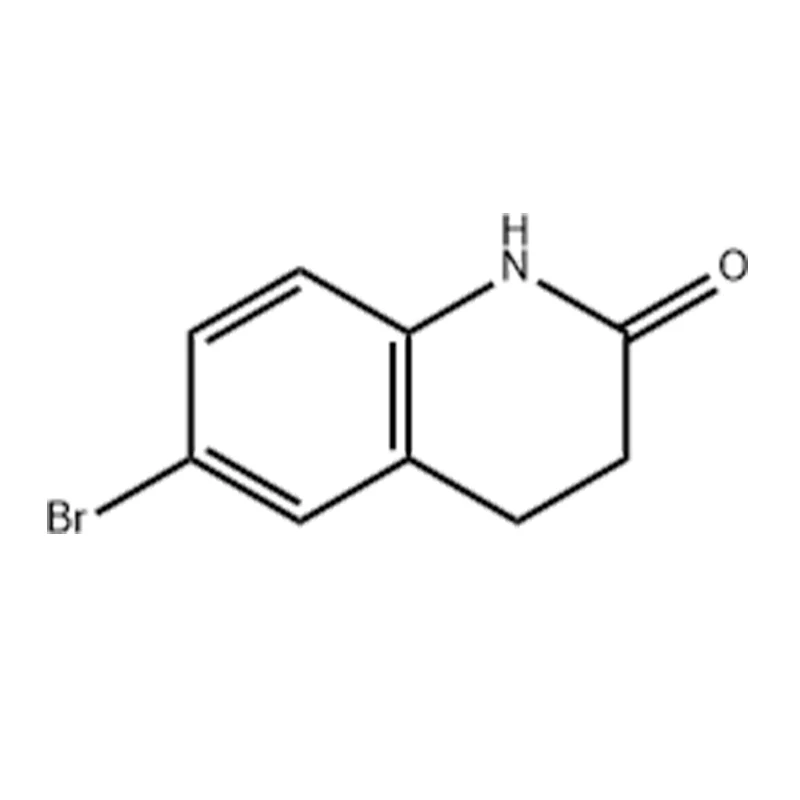
6-Bromo-3,4-dihydro-2(1H)-quinolinone (CAS 3279-90-1), also known as 6‑bromo‑1,2,3,4‑tetrahydro‑2‑quinolinone or 6‑bromo‑3,4‑dihydro‑1H‑quinolin‑2‑one, is a functionalized heterocyclic compound built on the dihydroquinolinone skeleton. As a representative member of the quinolinone class, 6-bromo-3,4-dihydro-2(1H)-quinolinone is recognized for its diverse biological activities, including antitumor, antimicrobial, antifungal, antiviral, antioxidant, anti‑inflammatory, and anticoagulant properties. In biochemical contexts, the compound interacts with various enzymes by binding to their active sites, thereby modulating metabolic pathways at the molecular level and influencing gene expression and cellular metabolism through interactions with transcription factors or regulatory proteins.
6-Bromo-3,4-dihydro-2(1H)-quinolinone also plays a crucial role in pharmaceutical development as a versatile synthetic intermediate. It is used in the preparation of bromodomain inhibitors for the treatment of proliferative disorders, autoimmune and inflammatory conditions, and neoplasms, including tumors and cancers, and serves as an important building block in the synthesis of inhibitors of monoamine oxidase (MAO), which are considered to be useful therapeutic agents for the treatment of depression and Parkinson‘s disease. In addition, 6-bromo-3,4-dihydro-2(1H)-quinolinone is employed as an organic synthesis intermediate in chemical production processes, particularly in the synthesis of various derivatives with a wide range of research applications, and can also serve as a core fragment for molecular splicing and modification in new drug design.
|
Parameter |
Specification |
|
CAS Number |
3279-90-1 |
|
Molecular Formula |
C₉H₈BrNO |
|
Molecular Weight |
226.07 g/mol |
|
Purity |
Standard ≥98% (HPLC/GC); 95% grade also commercially available |
|
Appearance |
White to off-white crystalline powder to brown solid; white solid reported |
|
Melting Point |
170–172°C (literature) |
|
Boiling Point |
376.3 ± 42.0°C (Predicted) |
|
Density |
1.559 ± 0.06 g/cm³ (Predicted) |
|
pKa |
13.92 ± 0.20 (Predicted) |
|
Canonical SMILES |
C1CC(=O)NC2=C1C=C(C=C2)Br |
|
Storage Condition |
Keep in dark place, sealed in dry, room temperature; or 0–8°C |
|
Solubility |
Slightly soluble in water; soluble in organic solvents such as ethyl acetate and DMF |
|
Sensitivity |
Light-sensitive |
|
Hazard Statements |
H315: Causes skin irritation. H319: Causes serious eye irritation. H335: May cause respiratory irritation |
|
Signal Word |
Warning |
1. Privileged dihydroquinolinone scaffold – The dihydroquinolinone core is a well‑established pharmacophore in drug discovery, found in numerous bioactive compounds with a broad spectrum of therapeutic applications.
2. Bromine handle for diversification – The 6‑bromo substituent provides a versatile synthetic handle for transition‑metal‑catalyzed cross‑coupling reactions (Suzuki, Heck, Buchwald‑Hartwig, etc.), enabling rapid generation of aryl‑substituted dihydroquinolinone derivatives with enhanced biological activity.
3. Multidimensional biological activity – Exhibits a comprehensive range of biological activities, including antitumor, antimicrobial, antifungal, antiviral, antioxidant, anti‑inflammatory, and anticoagulant properties, making it a valuable starting point for multiple therapeutic programs.
4. Enzyme inhibition potential – Inhibits monoamine oxidase (MAO) for potential applications in depression and Parkinson‘s disease treatment, and serves as a building block for bromodomain inhibitors targeting proliferative disorders, autoimmune and inflammatory conditions, and neoplasms.
5. Fragment molecule platform – As a core fragment, 6-bromo-3,4-dihydro-2(1H)-quinolinone can be used for molecular splicing, expansion, and modification in fragment‑based drug discovery campaigns, enabling efficient lead optimization.
6. High purity – Standard ≥98% purity ensures reliable and reproducible results in sensitive research applications
7. Established synthetic route – Well‑documented, high‑yielding bromination procedure using NBS provides consistent product quality at both laboratory and industrial scales.
A reliable synthesis of 6-bromo-3,4-dihydro-2(1H)-quinolinone has been reported, starting from the parent 3,4-dihydroquinolin-2(1H)-one (CAS 553-03-7):
To a solution of 3,4-dihydro-1H-quinolin-2-one (2.73 g, 18.55 mmol) in N,N-dimethylacetamide (30 mL) cooled in an ice‑water bath was slowly added dropwise a solution of N‑bromosuccinimide (3.30 g, 18.55 mmol) in N,N-dimethylacetamide (10 mL). The reaction mixture was stirred in the ice‑water bath for 6 hours and then warmed to room temperature and stirred for an additional 12 hours. After completion of the reaction, water (50 mL) was added to the mixture, followed by extraction with ethyl acetate (3 × 50 mL). The combined organic layers were dried over anhydrous sodium sulfate, filtered, and concentrated under reduced pressure. The crude residue was purified by silica gel column chromatography (petroleum ether/ethyl acetate = 3/1, v/v) to afford the title compound as a white solid (3.86 g, 92.1% yield).
A: The bromine atom serves as a versatile synthetic handle for further functionalization, particularly through transition‑metal‑catalyzed cross‑coupling reactions such as Suzuki, Heck, and Buchwald‑Hartwig couplings. This allows the introduction of diverse aryl, heteroaryl, or alkyl substituents at the 6‑position, enabling the rapid generation of compound libraries for structure‑activity relationship studies and lead optimization.
A: The compound should be stored in a dark place, sealed in a dry container at room temperature, or at 0–8°C. It is light‑sensitive; protect from light. When stored properly, it remains stable for up to 24 months.
Need a reliable source for this versatile intermediate? We‘re ready to help.At Cosperpharm, we combine technical expertise with exceptional customer service. Whether you’re working on bromodomain inhibitors, MAO inhibitors, or antimicrobial drug discovery, our team can support your research with high‑quality products and responsive assistance.
Address
No. 2 Yangguang 3rd Road, Duodao Chemical Cycle Industrial Park, Jingmen City, Hubei Province, China
Tel

![1-[2,3-Bis[(9Z,12Z)-octadeca-9,12-dien-1-yloxy]propyl]pyrrolidine](https://www.cosperpharma.com/upload/8820/1-2-3-bis-9z-12z-octadeca-9-12-dien-1-yloxy-propyl-pyrrolidine-349384.webp "1-[2,3-Bis[(9Z,12Z)-octadeca-9,12-dien-1-yloxy]propyl]pyrrolidine")
![1,2,4-Triazolo[4,3-a]pyridin-3(2H)-one](https://www.cosperpharma.com/upload/8820/1-2-4-triazolo-4-3-a-pyridin-3-2h-one-440735.webp "1,2,4-Triazolo[4,3-a]pyridin-3(2H)-one")