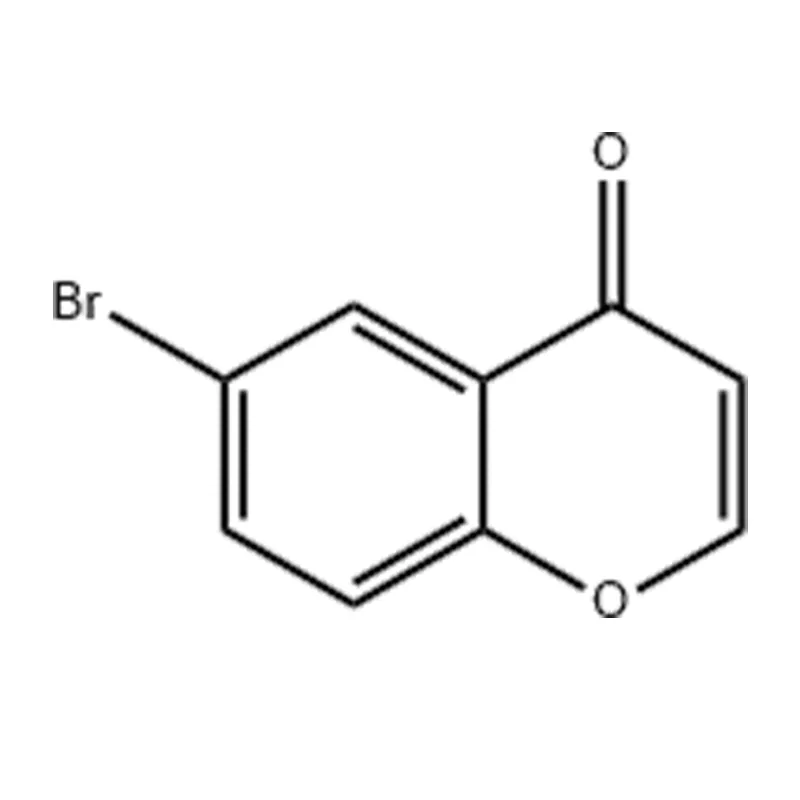
6-Bromochromone (CAS 51483‑92‑2) is a heterocyclic compound belonging to the chromone family — oxygen‑containing heterocycles characterized by a benzoannelated γ‑pyrone ring system. The molecular formula is C₉H₅BrO₂ with a molecular weight of 225.04 g/mol, and the compound is typically supplied at ≥98.0% purity as a white to light‑yellow powder or crystalline solid. The presence of a bromine atom at the 6‑position of the chromone ring significantly influences its chemical properties and reactivity.
In pharmaceutical development, 6-Bromochromone serves as a key intermediate in the synthesis of various bioactive molecules, particularly anti‑inflammatory and anti‑cancer drugs. Its derivatives have been investigated for antifungal, anti‑tumor, and α‑glucosidase inhibitory activities. In biochemical research, it acts as a tool compound to study enzyme activities and interactions, providing insights into metabolic pathways and disease mechanisms. In materials science, 6‑bromochromone is employed in the development of organic light‑emitting diodes (OLEDs) due to its unique electronic properties, and its reactive bromo group facilitates the synthesis of polymeric materials and dyes. Additionally, 6‑bromochromone has demonstrated promise in agricultural chemistry as a pesticide, showing efficacy against plant pathogens.
|
Parameter |
Specification |
|
CAS Number |
51483-92-2 |
|
Molecular Formula |
C₉H₅BrO₂ |
|
Molecular Weight |
225.04 g/mol |
|
Purity |
≥98.0% (GC) as standard |
|
Appearance |
White to light-yellow powder to crystal |
|
Melting Point |
135–141 °C |
|
Boiling Point |
306.0 ± 42.0 °C at 760 mmHg (Predicted) |
|
Density |
1.688 ± 0.06 g/cm³ (Predicted) |
|
Vapor Pressure |
0.0 ± 0.6 mmHg at 25 °C (Predicted) |
|
Canonical SMILES |
Brc1ccc2OC=CC(=O)c2c1 |
|
Reaxys Registry Number |
1637138 |
|
PubChem Substance ID |
87560771 |
|
Storage Condition |
Sealed in dry, room temperature (recommended in a cool and dark place, <15 °C); alternative storage at 0–8 °C |
|
GHS Signal Word |
Warning |
|
Hazard Statements |
H315 (Causes skin irritation); H319 (Causes serious eye irritation) |
|
Storage Class |
11 — combustible solids |
If inhaled: Move person into fresh air. If not breathing, give artificial respiration. Consult a physician.
In case of skin contact: Wash off with soap and plenty of water. Consult a physician if skin irritation persists.
In case of eye contact: Rinse thoroughly with plenty of water for at least 15 minutes and consult a physician. Continue rinsing during transport to hospital.
If swallowed: Rinse mouth with water. Never give anything by mouth to an unconscious person. Consult a physician.
A pharmaceutical research team is developing new antifungal agents to combat drug‑resistant Candida albicans infections, a major cause of hospital‑acquired bloodstream infections. Using 6-Bromochromone as a core scaffold, the team synthesizes a series of C6‑substituted chromone derivatives via Suzuki coupling with various boronic acids. The resulting compounds are screened for antifungal activity using a broth microdilution assay. Following published protocols, a derivative (6‑bromochromone‑3‑carbonitrile) demonstrates significant antifungal properties, completely inhibiting biofilm formation at a MIC of 5 μg/mL, which is ten‑fold more potent than 6‑chloro‑3‑formylchromone (MIC = 20 μg/mL).
A drug discovery team targeting Type‑II diabetes mellitus (T2DM) requires potent α‑glucosidase inhibitors to control postprandial hyperglycemia. Following a 2025 study published in the Journal of Molecular Structure, the team synthesizes a novel series of 6-Bromochromone-based thiosemicarbazones (compounds 3a‑p). The compounds are characterized by ¹H NMR, ¹³C NMR, and CHN analysis, and are evaluated for α‑glucosidase inhibitory activity. The most potent derivative (compound 3i) exhibits an IC₅₀ value of 0.61 ± 0.04 μM — approximately 1,400‑fold more active than the standard drug acarbose (IC₅₀ = 870.36 μM). Kinetic analysis shows concentration‑dependent inhibition with a Ki value of 1.16 μM. In silico molecular docking and molecular dynamics simulations confirm the binding mode, validating 6‑bromochromone as a powerful scaffold for anti‑diabetic drug discovery.
A chemical biology research group needs to visualize dynamic cellular processes in real time with high specificity. 6-Bromochromone is employed as a precursor to create novel fluorescent probes by conjugating the chromone core to fluorogenic moieties via cross‑coupling reactions. The bromine atom serves as an anchor for attaching polyethylene glycol (PEG) linkers or biotin affinity tags. The resulting probes are used for live‑cell imaging to track protein localization, membrane dynamics, or enzyme activity in real‑time studies of disease mechanisms and cellular signaling.
A materials science laboratory is developing new organic light‑emitting diodes (OLEDs) with enhanced efficiency and color purity for display applications. 6-Bromochromone is incorporated as a building block into conjugated polymers via Suzuki or Yamamoto polycondensation. The electron‑deficient chromone core and bromine handle allow for cross‑linking and tuning of the polymer‘s HOMO/LUMO levels. The resulting materials are characterized for their photoluminescence quantum yields, thin‑film morphology, and current efficiency in OLED device stacks, leading to high‑performance organic semiconductors.
An agrochemical research center is developing safer, environmentally friendly pesticides with high efficacy against plant pathogens but low toxicity to beneficial organisms. 6-Bromochromone derivatives are synthesized and evaluated for antifungal activity against crop‑destroying fungi while testing for toxicity to the beneficial nematode Caenorhabditis elegans. A derivative (6‑bromochromone‑3‑carbonitrile) shows strong antifungal activity with low phytotoxicity to Brassica rapa seeds (effective concentration >100 μg/mL) compared to control compounds, suggesting its potential as a lead candidate for developing next‑generation pesticides.
A medicinal chemistry team is constructing a focused library of chromone derivatives to explore SAR for anti‑inflammatory and anticancer activity. Using 6‑bromochromone as the common starting material, the team performs parallel Suzuki coupling with a panel of boronic acids (aryl, heteroaryl, alkyl) to generate C6‑substituted derivatives. The resulting library is screened for COX‑1/COX‑2 inhibition (anti‑inflammatory) and for antiproliferative activity against cancer cell lines (e.g., MCF‑7 breast cancer, A549 lung cancer). Lead compounds with improved potency and selectivity are identified for further preclinical evaluation.
Each batch undergoes:
● Gas chromatography (GC) – purity ≥97.0%
● Non‑aqueous titration – purity ≥97.0%
● Refractive index – confirmatory analysis
● ¹H NMR – structural verification
● Appearance – colorless to light yellow to light orange clear liquid
A comprehensive COA, MSDS (with full GHS information), and certificate of origin accompany every shipment.
Ready to advance your research? Let‘s connect.At Cosperpharm, we combine technical expertise with exceptional customer service. If you have any questions regarding 6‑Bromochromone (CAS 51483‑92‑2) or wish to request a quotation, our team is ready to assist you.
Address
No. 2 Yangguang 3rd Road, Duodao Chemical Cycle Industrial Park, Jingmen City, Hubei Province, China
Tel

![1-[2,3-Bis[(9Z,12Z)-octadeca-9,12-dien-1-yloxy]propyl]pyrrolidine](https://www.cosperpharma.com/upload/8820/1-2-3-bis-9z-12z-octadeca-9-12-dien-1-yloxy-propyl-pyrrolidine-349384.webp "1-[2,3-Bis[(9Z,12Z)-octadeca-9,12-dien-1-yloxy]propyl]pyrrolidine")
![1,2,4-Triazolo[4,3-a]pyridin-3(2H)-one](https://www.cosperpharma.com/upload/8820/1-2-4-triazolo-4-3-a-pyridin-3-2h-one-440735.webp "1,2,4-Triazolo[4,3-a]pyridin-3(2H)-one")