
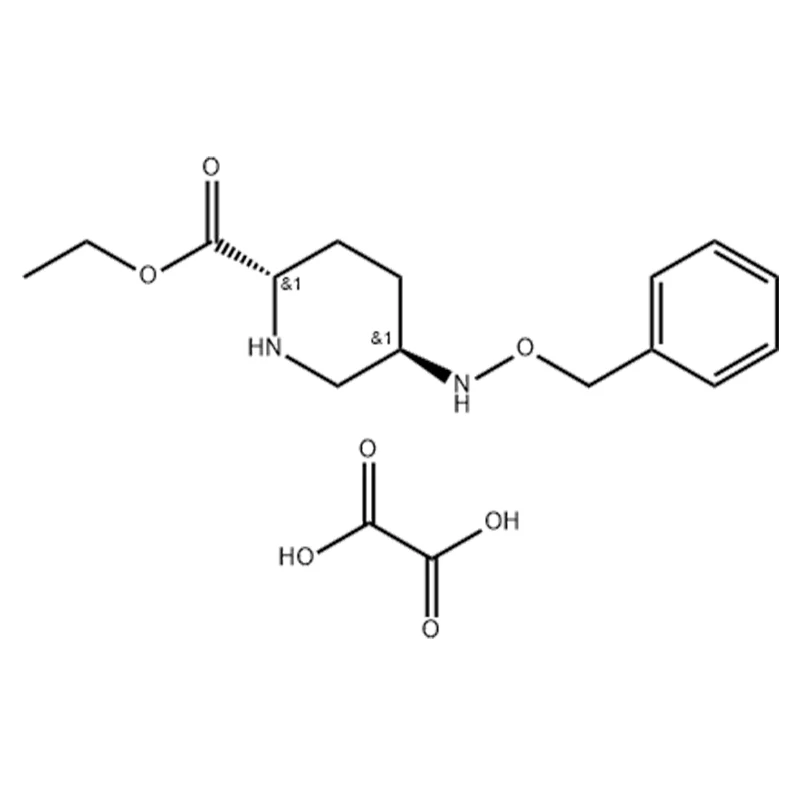
Avibactam INT 1 (CAS 1416134-48-9), also known as (2S,5R)-ethyl 5-((benzyloxy)amino)piperidine-2-carboxylate oxalate or (2S,5R)-benzyloxyaminopiperidine-2-carboxylic acid ethyl oxalate, is a chiral organic compound belonging to the class of piperidine carboxylates. The compound is the oxalate salt of a highly functionalized piperidine derivative with the molecular formula C₁₇H₂₄N₂O₇ and a molecular weight of 368.39 g/mol. It is typically supplied as a white to off‑white solid at purities ranging from 98% to 99%.
In pharmaceutical manufacturing, Avibactam INT 1 plays an irreplaceable role as a key synthetic intermediate and process‑related impurity in the production of Avibactam sodium, a globally approved non‑β‑lactam β‑lactamase inhibitor used in combination with cephalosporins such as ceftazidime‑avibactam (brand name Avycaz) for the treatment of complicated intra‑abdominal infections (cIAI), complicated urinary tract infections (cUTI), and hospital‑acquired bacterial pneumonia (HABP/VABP) caused by multidrug‑resistant Gram‑negative pathogens.
Avibactam irreversibly inhibits the activity of Ambler class A (including extended‑spectrum β‑lactamases, ESBLs, and KPC carbapenemases), class C (AmpC), and some class D (OXA) serine β‑lactamases by forming a covalent adduct with the enzyme that is stable to hydrolysis. Specifically, the β‑lactamase serine residue performs a nucleophilic attack on the amide bond of Avibactam, leading to ring opening and formation of an enzyme–inhibitor complex. This complex is only slowly reversible, keeping the enzyme in a largely inhibited state for an extended period. As the non‑β‑lactam structural scaffold, Avibactam INT 1 enables the irreversible inhibition of β‑lactamases from Mycobacterium tuberculosis and other resistant pathogens, restoring the activity of partner antibiotics (e.g., ceftazidime) against resistant bacterial infections.
In quality control, Avibactam INT 1 is supplied as Avibactam Impurity 27, Impurity 51, and Impurity 9 with detailed characterization data (NMR, HPLC, MS) compliant with regulatory guidelines. It is widely employed for analytical method development, method validation (AMV), quality control (QC), and abbreviated new drug application (ANDA) submissions for Avibactam‑containing drug products.
In fine chemical synthesis, Avibactam INT 1 is extensively used as a research chemical for pharmaceutical development, serving as an organic building block for constructing more complex diazabicyclooctane derivatives, a process development intermediate for API manufacturing, and a reference material for impurity profiling.
|
Parameter |
Specification |
|
CAS Number |
1416134-48-9 |
|
EINECS Number |
866-777-0 |
|
Molecular Formula |
C₁₇H₂₄N₂O₇ |
|
Molecular Weight |
368.39 g/mol |
|
Purity |
≥98% (HPLC) as standard; 99% available upon request |
|
Appearance |
White to off-white solid; white to yellow solid |
|
Storage Condition |
Inert atmosphere (nitrogen or argon), room temperature; alternative storage at 2–8°C |
|
Stability |
Stable for up to 24 months when stored at 2–8°C in sealed, moisture-proof containers; avoid repeated freeze-thaw cycles |
|
Hazard Statements |
H302 (Harmful if swallowed); H315 (Causes skin irritation); H319 (Causes serious eye irritation); H335 (May cause respiratory irritation) |
|
Canonical SMILES |
CCOC(=O)[C@@H]1CCC@@HCN1.O=C(O)C(=O)O |
A documented, scalable industrial synthetic procedure for the preparation of Avibactam INT 1 involves the stereoselective reduction of an imine intermediate followed by oxalate salt formation. The following procedure was performed in a 2000 mL four‑neck flask equipped with a stirring apparatus and a thermometer.
● Ethyl acetate (500 g) and 5‑benzyloxyiminopiperidine-2‑carboxylic acid ethyl ester (110.0 g, 0.4 mol) were charged into the flask.
● The reaction system was cooled to −20 °C to −15 °C.
● Concentrated sulfuric acid (201.0 g, 2.0 mol) was slowly added dropwise while maintaining the temperature.
● After completion of the addition, the mixture was stirred at −20 °C for an additional 1 hour.
● Sodium triacetoxyborohydride (190.0 g, 0.9 mol) was then added portionwise at −20 °C, maintaining the temperature between −20 °C and −15 °C, and the reaction was stirred for 5 hours.
● After completion, the temperature was controlled below 0 °C, and water (200 g) was slowly added to quench the reaction.
● The mixture was neutralized to pH 7–8 with aqueous ammonia.
● The organic layer was separated, washed twice with saturated brine (100 g), and concentrated to recover the solvent.
● To the residue, ethyl acetate (320 g) and methanol (160 g) were added.
● Oxalic acid dihydrate (52.0 g, 0.42 mol) was introduced.
● The mixture was heated to 45 °C and stirred for 2 hours, then cooled to room temperature and filtered.
● The filter cake was washed with a mixed solvent of ethyl acetate/methanol (2:1, 100 g) followed by ethyl acetate (50 g).
● The filter cake was dried under vacuum to obtain the single isomer, (2S,5R)-5-((benzyloxy)amino)piperidine-2-carboxylic acid ethyl ester oxalate (Avibactam INT 1), with a yield of 96.3 g (65.4%) and a chiral HPLC purity of 99.6%.
A contract manufacturing organization (CMO) is scaling up the GMP production of Avibactam sodium to supply the global market for antibiotic‑resistant infections. Avibactam INT 1 is a critical intermediate and process‑related impurity in the multi‑step synthetic pathway to Avibactam sodium. The team monitors the content of Avibactam INT 1 in intermediate batches as an in‑process control (IPC) parameter during the manufacturing process. Final purification and crystallization steps are optimized to ensure that residual Avibactam INT 1 levels in the final API meet stringent ICH and regulatory impurity specifications. Full characterization data, including NMR, chiral HPLC, and MS, are provided for process validation and regulatory filing submissions (IND, NDA, ANDA).
A pharmaceutical QC laboratory is developing an HPLC‑MS method for the quality control of Avibactam sodium API batches. Avibactam INT 1 is supplied as Avibactam Impurity 27 with comprehensive characterization data (NMR, HPLC, GC, MS) compliant with regulatory guidelines. The reference standard is used to prepare calibration curves, establish system suitability parameters, and validate the analytical method for detecting and quantifying this process‑related impurity in Avibactam drug substance. The validated method is implemented for batch‑release testing, stability studies, and impurity profiling, ensuring compliance with ICH guidelines and regulatory requirements for market approval.
A generic pharmaceutical company is developing an Abbreviated New Drug Application (ANDA) for a ceftazidime‑avibactam combination product. The regulatory submission requires comprehensive impurity profiling, including identification and control of process‑related impurities such as Avibactam INT 1. The team purchases Avibactam INT 1 as an impurity reference standard with full COA, stability data, and characterization spectra. The reference standard is used to develop and validate stability‑indicating methods, to identify and quantify impurities in stability samples, and to establish impurity acceptance criteria for the generic drug product, ensuring that the product is safe, effective, and equivalent to the brand‑name reference listed drug (RLD).
A research team in antibacterial drug discovery is developing next‑generation diazabicyclooctane (DBO) β‑lactamase inhibitors with activity against emerging carbapenemase variants (e.g., KPC, NDM, OXA‑48). Using Avibactam INT 1 as a core scaffold, the team performs derivatization at the 5‑position (via the secondary amine after benzyl deprotection) and modifications at the 2‑position (via ester hydrolysis and subsequent functionalization). The resulting novel DBO compounds are evaluated for β‑lactamase inhibition potency (IC₅₀) against a panel of clinically relevant enzymes, including class A, C, and D serine β‑lactamases. The SAR studies identify key structural features required for broad‑spectrum activity and help overcome resistance mechanisms, guiding the selection of preclinical development candidates.
A process chemistry group is developing a scalable synthetic route for a novel DBO β‑lactamase inhibitor for which Avibactam INT 1 is a key intermediate. The team screens various reducing agents (NaBH₄, NaBH(OAc)₃, NaBH₃CN, etc.) and reaction conditions to achieve optimal stereoselectivity and yield for the imine reduction step. Kinetic studies are performed to understand the reaction mechanism and identify the optimal temperature and reagent addition rate. The final optimized process produces Avibactam INT 1 in consistently high yields (>65%) and chiral purity (>99% de), and the process is successfully scaled to pilot‑plant and commercial‑scale manufacturing, enabling cost‑effective production of the novel DBO inhibitor for clinical trials.
A pharmaceutical analytical research group is conducting forced degradation studies on Avibactam sodium drug substance to identify potential degradation products and elucidate the drug‘s degradation pathways. Avibactam INT 1 is used as a potential degradation product or by‑product marker to detect and identify hydrolysis or oxidative degradation products in stress stability studies. Preparative HPLC is employed to isolate degradation products, which are then characterized by LC‑MS/MS and NMR spectroscopy. The identified degradation products are used to update specification limits, monitor stability sample trends, and develop stability‑indicating assays, supporting regulatory submissions and establishing the drug‘s shelf life.
A pharmaceutical analytical laboratory is developing a chiral HPLC method for the simultaneous determination of (2S,5R)‑Avibactam INT 1 and its (2S,5S) diastereomer impurity in Avibactam sodium intermediate batches. Avibactam INT 1 (target isomer) and the (2S,5S) impurity reference standard (if available) are used to optimize chiral separation conditions (column type, mobile phase composition, flow rate, column temperature). The validated chiral method is used to monitor the diastereomeric purity of Avibactam INT 1 in intermediate production and to ensure that the (2S,5S) isomer content meets specifications for downstream API manufacturing. The method is documented and submitted as part of the regulatory quality control package for the Avibactam drug substance.
A research institute investigating new treatment regimens for drug‑resistant tuberculosis is evaluating the synergy between Avibactam (derived from Avibactam INT 1) and meropenem against Mycobacterium tuberculosis clinical isolates. The study uses Avibactam INT 1 as a research chemical to prepare Avibactam for in‑vitro susceptibility testing. Checkerboard assays are conducted to determine the fractional inhibitory concentration index (FICI) of the combination, and time‑kill assays are performed to assess bactericidal activity over time. The results demonstrate synergy between Avibactam and meropenem against a subset of resistant isolates, supporting further preclinical development of the combination for the treatment of drug‑resistant tuberculosis.
Each batch undergoes:
● Gas chromatography (GC) – purity ≥97.0%
● Non‑aqueous titration – purity ≥97.0%
● Refractive index – confirmatory analysis
● ¹H NMR – structural verification
● Appearance – colorless to light yellow to light orange clear liquid
A comprehensive COA, MSDS (with full GHS information), and certificate of origin accompany every shipment.
We look forward to supporting your research and development needs.If you have any questions regarding Avibactam INT 1 (CAS 1416134-48-9) or wish to request a quotation, please do not hesitate to reach out. Our sales and technical support teams are ready to assist you.
Address
No. 2 Yangguang 3rd Road, Duodao Chemical Cycle Industrial Park, Jingmen City, Hubei Province, China
Tel

![1-[2,3-Bis[(9Z,12Z)-octadeca-9,12-dien-1-yloxy]propyl]pyrrolidine](https://www.cosperpharma.com/upload/8820/1-2-3-bis-9z-12z-octadeca-9-12-dien-1-yloxy-propyl-pyrrolidine-349384.webp "1-[2,3-Bis[(9Z,12Z)-octadeca-9,12-dien-1-yloxy]propyl]pyrrolidine")
![1,2,4-Triazolo[4,3-a]pyridin-3(2H)-one](https://www.cosperpharma.com/upload/8820/1-2-4-triazolo-4-3-a-pyridin-3-2h-one-440735.webp "1,2,4-Triazolo[4,3-a]pyridin-3(2H)-one")