
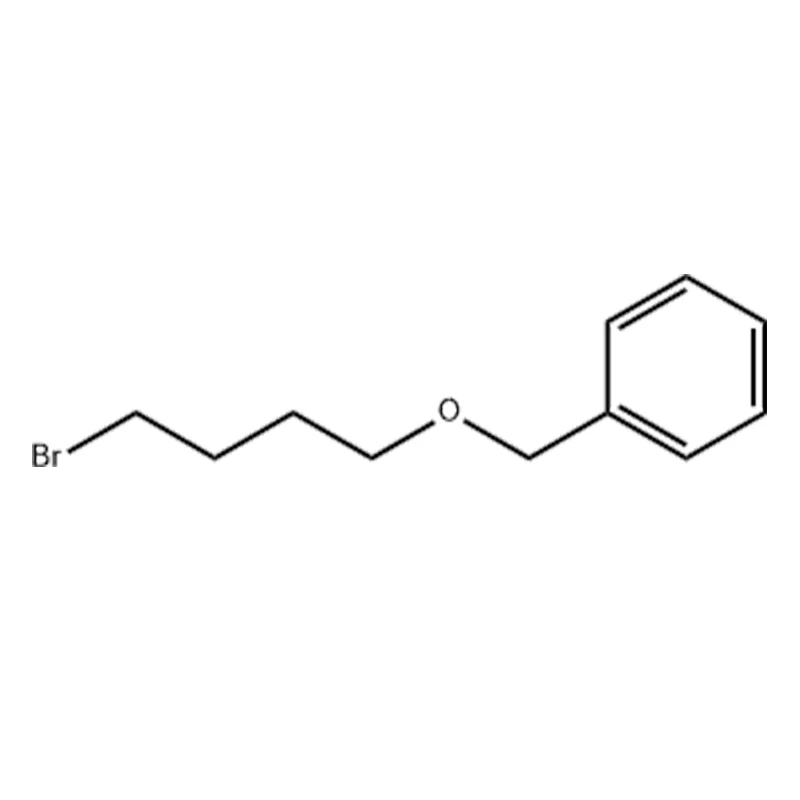
Benzyl 4-bromobutyl ether is a halogenated ether compound that finds extensive application as a key synthetic intermediate in medicinal chemistry and pharmaceutical process development. The bromine atom in Benzyl 4-bromobutyl ether possesses high reactivity and can participate in various nucleophilic substitution reactions, enabling the introduction of hydroxyl, amino, thiol, and other functional groups for subsequent structural modification and diversification. Benzyl 4-bromobutyl ether is employed in the synthesis of monodisperse oligo(tetrahydrofuran) for supramolecular network structures, as well as in the construction of pharmaceutical intermediates and fine chemicals. In the field of targeted protein degradation, Benzyl 4-bromobutyl ether has been identified as a PROTAC (Proteolysis Targeting Chimera) linker building block, where its four-carbon spacing and the orthogonal protecting group strategy facilitate the convergent assembly of heterobifunctional degrader molecules. The predictable reactivity profile and broad synthetic utility of Benzyl 4-bromobutyl ether have established it as an indispensable tool in the modern organic chemist‘s repertoire.
|
Parameter |
Specification |
|
Product Name |
Benzyl 4-bromobutyl ether |
|
CAS Number |
60789-54-0 |
|
Molecular Formula |
C₁₁H₁₅BrO |
|
Molecular Weight |
243.14 g/mol |
|
Purity (GC) |
>96.0% (standard grade); 97% (high-purity grade) |
|
Physical Form |
Colorless to almost colorless clear liquid |
|
Appearance |
Colorless oily liquid |
|
Boiling Point |
115 °C / 0.4 mmHg (lit.); 103–105 °C / 0.3 mmHg (alternative measurement) |
|
Density |
1.275–1.28 g/mL at 25 °C (lit.) |
|
Refractive Index |
n20/D 1.529 (lit.) |
|
Flash Point |
113 °C |
|
LogP |
3.38 (predicted) |
|
Solubility |
Slightly soluble in chloroform and methanol; freely soluble in dichloromethane, ethyl acetate, THF; insoluble in water |
|
Stability |
Stable under recommended conditions; avoid contact with oxidizing agents |
|
Storage Condition |
Room temperature; store in a tightly sealed container in a cool, dry, well-ventilated place; protect from light |
The preparation of Benzyl 4-bromobutyl ether is most commonly accomplished via the Williamson ether synthesis. In a representative procedure described in patent literature (US05864039), 60% sodium hydride (1.2 g, 30 mmol) is suspended in anhydrous tetrahydrofuran (30 mL), and benzyl alcohol (3.0 g, 27.7 mmol) is added dropwise under ice-cooling with stirring. The mixture is stirred at room temperature for 30 minutes to ensure complete formation of the sodium benzyl alkoxide, then cooled again in an ice bath.
Subsequently, 1,4-dibromobutane (6.0 g, 27.8 mmol) is added, and the reaction mixture is stirred for 3 hours at ambient temperature. The use of excess 1,4-dibromobutane relative to the alkoxide minimizes the formation of the bis-ether byproduct. Water is added to quench the reaction, and the mixture is extracted with ethyl acetate. The organic layer is washed with brine, dried over anhydrous sodium sulfate, filtered, and concentrated under reduced pressure. The crude product is purified by silica gel column chromatography or vacuum distillation to afford Benzyl 4-bromobutyl ether as a colorless liquid in approximately 56% yield (3.8 g).
Alternative procedures employ potassium carbonate as the base in DMF or acetonitrile, which allows for milder reaction conditions and simpler workup protocols. The reaction is conveniently monitored by TLC, and the purified product is characterized by ¹H and ¹³C NMR spectroscopy, with the benzylic methylene protons appearing as a singlet at approximately δ 4.50 ppm and the methylene protons adjacent to bromine as a triplet in the region of δ 3.40–3.45 ppm in CDCl₃.
Benzyl 4-bromobutyl ether serves as a key linker building block in the convergent synthesis of PROTAC (Proteolysis Targeting Chimera) molecules, where the four-carbon spacer and orthogonal benzyl protecting group enable sequential coupling of E3 ligase ligands and target protein ligands.
Employed as a bifunctional C4 building block in the synthesis of pharmaceutical candidates, where the alkyl bromide serves as an electrophilic handle for introducing a protected 4-hydroxybutyl chain onto amine, alcohol, thiol, or carbanion nucleophiles.
The primary alkyl bromide undergoes facile SN2 reactions with a broad range of nucleophiles, enabling the installation of diverse functionality at the 1-position for subsequent structural elaboration.
Used in the synthesis of monodisperse oligo(tetrahydrofuran) and supramolecular network structures, where the benzyl-protected bromoalkane serves as a well-defined building block for constructing precision polymer architectures.
The benzyl protecting group can be selectively removed under hydrogenolytic conditions (H₂, Pd/C) or via Lewis acid treatment to liberate 4-bromobutan-1-ol, a versatile intermediate for further oxidation or coupling.
Used as a C4 building block in the total synthesis of complex natural products and biologically active molecules, where the protected alcohol can be unmasked at a strategic late stage to reveal a hydroxyl group required for biological activity.
Employed as a synthetic building block in the development of agrochemical active ingredients and advanced functional materials, where the combination of a reactive halide and a protected alcohol enables modular construction of target architectures.
Used as a reference marker in HPLC and GC methods to monitor the levels of this benzyl-protected intermediate as a process-related impurity in drug substances where benzyl-protected bromoalkanes are employed during synthesis.
Avoid breathing dust/fume/gas/mist/vapours/spray.
Wash skin thoroughly after handling.
Use only outdoors or in a well-ventilated area.
Wear protective gloves/protective clothing/eye protection/face protection.
IF ON SKIN: Wash with plenty of soap and water.
IF INHALED: Remove person to fresh air and keep comfortable for breathing.IF IN EYES: Rinse cautiously with water for several minutes. Remove contact lenses, if present and easy to do. Continue rinsing.
Call a POISON CENTER or doctor if you feel unwell.
Specific treatment (see supplemental first aid instructions on the SDS label).
If skin irritation occurs: Get medical advice/attention.
If eye irritation persists: Get medical advice/attention.
Take off contaminated clothing and wash it before reuse.
Suitable extinguishing media: water spray, alcohol-resistant foam, dry chemical, or carbon dioxide.
Hazardous combustion products: carbon oxides (CO, CO₂), hydrogen bromide gas (HBr).
Firefighters should wear self-contained breathing apparatus.
Considering Benzyl 4-bromobutyl ether for your next synthetic campaign or analytical method development? Let us know a few details, and our team will prepare a personalized quotation tailored to your requirements.
Address
No. 2 Yangguang 3rd Road, Duodao Chemical Cycle Industrial Park, Jingmen City, Hubei Province, China
Tel

![1-[2,3-Bis[(9Z,12Z)-octadeca-9,12-dien-1-yloxy]propyl]pyrrolidine](https://www.cosperpharma.com/upload/8820/1-2-3-bis-9z-12z-octadeca-9-12-dien-1-yloxy-propyl-pyrrolidine-349384.webp "1-[2,3-Bis[(9Z,12Z)-octadeca-9,12-dien-1-yloxy]propyl]pyrrolidine")
![1,2,4-Triazolo[4,3-a]pyridin-3(2H)-one](https://www.cosperpharma.com/upload/8820/1-2-4-triazolo-4-3-a-pyridin-3-2h-one-440735.webp "1,2,4-Triazolo[4,3-a]pyridin-3(2H)-one")