
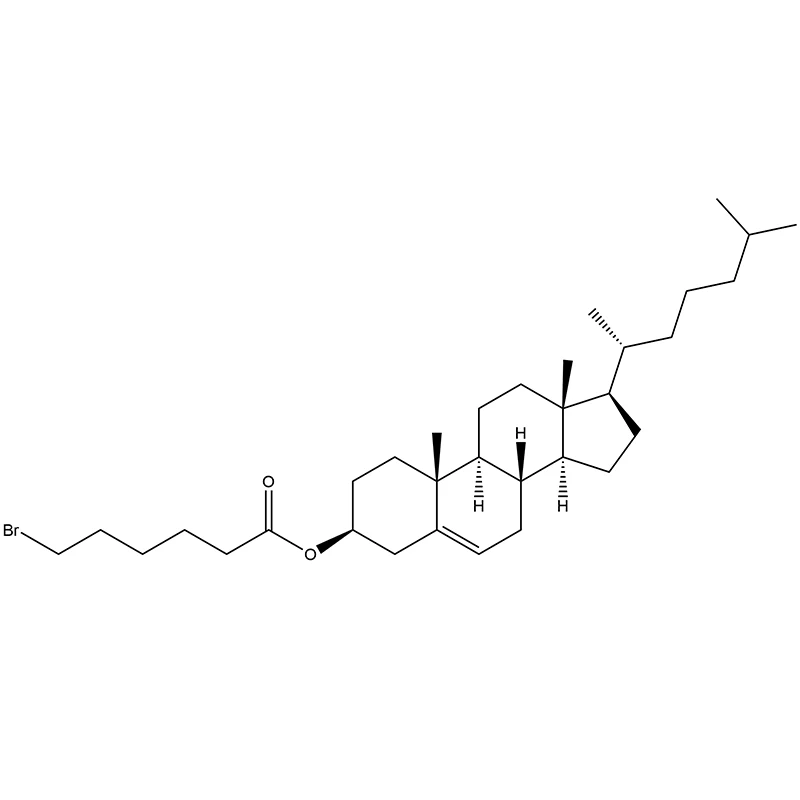
Cholest-5-en-3-ol (3β)-, 3-(6-bromohexanoate) is a cholesterol-based ω-bromoester that serves as a key synthetic intermediate in materials science, supramolecular chemistry, and liquid crystal research. The terminal alkyl bromide in Cholest-5-en-3-ol (3β)-, 3-(6-bromohexanoate) provides a versatile electrophilic handle that can be displaced by phenols, amines, thiols, and carboxylates to install a wide variety of functional groups onto the cholesterol scaffold via a six-carbon spacer. In the field of liquid crystalline materials, Cholest-5-en-3-ol (3β)-, 3-(6-bromohexanoate) has been successfully employed as a building block for the synthesis of unsymmetrical dimesogenic compounds, where it undergoes condensation with 4-(trans-4-n-alkylcyclohexyl)phenols to generate mesogens exhibiting low and wide phase transition temperatures. The cholesterol ester moiety in Cholest-5-en-3-ol (3β)-, 3-(6-bromohexanoate) also serves as a lyotropic liquid crystal template, and the compound has been utilized as a precursor in the synthesis of monodispersive linear supermolecules that stabilize unusual fluid layered phases. Beyond liquid crystal applications, Cholest-5-en-3-ol (3β)-, 3-(6-bromohexanoate) functions as a general-purpose cholesterol-functionalized C6 building block for the preparation of cholesterol-modified polymers, cholesterol-drug conjugates for targeted delivery, and cholesterol-based gelators—where the six-carbon spacer provides an optimal balance between the rigid steroid mesogen and the functional payload, enabling the engineering of self-assembled nanostructures with tunable thermal, optical, and rheological properties.
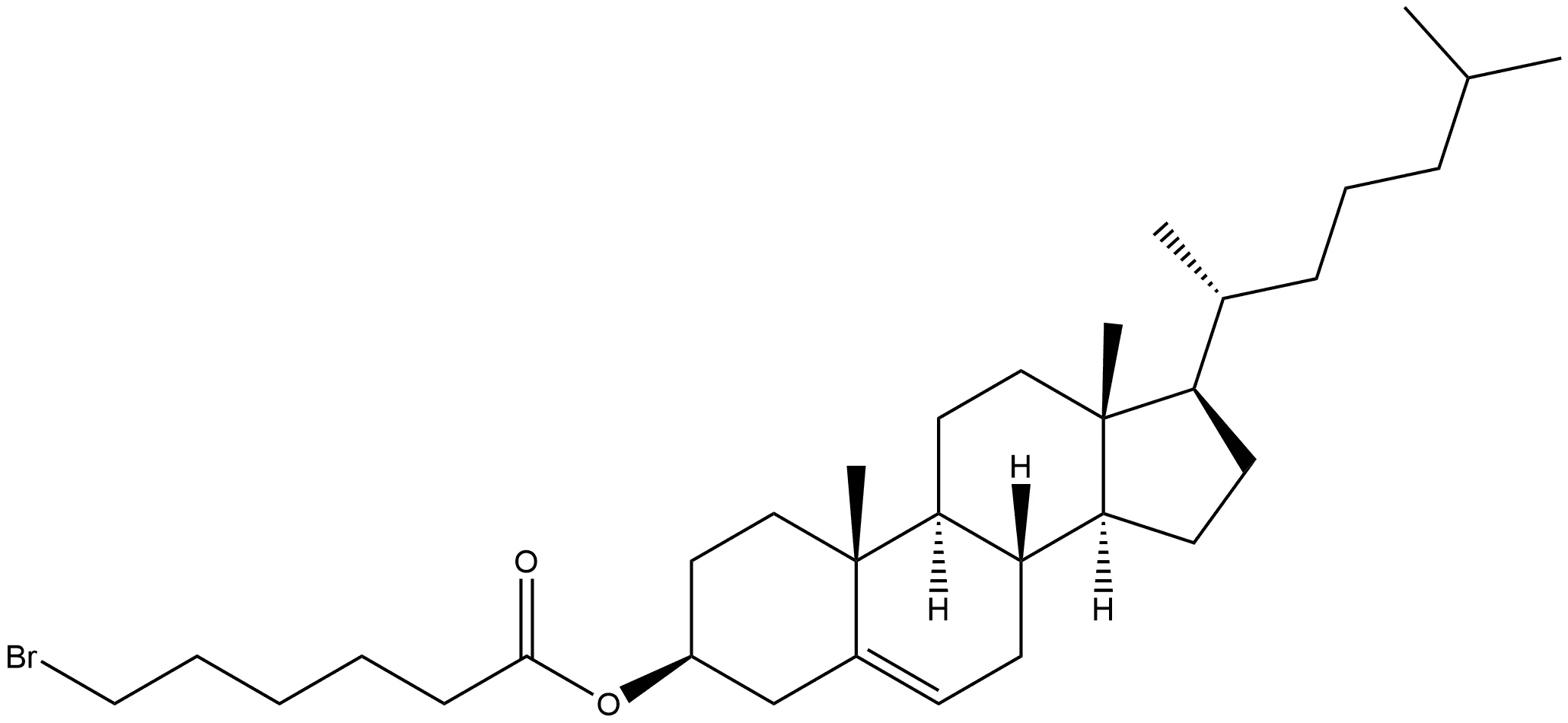
|
Parameter |
Specification |
|
Product Name |
Cholest-5-en-3-ol (3β)-, 3-(6-bromohexanoate) |
|
CAS Number |
82962-33-2 |
|
Molecular Formula |
C₃₃H₅₅BrO₂ |
|
Molecular Weight |
563.69 g/mol |
|
Purity |
≥95.0% (typical specification) |
|
Physical Form |
Crystalline solid |
|
Melting Point |
119–120 °C |
|
Boiling Point |
578.6 ± 43.0 °C (Predicted, 760 Torr) |
|
Density |
1.11 ± 0.1 g/cm³ (Predicted, 25 °C) |
|
Storage Condition |
–20 °C, sealed under inert atmosphere, protected from light and moisture |
A: For long-term integrity, store at –20 °C in a tightly sealed container under an inert atmosphere of nitrogen or argon, protected from light and moisture. The alkyl bromide is susceptible to hydrolysis and nucleophilic displacement, and the ester linkage may undergo slow hydrolysis under humid conditions; therefore, storage under anhydrous, inert conditions is essential for maintaining product quality.
A: The compound is typically synthesized via Steglich esterification of cholesterol with 6-bromohexanoic acid using DCC or EDC·HCl as the coupling reagent and DMAP as a catalyst in anhydrous dichloromethane. Alternatively, the acid chloride of 6-bromohexanoic acid may be reacted with cholesterol in the presence of a base such as pyridine or triethylamine. Purification by recrystallization from ethanol or silica gel column chromatography affords the product as a white crystalline solid in 70–90% yield.
Each batch undergoes:
● Gas chromatography (GC) – purity ≥97.0%
● Non‑aqueous titration – purity ≥97.0%
● Refractive index – confirmatory analysis
● ¹H NMR – structural verification
● Appearance – colorless to light yellow to light orange clear liquid
A comprehensive COA, MSDS (with full GHS information), and certificate of origin accompany every shipment.
Cholest-5-en-3-ol (3β)-, 3-(6-bromohexanoate) serves as a key building block in the synthesis of unsymmetrical dimesogenic compounds. It undergoes condensation with 4-(trans-4-n-alkylcyclohexyl)phenols to generate mesogens exhibiting cholesteric liquid crystalline phases with low and wide phase transition temperatures, confirmed by DSC, polarizing optical microscopy, and XRD.
Used as a precursor for monodispersive linear supermolecules that stabilize unusual fluid layered phases. The cholesterol scaffold directs hierarchical self-assembly, while the six-carbon tether provides conformational flexibility for nanostructure formation.
The terminal alkyl bromide enables attachment of the cholesterol moiety to hydroxyl- or amine-terminated polymers via Williamson etherification or amine alkylation, producing cholesterol-end-capped macromolecules for surface modification, drug delivery, and biomimetic materials.
Cholesterol esters are well-established low-molecular-weight organogelators. Derivatives of Cholest-5-en-3-ol (3β)-, 3-(6-bromohexanoate), where the bromide is displaced with functional groups capable of hydrogen bonding or π–π stacking, may serve as gelators for organic solvents and oils.
The ω-bromo group can be displaced by amine-containing drug molecules to construct cholesterol-drug conjugates, where the lipophilic cholesterol scaffold facilitates incorporation into lipid nanoparticles, liposomes, or cellular membranes for targeted drug delivery.
Alkylation of secondary or tertiary amines with Cholest-5-en-3-ol (3β)-, 3-(6-bromohexanoate) yields cholesterol-based cationic lipids that can be formulated into lipid nanoparticles for siRNA, mRNA, or plasmid DNA delivery.
Displacement of the bromide with thiol-terminated anchoring groups generates cholesterol-thiol conjugates suitable for forming self-assembled monolayers on gold surfaces, enabling the study of cholesterol-mediated molecular recognition and membrane interactions.
The well-defined structure and reactive bromide handle make Cholest-5-en-3-ol (3β)-, 3-(6-bromohexanoate) a versatile platform for systematically varying the attached mesogen or functional group to elucidate structure–property relationships governing liquid crystalline phase behavior, thermal transitions, and optical properties.
Interested in incorporating Cholest-5-en-3-ol (3β)-, 3-(6-bromohexanoate) into your liquid crystal synthesis or supramolecular materials research program? Share a few details with our team, and we will prepare a personalized quotation tailored to your project.
Address
No. 2 Yangguang 3rd Road, Duodao Chemical Cycle Industrial Park, Jingmen City, Hubei Province, China
Tel

![1-[2,3-Bis[(9Z,12Z)-octadeca-9,12-dien-1-yloxy]propyl]pyrrolidine](https://www.cosperpharma.com/upload/8820/1-2-3-bis-9z-12z-octadeca-9-12-dien-1-yloxy-propyl-pyrrolidine-349384.webp "1-[2,3-Bis[(9Z,12Z)-octadeca-9,12-dien-1-yloxy]propyl]pyrrolidine")
![1,2,4-Triazolo[4,3-a]pyridin-3(2H)-one](https://www.cosperpharma.com/upload/8820/1-2-4-triazolo-4-3-a-pyridin-3-2h-one-440735.webp "1,2,4-Triazolo[4,3-a]pyridin-3(2H)-one")