
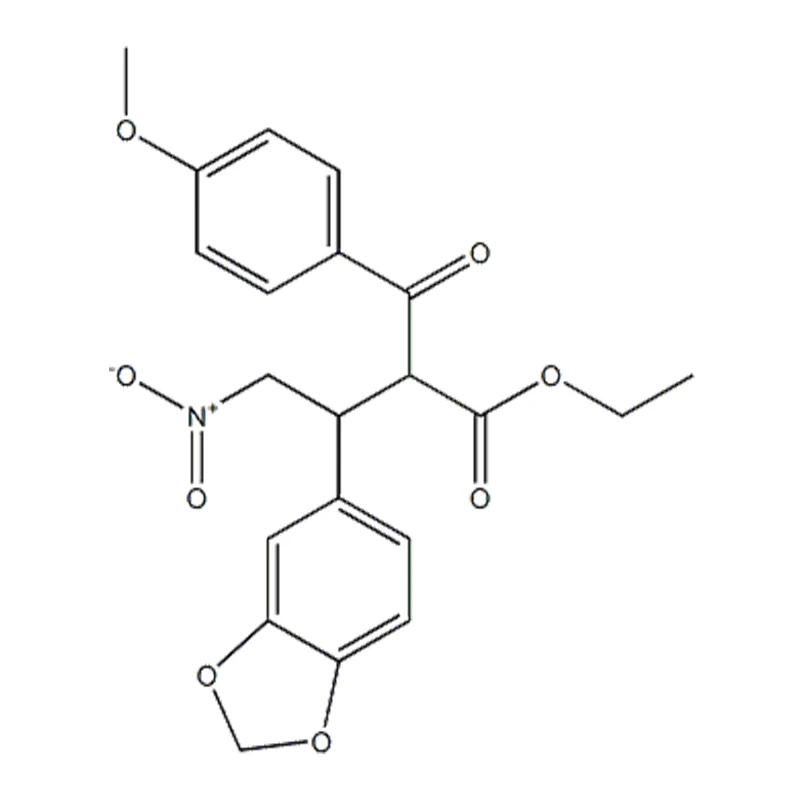
Ethyl 2-(4-Methoxybenzoyl)-3-(3,4-Methylenedioxy-phenyl)-4-nitro-butanoate is an advanced multi-functional intermediate associated with the synthesis of the endothelin receptor antagonist Atrasentan. In pharmaceutical impurity profiling, Ethyl 2-(4-Methoxybenzoyl)-3-(3,4-Methylenedioxy-phenyl)-4-nitro-butanoate serves as a key reference standard and process-related impurity used in forced degradation studies, analytical method validation, and quality control testing for Atrasentan hydrochloride formulations. The chemical structure of Ethyl 2-(4-Methoxybenzoyl)-3-(3,4-Methylenedioxy-phenyl)-4-nitro-butanoate includes two substituted aromatic moieties separated by a three-carbon backbone bearing a nitro group, providing a framework for constructing more complex endothelin antagonist scaffolds. For generic pharmaceutical manufacturers developing Abbreviated New Drug Applications (ANDA) for Atrasentan, Ethyl 2-(4-Methoxybenzoyl)-3-(3,4-Methylenedioxy-phenyl)-4-nitro-butanoate is an indispensable tool for establishing impurity profiles, demonstrating product consistency, and meeting regulatory requirements for reference standards.
|
Parameter |
Specification |
|
CAS Number |
173864-45-4 |
|
Molecular Formula |
C₂₁H₂₁NO₈ |
|
Molecular Weight |
415.39 g/mol |
|
Purity (HPLC) |
≥98% (customizable upon request) |
|
Appearance |
Crystalline solid (typically white to off-white) |
|
Boiling Point |
603.2 ± 55.0 °C (Predicted) |
|
Density |
1.311 ± 0.06 g/cm³ (Predicted) |
|
pKa |
7.74 ± 0.58 (Predicted) |
|
Storage Condition |
Sealed in dry, cool location; maintain under inert atmosphere for long-term storage |
|
Solubility |
Soluble in chloroform, dichloromethane (DCM), ethyl acetate, methanol, ethanol, and other organic solvents |
|
Stability |
Stable under recommended storage conditions; protect from light and moisture |
Preparation of Ethyl 2-(4-Methoxybenzoyl)-3-(3,4-Methylenedioxy-phenyl)-4-nitro-butanoate
The synthesis of Ethyl 2-(4-Methoxybenzoyl)-3-(3,4-Methylenedioxy-phenyl)-4-nitro-butanoate typically proceeds through a multi-step convergent route that assembles the two aromatic fragments onto a central three-carbon backbone bearing the nitro group and ethyl ester.
While the complete synthetic route for this specific compound is not extensively detailed in the public domain, the structural features indicate it is generated as an intermediate or a process-related impurity during the preparation of Atrasentan and related endothelin receptor antagonists. The synthesis likely involves the following key transformations:
1.Formation of the β-keto ester core: Construction of the central C3 backbone via condensation of an appropriately functionalized 4-methoxybenzoyl equivalent with an ethyl acetate-derived nucleophile.
2.Introduction of the nitro group: Either direct nitration of a preformed enolate intermediate or addition of a nitromethyl unit through a Henry-type or Michael addition sequence.
3.Attachment of the methylenedioxyaryl group: Incorporation of the 3,4-methylenedioxyphenyl moiety via an alkylation or addition reaction to the electrophilic β-keto ester system.
4.Final purification: Crystallization or chromatographic purification to achieve ≥98% HPLC purity, with structural confirmation by ¹H NMR, ¹³C NMR, and mass spectrometry.
A: Yes. Cosperpharm can provide traceability documentation against pharmacopeial standards (USP or EP) based on feasibility. Please specify your traceability requirements at the time of inquiry.
A: No. This product is supplied for analytical research and laboratory use only. It is not intended for human consumption, therapeutic administration, or in vivo applications.
Store Ethyl 2-(4-Methoxybenzoyl)-3-(3,4-Methylenedioxy-phenyl)-4-nitro-butanoate sealed in a tightly closed container, placed in a dry, cool location away from direct sunlight and sources of ignition. For long-term storage exceeding six months, it is strongly recommended to store the material under an inert atmosphere (nitrogen or argon) at refrigerated temperatures (2–8°C) to preserve optimal stability. Minimize exposure to atmospheric moisture and light during handling to prevent degradation.
Accelerated stability studies (40°C / 75% RH) and long-term stability data for this compound are available upon request to support your regulatory filing.
Ready to source high-quality Ethyl 2-(4-Methoxybenzoyl)-3-(3,4-Methylenedioxy-phenyl)-4-nitro-butanoate for your Atrasentan impurity profiling, analytical method validation, regulatory filing, or pharmaceutical research program? Contact Cosperpharm today.
Address
No. 2 Yangguang 3rd Road, Duodao Chemical Cycle Industrial Park, Jingmen City, Hubei Province, China
Tel

![1-[2,3-Bis[(9Z,12Z)-octadeca-9,12-dien-1-yloxy]propyl]pyrrolidine](https://www.cosperpharma.com/upload/8820/1-2-3-bis-9z-12z-octadeca-9-12-dien-1-yloxy-propyl-pyrrolidine-349384.webp "1-[2,3-Bis[(9Z,12Z)-octadeca-9,12-dien-1-yloxy]propyl]pyrrolidine")
![1,2,4-Triazolo[4,3-a]pyridin-3(2H)-one](https://www.cosperpharma.com/upload/8820/1-2-4-triazolo-4-3-a-pyridin-3-2h-one-440735.webp "1,2,4-Triazolo[4,3-a]pyridin-3(2H)-one")