
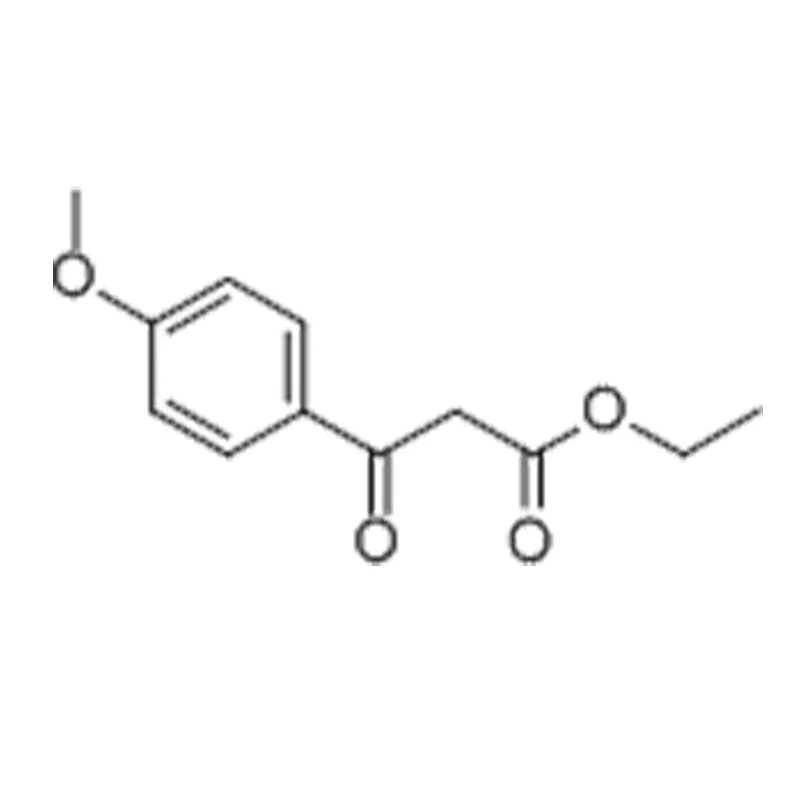
Ethyl 3-(4-methoxyphenyl)-3-oxopropanoate is a versatile β-keto ester widely utilized as a synthetic intermediate in the preparation of pharmaceutically active compounds and fine chemicals. In medicinal chemistry, Ethyl 3-(4-methoxyphenyl)-3-oxopropanoate serves as a key precursor for constructing heterocyclic scaffolds including pyrazoles, pyrimidines, isoxazoles, and coumarin derivatives, many of which exhibit antimicrobial, anti-inflammatory, and enzyme inhibitory activities.
The reactivity of Ethyl 3-(4-methoxyphenyl)-3-oxopropanoate stems from its α-methylene group flanked by two electron-withdrawing carbonyl functionalities, enabling facile enolate formation under mild basic conditions. Ethyl 3-(4-methoxyphenyl)-3-oxopropanoate also participates in Pechmann condensation with resorcinol derivatives to produce 4-aryl coumarins, and undergoes one-pot multi-component reactions with arylhydrazines and other coupling partners to generate diverse heterocyclic libraries. These transformation capabilities position Ethyl 3-(4-methoxyphenyl)-3-oxopropanoate as an indispensable building block for both academic research and industrial pharmaceutical manufacturing.
|
Parameter |
Specification |
|
CAS Number |
2881-83-6 |
|
Molecular Formula |
C₁₂H₁₄O₄ |
|
Molecular Weight |
222.24 g/mol |
|
Purity (as supplied) |
≥98% (GC) |
|
Appearance |
Light yellow to yellow to orange clear liquid |
|
Density |
1.160 g/mL at 20 °C (lit.) |
|
Boiling Point |
154 °C at 1 hPa (lit.) / 170 °C at 14 mmHg |
|
Refractive Index |
1.5410 to 1.5460 |
|
Flash Point |
115 °C |
|
Solubility |
Soluble in water (approx. 1.7 g/L at 20 °C); soluble in organic solvents (THF, ethyl acetate, ethanol, DMSO) |
|
pKa |
10.34 ± 0.25 (Predicted) |
|
Storage Condition |
Sealed in dry, room temperature; store in a cool, well-ventilated area |
|
MDL Number |
MFCD00449636 |
|
HS Code / Customs Code |
2918990090 |
|
WGK Germany |
3 |
The target compound can be prepared via two primary routes. The first route starts from p-hydroxybenzaldehyde, proceeding through methylation to form p-anisaldehyde, followed by condensation and esterification steps. A more direct and widely adopted laboratory synthesis uses p-methoxyacetophenone as the starting material via Claisen condensation with diethyl carbonate.
To a stirred mixture of sodium hydride (3 mol equivalents) and diethyl carbonate (4 mol equivalents) in 50 mL of tetrahydrofuran (THF), p-methoxyacetophenone (1 mol equivalent) is slowly added dropwise over 30 minutes or more under an inert atmosphere. The reaction mixture is heated to reflux for 3–4 hours until the solution turns dark brown. Reaction progress is monitored by thin layer chromatography (TLC) using 10% ethyl acetate/hexane as the mobile phase.
After completion, the mixture is cooled to room temperature and carefully acidified with 5 mL of glacial acetic acid, followed by addition of 100 mL of ice-cold dilute hydrochloric acid solution. The aqueous phase is extracted with ethyl acetate (3 × 75 mL). The combined organic phases are washed sequentially with saturated sodium bicarbonate solution, saturated saline, and deionized water. The organic layer is dried over anhydrous sodium sulfate and concentrated under reduced pressure to yield Ethyl 3-(4-methoxyphenyl)-3-oxopropanoate as a viscous liquid in good yield (typically 60–85%). The product structure is confirmed by ¹H NMR and ¹³C NMR spectroscopy, with spectral data consistent with literature reports.
Ethyl 3-(4-methoxyphenyl)-3-oxopropanoate should be stored sealed in a dry, well-ventilated area at room temperature (15–25°C). Keep the container tightly closed when not in use. Store in a cool, dry place away from direct sunlight and sources of ignition. Opened containers must be carefully resealed and stored upright to prevent leakage. Avoid prolonged exposure to moisture as hydrolysis may occur over extended periods.
For long-term storage (>12 months), refrigeration at 2–8°C is recommended to maintain optimal stability. Accelerated and long-term stability data are available upon request from Cosperpharm.
Used as a building block for constructing heterocyclic drug candidates, including anti-inflammatory, antimicrobial, and enzyme-targeting agents. Serves as a precursor for pyrazole, pyrimidine, and isoxazole pharmacophores.
Participates in Pechmann condensation (with resorcinol to produce 7-hydroxy-4-(4-methoxyphenyl)coumarin) and one-pot multi-component reactions for the preparation of diverse heterocyclic libraries.
β-Keto esters are important intermediates in the synthesis of plant protection agents and agrochemical active ingredients.
β-Keto ester derivatives have applications as precursors for organoleptic compounds including flavors, fragrances, and masking agents.
Widely used in teaching laboratories for demonstrating Claisen condensation, enolate chemistry, and heterocyclic synthesis. Also used in method development and synthetic methodology research.
Pharmaceutical process chemists use this intermediate for reaction optimization, impurity profiling, and commercial manufacturing route development.
Ready to source high-quality Ethyl 3-(4-methoxyphenyl)-3-oxopropanoate for your pharmaceutical, agrochemical, or research applications? Contact Cosperpharm today.
Address
No. 2 Yangguang 3rd Road, Duodao Chemical Cycle Industrial Park, Jingmen City, Hubei Province, China
Tel

![1-[2,3-Bis[(9Z,12Z)-octadeca-9,12-dien-1-yloxy]propyl]pyrrolidine](https://www.cosperpharma.com/upload/8820/1-2-3-bis-9z-12z-octadeca-9-12-dien-1-yloxy-propyl-pyrrolidine-349384.webp "1-[2,3-Bis[(9Z,12Z)-octadeca-9,12-dien-1-yloxy]propyl]pyrrolidine")
![1,2,4-Triazolo[4,3-a]pyridin-3(2H)-one](https://www.cosperpharma.com/upload/8820/1-2-4-triazolo-4-3-a-pyridin-3-2h-one-440735.webp "1,2,4-Triazolo[4,3-a]pyridin-3(2H)-one")