
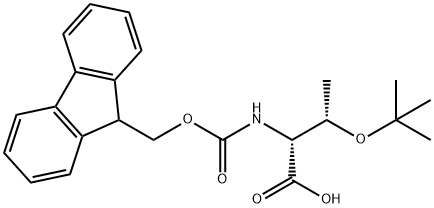
Fmoc-D-Thr(tBu)-OH is the standard building block for the incorporation of D‑threonine residues into peptides via Fmoc solid‑phase peptide synthesis. The Fmoc protecting group in Fmoc-D-Thr(tBu)-OH ensures robust N‑terminal protection during chain assembly, while the tert‑butyl ether group provides efficient protection of the hydroxyl side chain, preventing side reactions such as O‑acylation, elimination, or dehydration under standard peptide coupling conditions. The D‑enantiomer configuration of Fmoc-D-Thr(tBu)-OH makes it particularly valuable for synthesizing protease‑resistant peptides and non‑natural peptide sequences where backbone stereochemistry influences biological activity and metabolic stability. Additionally, Fmoc-D-Thr(tBu)-OH serves as a versatile building block in the preparation of peptidomimetics, O‑glycopeptide analogs, and constrained peptide structures. The tBu side‑chain protection is removed simultaneously with the final cleavage and deprotection step using TFA (typically 95% TFA with scavengers), allowing for the unmasking of the free hydroxyl group at the end of the synthesis.
Product Parameters
|
Parameter |
Specification |
|
Product Name |
Fmoc-D-Thr(tBu)-OH |
|
CAS Number |
|
|
Molecular Formula |
|
|
Molecular Weight |
|
|
Appearance |
|
|
Melting Point |
|
|
Boiling Point |
581.7±50.0℃ |
|
Solubility |
|
|
Storage Temperature |
2–8 °C (long-term) |
FAQ
Q1: What is the stereochemistry of Fmoc-D-Thr(tBu)-OH?
A: Fmoc-D-Thr(tBu)-OH is (2R,3S)-configured — D‑configuration at the α‑carbon (C2) and L‑configuration at the β‑carbon (C3) relative to the natural L‑threonine backbone. The absolute stereochemistry is maintained as in natural threonine at the β‑carbon due to the biosynthetic origin, while the α‑carbon has been inverted to the D‑configuration.
Q2: How is the tBu side‑chain protecting group removed?
A: The tert‑butyl ether group is removed under strongly acidic conditions during the final cleavage step using 95% TFA with appropriate scavengers (e.g., TIS, EDT, water). Unlike the Fmoc group, tBu is stable to basic conditions throughout chain assembly.
Storage Conditions
Store Fmoc-D-Thr(tBu)-OH in a tightly sealed container at 2–8 °C (refrigerator) in a dry, dark place. For long‑term storage (>12 months), store at –20 °C under inert atmosphere (nitrogen or argon). The compound should be protected from moisture and light. Allow the sealed container to reach ambient temperature before opening to minimize moisture condensation.
Shelf life: 3 years when stored at –20 °C in a sealed container; 2 years when stored at 2–8 °C.
Handling precautions: Use in a fume hood. Wear chemical‑resistant gloves, safety goggles, and a lab coat. Avoid generating dust. Wash hands thoroughly after handling. Refer to the Safety Data Sheet (SDS) for complete safety information.
Application Scenarios
1. Fmoc SPPS (Solid‑Phase Peptide Synthesis)
Fmoc-D-Thr(tBu)-OH is the standard building block for introducing D‑threonine residues into peptides via Fmoc solid‑phase peptide synthesis. The Fmoc group is removed with 20% piperidine in DMF, and the free amino group is coupled to the next Fmoc‑protected amino acid using activation reagents (HATU recommended for hindered D‑amino acids).
2. Protease‑Resistant Peptide Development
D‑Threonine residues introduced via Fmoc-D-Thr(tBu)-OH confer proteolytic stability to peptide sequences, preventing recognition and cleavage by endogenous proteases. This is essential for developing long‑acting peptide therapeutics, including antimicrobial peptides and enzyme‑resistant analogs of endogenous hormones.
3. O‑Glycopeptide Synthesis
After removal of the tBu protecting group, the free hydroxyl can be glycosylated to generate O‑glycopeptides. The tBu protection ensures that the hydroxyl remains unmodified during chain assembly, allowing for late‑stage glycosylation or direct incorporation of glycosylated threonine building blocks.
4. O‑Phosphopeptide Synthesis
The free hydroxyl unmasked after tBu removal can be phosphorylated to produce O‑phosphopeptides, which are valuable tools for studying kinase/phosphatase signaling pathways and protein‑protein interactions.
5. Antimicrobial Peptide (AMP) Synthesis
Fmoc-D-Thr(tBu)-OH is used in the synthesis of antimicrobial peptides containing D‑amino acids, which exhibit enhanced stability against bacterial proteases and often show improved antimicrobial activity compared to all‑L counterparts.
6. Cyclic Peptide Synthesis
Fmoc-D-Thr(tBu)-OH is used as a building block for side‑chain‑to‑side‑chain and side‑chain‑to‑backbone cyclization strategies after removal of the tBu group and activation of the free hydroxyl.
7. Peptide Impurity Reference Standard
Fmoc-D-Thr(tBu)-OH serves as an analytical reference standard for enantiomeric purity testing of Fmoc‑L‑Thr(tBu)‑OH batches, ensuring that L‑configured building blocks used in therapeutic peptide manufacturing are free from D‑enantiomer contamination.
8. Process Development & Scale‑Up
Peptide chemists use Fmoc-D-Thr(tBu)-OH for reaction optimization (coupling conditions for D‑amino acids, deprotection efficiency), impurity mapping, and development of scalable commercial routes for D‑amino acid‑containing peptide APIs.
Contact us
Looking for a dependable source of Fmoc-D-Thr(tBu)-OH for your peptide synthesis pipeline? Cosperpharm is ready to supply.
Address
No. 2 Yangguang 3rd Road, Duodao Chemical Cycle Industrial Park, Jingmen City, Hubei Province, China
Tel

![1-[2,3-Bis[(9Z,12Z)-octadeca-9,12-dien-1-yloxy]propyl]pyrrolidine](https://www.cosperpharma.com/upload/8820/1-2-3-bis-9z-12z-octadeca-9-12-dien-1-yloxy-propyl-pyrrolidine-349384.webp "1-[2,3-Bis[(9Z,12Z)-octadeca-9,12-dien-1-yloxy]propyl]pyrrolidine")
![1,2,4-Triazolo[4,3-a]pyridin-3(2H)-one](https://www.cosperpharma.com/upload/8820/1-2-4-triazolo-4-3-a-pyridin-3-2h-one-440735.webp "1,2,4-Triazolo[4,3-a]pyridin-3(2H)-one")