
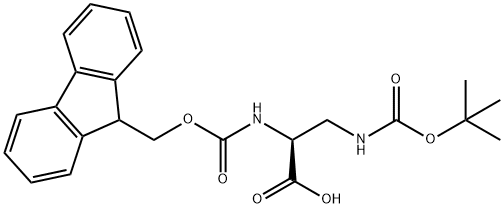
Fmoc-Dap(Boc)-OH serves as a pivotal building block in Fmoc/t-Bu solid-phase peptide synthesis, enabling the site-specific incorporation of 2,3-diaminopropionic acid residues into peptide sequences. The orthogonal protection scheme of Fmoc-Dap(Boc)-OH — with Fmoc on the α-amino group and Boc on the β-amino group — allows chemists to selectively deprotect and functionalize either position during peptide assembly, a feature that has been successfully exploited in the synthesis of bicyclic peptide frameworks such as the tachykinin NK2 antagonist MEN 11420. The β-amino group of Fmoc-Dap(Boc)-OH provides a unique orthogonal handle for site-specific conjugation of fluorescent dyes, quenchers, or biotin moieties, making this compound indispensable for advanced peptide labeling and probe development. Furthermore, Fmoc-Dap(Boc)-OH enables systematic structure-activity relationship (SAR) analysis of side-chain length effects on biological activity when substituting lysine residues. As a validated commercial reagent, Fmoc-Dap(Boc)-OH is available with HPLC purity typically ≥97.0% and is widely stocked by major suppliers including Sigma-Aldrich.
Product Parameters
|
Parameter |
Specification |
|
Product Name |
Fmoc-Dap(Boc)-OH |
|
CAS Number |
|
|
Molecular Formula |
|
|
Molecular Weight |
|
|
Appearance |
White to almost white crystalline powder |
|
Melting Point |
131–139 °C |
|
Density |
1.263 ± 0.06 g/cm³ (predicted) |
|
Boiling Point |
652.5 ± 55.0 °C at 760 mmHg (predicted) |
|
Water Solubility |
Slightly soluble in water |
|
Storage Condition |
2-8℃ |
Why Cosperpharm?
When your solid-phase peptide synthesis campaign demands orthogonally protected building blocks with verified enantiopurity and documented batch-to-batch consistency, Cosperpharm delivers Fmoc-Dap(Boc)-OH with the analytical rigor and supply flexibility that pharmaceutical and biotechnology customers require.
Orthogonal protection begins with verified quality. The Fmoc and Boc protecting groups in Fmoc-Dap(Boc)-OH must remain intact through multiple synthesis cycles. Any premature deprotection or racemization in this starting material will compromise your peptide sequence fidelity. Our analytical release protocol includes HPLC purity verification (≥97.0%), optical rotation confirmation ([α]²⁰/D = −6.4° in MeOH), and identity verification by NMR and ESI-MS — because your peptide’s biological activity depends on the stereochemical integrity of this building block.
Documentation that supports regulatory submission. Every shipment includes a Certificate of Analysis (COA) with batch-specific HPLC purity, optical rotation data, and chromatographic traceability. Custom quality agreements and comprehensive documentation packages are available upon request for customers developing peptide-based therapeutics.
Flexible supply across all development stages. Cosperpharm supplies Fmoc-Dap(Boc)-OH from research-grade quantities (1g–10g) for exploratory peptide synthesis and SAR studies, to bulk quantities for commercial peptide manufacturing. R&D samples ship within 5–7 business days; bulk orders ship within 2–3 weeks.
Technical support for the full synthetic cascade. Our process chemistry team can advise on deprotection strategies (piperidine for Fmoc removal; TFA for Boc cleavage), coupling condition optimization, and analytical methods for detecting process-related impurities — because we have worked extensively with this constrained diamino acid scaffold across multiple peptide manufacturing campaigns.
Global reach with transparent pricing. Cosperpharm ships to pharmaceutical manufacturers, CROs, and research institutions worldwide, with full customs documentation included. Volume discounts apply at kilogram scales, and we communicate lead times upfront.
FAQ
Q1: What is the difference between Fmoc-Dap(Boc)-OH and Fmoc-Lys(Boc)-OH?
A: Fmoc-Dap(Boc)-OH has a C₂ side-chain spacer (single methylene) between the α-carbon and the β-amino group, whereas Fmoc-Lys(Boc)-OH has a C₄ spacer. This shorter, more rigid spacer provides distinct conformational properties and enables different peptide backbone geometries.
Q2: What is the solubility of Fmoc-Dap(Boc)-OH?
A: Fmoc-Dap(Boc)-OH is soluble in DMSO (≥49.5 mg/mL) and ethanol (≥16.57 mg/mL), but is insoluble in water. DMF is also a suitable solvent for peptide synthesis applications.
Storage Conditions
Store Fmoc-Dap(Boc)-OH in a tightly sealed container at 2–8 °C. Keep the container dry, protected from light, and stored in a clean, well-ventilated area away from strong oxidizing agents, strong acids, and strong bases. The compound is hygroscopic; therefore, desiccated storage is recommended and the container should be opened only in a low-humidity environment. Allow the sealed container to reach ambient temperature before opening to minimize moisture condensation.
Shelf life: Stable for extended periods when stored at 2–8 °C in a sealed, dry container. Please refer to the Certificate of Analysis for batch-specific expiration dating.
Handling precautions: Use only in a fume hood. Wear chemical-resistant gloves, safety goggles, and a lab coat. Avoid generating dust or aerosols. Do not eat, drink, or smoke in work areas. After handling, wash hands thoroughly. Contaminated clothing should be removed and washed before reuse. Refer to the Safety Data Sheet (SDS) for complete safety information.
Contact Us
Securing Fmoc-Dap(Boc)-OH for your peptide synthesis campaign, SAR study, or bioconjugation project should be straightforward. Cosperpharm makes it simple.
Address
No. 2 Yangguang 3rd Road, Duodao Chemical Cycle Industrial Park, Jingmen City, Hubei Province, China
Tel

![1-[2,3-Bis[(9Z,12Z)-octadeca-9,12-dien-1-yloxy]propyl]pyrrolidine](https://www.cosperpharma.com/upload/8820/1-2-3-bis-9z-12z-octadeca-9-12-dien-1-yloxy-propyl-pyrrolidine-349384.webp "1-[2,3-Bis[(9Z,12Z)-octadeca-9,12-dien-1-yloxy]propyl]pyrrolidine")
![1,2,4-Triazolo[4,3-a]pyridin-3(2H)-one](https://www.cosperpharma.com/upload/8820/1-2-4-triazolo-4-3-a-pyridin-3-2h-one-440735.webp "1,2,4-Triazolo[4,3-a]pyridin-3(2H)-one")