
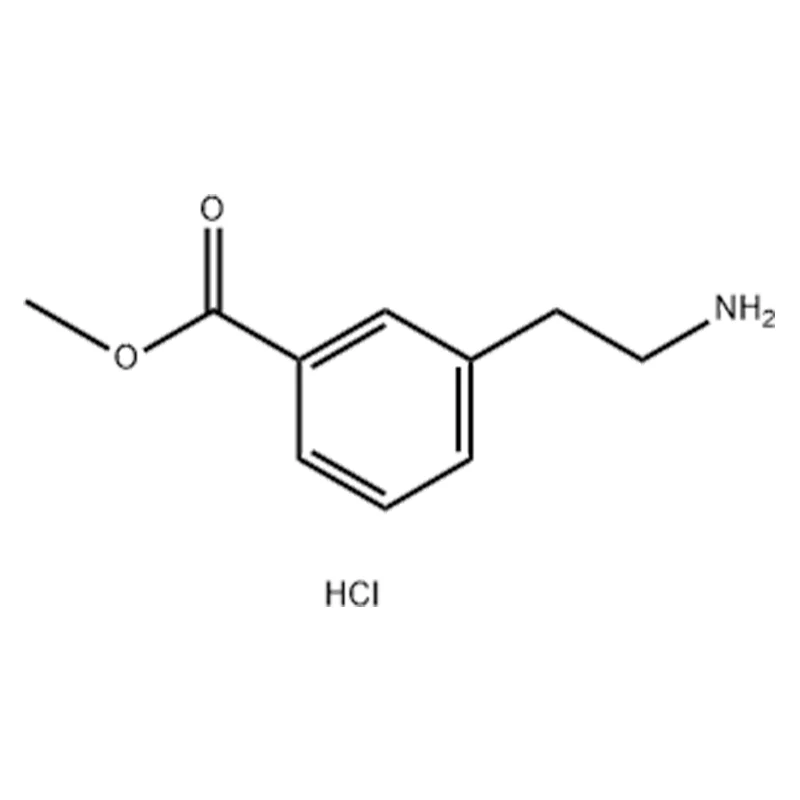
Methyl 3-(2-Aminoethyl)benzoate Hydrochloride (also referred to as 3-(2-Aminoethyl)benzoic acid methyl ester HCl) is a versatile building block widely employed in medicinal chemistry and organic synthesis, serving as a key intermediate for the preparation of pharmaceutically relevant compounds including isothiocyanates and carbamate derivatives with anticancer potential. In drug discovery programs, Methyl 3-(2-Aminoethyl)benzoate Hydrochloride functions as a bifunctional linker, providing both an ester handle (convertible to carboxylic acid, amide, or reduced alcohol) and a primary amine (suitable for urea, thiourea, or sulfonamide formation), enabling rapid access to diverse compound libraries.
The biological activity of Methyl 3-(2-Aminoethyl)benzoate Hydrochloride is primarily attributed to its ability to modulate neurotransmitter systems following incorporation into larger molecular architectures. Beyond its utility in anticancer agent synthesis, Methyl 3-(2-Aminoethyl)benzoate Hydrochloride has been investigated as a structural analog within the procainamide series of class IA antiarrhythmic drugs, which function by blocking cardiac sodium channels and slowing irregular electrical impulses in myocardial tissue. The hydrochloride salt form of Methyl 3-(2-Aminoethyl)benzoate Hydrochloride contributes to its enhanced aqueous solubility relative to the free base, facilitating its use in aqueous reaction media and biological assay systems.
|
Parameter |
Specification |
|
Product Name |
Methyl 3-(2-Aminoethyl)benzoate Hydrochloride |
|
CAS Number |
167846-36-8 |
|
Molecular Formula |
C₁₀H₁₄ClNO₂ |
|
Molecular Weight |
215.68 g/mol |
|
Purity |
≥95% (HPLC); higher purity up to 98% available upon request |
|
Appearance |
White to off-white solid |
|
Melting Point |
145–150°C |
|
Solubility |
Slightly soluble in DMSO, slightly soluble in water |
|
Morphology |
Solid |
|
Color |
White to off-white |
|
Stability |
Hygroscopic — store under inert atmosphere |
|
Storage Condition |
Hygroscopic, -20°C freezer, under inert atmosphere, sealed |
A: Methyl 3-(2-Aminoethyl)benzoate Hydrochloride is a synthetic building block used primarily in medicinal chemistry and organic synthesis. It serves as an intermediate in the preparation of isothiocyanates (which have shown anticancer activity), carbamate derivatives, urea-based compounds, and analogs of procainamide-related antiarrhythmic agents.
A: The hydrochloride salt provides enhanced aqueous solubility compared to the free base, making the compound more compatible with biological assays and aqueous reaction systems. It also improves long-term storage stability by reducing susceptibility to amine oxidation.
Methyl 3-(2-Aminoethyl)benzoate Hydrochloride is hygroscopic and must be stored in a tightly sealed container under an inert atmosphere (nitrogen or argon). Store in a -20°C freezer to preserve optimal stability. Keep the container tightly closed when not in use, and allow the sealed container to reach ambient temperature before opening to minimize moisture condensation. Avoid prolonged exposure to humidity, as the compound may absorb atmospheric moisture over time. Do not store near oxidizing agents or strong acids.
Accelerated stability data and long-term stability summaries are available upon request for customers incorporating this intermediate into regulated processes.
This compound serves as a precursor for preparing isothiocyanates, which have been reported to exhibit anticancer activity. The primary amine can be converted to the corresponding isothiocyanate via reaction with thiophosgene or carbon disulfide followed by desulfurization, generating electrophilic fragments for covalent modification studies.
As a structural analog within the procainamide series of class IA antiarrhythmic drugs, this building block is used in the synthesis of novel cardiac sodium channel modulators. The meta-substituted benzoate framework distinguishes these derivatives from para-substituted procainamide itself.
The meta-substituted aminoethylbenzoate motif has been investigated in the Hansl series of CNS-active agents for cognitive enhancement applications. This intermediate provides convenient access to nootropic compound libraries for structure-activity relationship studies.
The primary amine enables one-step synthesis of ureas (with isocyanates), carbamates (with chloroformates), and thioureas (with isothiocyanates), supporting medicinal chemistry hit-to-lead optimization programs across multiple therapeutic areas.
The amine can be coupled with carboxylic acids or activated esters (EDC/HOBt, HATU, DCC) to generate amides, making this compound a useful fragment for constructing peptidomimetic or heterocyclic compound libraries. The methyl ester can be hydrolyzed to generate a second coupling partner in orthogonal protection strategies.
Pharmaceutical process chemists use this intermediate for reaction optimization, impurity mapping, and commercial route development. Cosperpharm provides characterization data and process support to facilitate seamless scale-up from laboratory to pilot plant.
High-purity material (≥98%) serves as an analytical reference standard for HPLC method validation, impurity identification, and quality control testing of downstream pharmaceutical compounds prepared from this building block.
Getting quality intermediates into your lab or production line should be straightforward. Cosperpharm — Precision Intermediates for Pharmaceutical Innovation.
Address
No. 2 Yangguang 3rd Road, Duodao Chemical Cycle Industrial Park, Jingmen City, Hubei Province, China
Tel

![1-[2,3-Bis[(9Z,12Z)-octadeca-9,12-dien-1-yloxy]propyl]pyrrolidine](https://www.cosperpharma.com/upload/8820/1-2-3-bis-9z-12z-octadeca-9-12-dien-1-yloxy-propyl-pyrrolidine-349384.webp "1-[2,3-Bis[(9Z,12Z)-octadeca-9,12-dien-1-yloxy]propyl]pyrrolidine")
![1,2,4-Triazolo[4,3-a]pyridin-3(2H)-one](https://www.cosperpharma.com/upload/8820/1-2-4-triazolo-4-3-a-pyridin-3-2h-one-440735.webp "1,2,4-Triazolo[4,3-a]pyridin-3(2H)-one")