
The drug co-crystalization technology represents an innovative drug development strategy that does not alter the chemical structure of the original drug; instead, it optimizes the drug's physicochemical properties through physical means—such as enhancing solubility, improving stability, and increasing bioavailability. This approach can facilitate synergistic therapeutic effects and reduce toxicity while enhancing efficacy, thereby helping to address certain challenges associated with conventional compound-based drugs and combination therapies.
Another advantage of the drug co-crystalization technology is its ability to circumvent the patent barriers surrounding original drugs. Since the novel chemical entity formed through drug co-crystalization possesses novelty, practicality, and creativity—thereby meeting the requirements for patent application examination—this approach provides pharmaceutical companies and R&D institutions with a new research and development direction, incentivizing them to invest greater R&D resources in this field.
Eutectic drug development: a low-risk, low-investment yet high-return approach for new drug NDA submissions
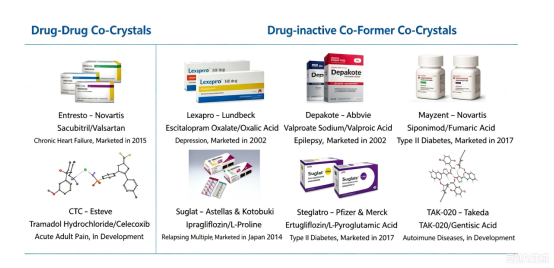
Entresto – Novartis
Entresto is a cardiovascular medication developed by Novartis for the treatment of heart failure; its active ingredient is LCZ696, which is a drug-drug co-crystal composed of sacubitril and valsartan sodium.
In 2015, both the FDA and the European Union approved Nuxinuo through their expedited review pathways, classifying it as a first-in-class new drug. The breakthrough of Nuxinuo lies in its use of eutectic technology to enhance the drug's bioavailability and therapeutic efficacy, enabling it to rapidly become the market leader.
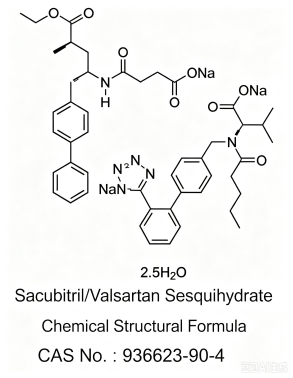
Valsartan is a marketed API in this drug formulation, whereas sacubitril is a novel API. These two APIs form a synergistic effect within the same crystal lattice, achieving a clinical efficacy where '1+1> 2'. In Noxinuo, the oral bioavailability of sacubitril is ≥60%, while the oral bioavailability of valsartan is increased by 50%; furthermore, no significant food-induced effects are observed.
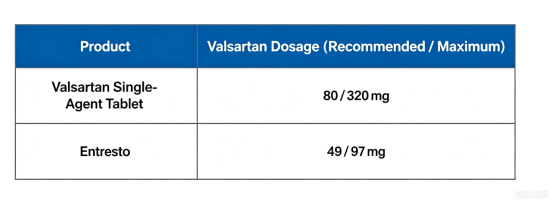
In 2019, Norvasc became Novartis' highest-selling cardiovascular drug (for chronic heart failure), generating $1.73 billion in net sales for Novartis—a 68% increase compared with 2018—highlighting the tremendous commercial potential of the eutectic technology.
According to the guidance principles issued by the U.S. Food and Drug Administration (FDA), if the active pharmaceutical ingredients (APIs) contained in a co-crystal have already been approved for specific therapeutic uses, the co-crystal product may not require new clinical trials. The FDA views such co-crystals as novel dosage forms of existing drugs and requires submission of a New Drug Application under Section 505(b)(2), rather than classifying them as entirely new drugs.
Sinolite's Sacubitril-Aldactin Sodium Tablets
Sacubitril-aliskiren sodium tablets are a drug containing a sacubitril–aliskiren co-crystal, which has submitted a registration application to the Center for Drug Evaluation (CDE) of China under the requirements for Category 1 new drugs. Based on patent information, it can be inferred that the API–API co-crystal composition of sacubitril-aliskiren sodium tablets includes two active ingredients: Active Ingredient 1 is sacubitril, while the co-crystal active ingredient 2 is the active metabolite EXP3174 of aliskiren—this represents a novel active molecule.
By comparing the structural relationship between the metabolite EXP3174 and alesanatamab, it can be inferred that Sarcopenia Tablets containing sacubitril and alesanatamab share similarities in their drug design philosophy with Nohsinto. However, Xinlitai has adopted a unique R&D approach in the field of drug–drug co-crystals, successfully obtaining approval for a novel domestic drug–drug co-crystal formulation—a practice that is highly worthy of emulation and reference within China's pharmaceutical industry.
The successful development of Nohsinto and Xinlitai has provided new perspectives and methodologies for drug discovery. According to industry reports, compared with traditional new drug development timelines and costs, the R&D timeline for co-crystal formulations can be shortened by up to several years; this not only accelerates patients' access to new therapies but also significantly reduces R&D and regulatory compliance costs.
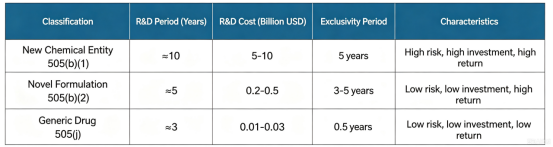
Selected representative eutectic drugs already approved for market
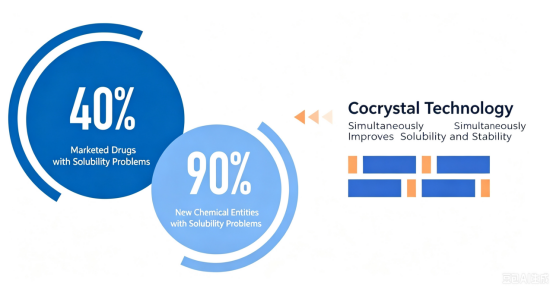
Advantages of eutectoid structures
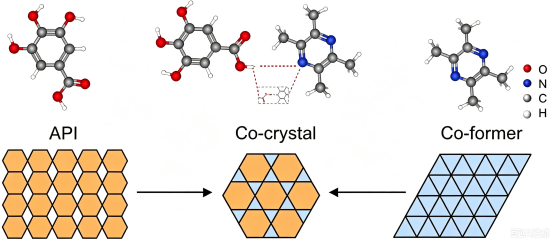
The eutectic technology enables the formation of eutectic compounds by conjugating the API with an appropriate eutectic modifier (CCF), thereby improving key parameters such as drug solubility, bioavailability, thermal stability, and mechanical properties.
Approximately 40% of marketed drugs and 90% of new chemical entities face solubility challenges, which can lead to significant clinical deficiencies in existing products. Co-crystalization technology is crucial for enhancing the bioavailability of poorly soluble drugs and improving the stability of their formulations, making it a preferred solution for BSC Class II and Class IV compounds.
Accelerating drug approval and extending market exclusivity periods:
Drugs modified via eutectic technology often pass clinical trials more rapidly due to improved absorption characteristics, thereby shortening the time-to-market for these products. The commercialization of drug eutectic formulations offers a novel approach to new drug development, holds promise for alleviating the currently time-and effort-intensive nature of new drug R&D, and positions them as a viable alternative to traditional pharmaceuticals.
Improves the physicochemical properties of drugs and enhances their stabilit.:
Eutectic mixtures can significantly improve the physicochemical properties of APIs—such as melting point, solubility, permeability, stability, bioavailability, and mechanical properties—without disrupting the covalent bonds within the API. Eutectic mixtures enable the generation of a wider variety of solid forms for pharmaceuticals; particularly for active pharmaceutical ingredients that are amorphous, low-melting-point, non-dissociated, or exhibit a low pKa, eutectic systems serve as an important approach for modifying the solid form of these drugs.
Reducing costs and improving production efficiency:
One of the primary advantages of eutectic mixtures is that both components exist in crystalline form, offering superior stability, which facilitates manufacturing and storage. Another advantage is that eutectic mixtures can be prepared using simple and low-cost methods, are easy to scale up, reduce losses during the production process, enhance batch production efficiency, and ultimately contribute to lower production costs over the long term.
Eutectoid Preparation Technology
The preparation techniques for eutectics can be broadly categorized into two main types: the solvent-based method and the solvent-free method; each method possesses its own unique advantages and specific application scenarios. The solvent-based methods—such as evaporation crystallization, cooling crystallization, and solvation crystallization—are renowned for their ease of operation and high efficiency; however, they require careful control to avoid the formation of solvates. In contrast, solvent-free techniques—such as the grinding method, hot melt extrusion, and microwave-induced crystallization—better align with the principles of green chemistry by reducing the environmental impact associated with solvent usage.
The identification of excipients typically involves tests such as the differentiation between active pharmaceutical ingredients (APIs) and excipients, impurity testing, and confirmation of physical properties. Currently, commonly used methods for excipient identification include high-performance liquid chromatography (HPLC), gas chromatography (GC), mass spectrometry (MS), and atomic absorption spectroscopy (AAS).
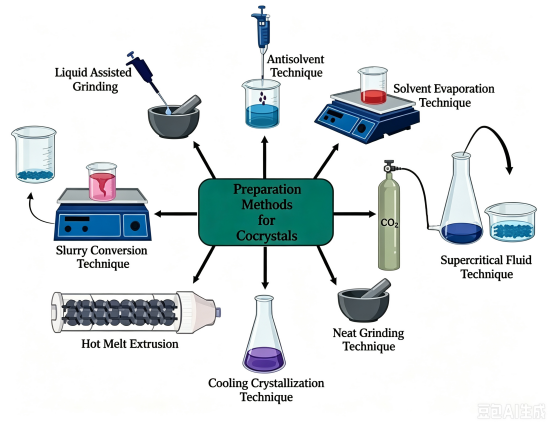
Technical Selection Considerations
Selecting an appropriate eutectoid preparation technique requires consideration of multiple factors:
Properties of APIs and ligands: solubility, thermal stability, and intermolecular interaction forces.
Process requirements: energy consumption, cost, scalability feasibility, production efficiency, and environmental friendliness.
Product characteristics: Influence of polymorph, particle size distribution, and crystal morphology on bioavailability.
Eutectoid screening
Eutectic screening is a critical step in eutectic drug development; it directly impacts the performance, quality, and production efficiency of eutectic products.
Eutectic screening is an experimental screening process used to determine whether candidate eutectic ligands (CCFs) can form a eutectic complex with the target API. Eutectic screening aims to rapidly and efficiently identify combinations of ligands and crystallization conditions that can form stable eutectic structures with the API. This process typically involves the following methods:
Suspension crystallization method:
By adding an excess of API and ligand to the solution, the formation of the co-crystal can be promoted by leveraging the solubility–precipitation equilibrium during stirring. Ultrasonic assistance can accelerate this process and enhance screening efficiency.
Hot-melt method:
The Differential Scanning Calorimetry (DSC) method analyzes the thermal effects observed during the heating of a sample to determine whether a eutectic phenomenon occurs, thereby confirming the possibility of eutectic formation. This method is suitable for rapidly ruling out combinations that do not form an eutectic mixture, although further validation may be required.
Trituration:
This process includes both dry and wet grinding methods, which utilize mechanical force to promote intermolecular interactions and facilitate the formation of eutectics; it is well-suited for preliminary screening and small-scale preparation.
![benzo[1,2-b:4,5-b']difuran-2,6(3H,7H)-dione](https://www.cosperpharma.com/upload/8820/benzo-1-2-b-4-5-b-difuran-2-6-3h-7h-dione-204233.png "benzo[1,2-b:4,5-b']difuran-2,6(3H,7H)-dione")