
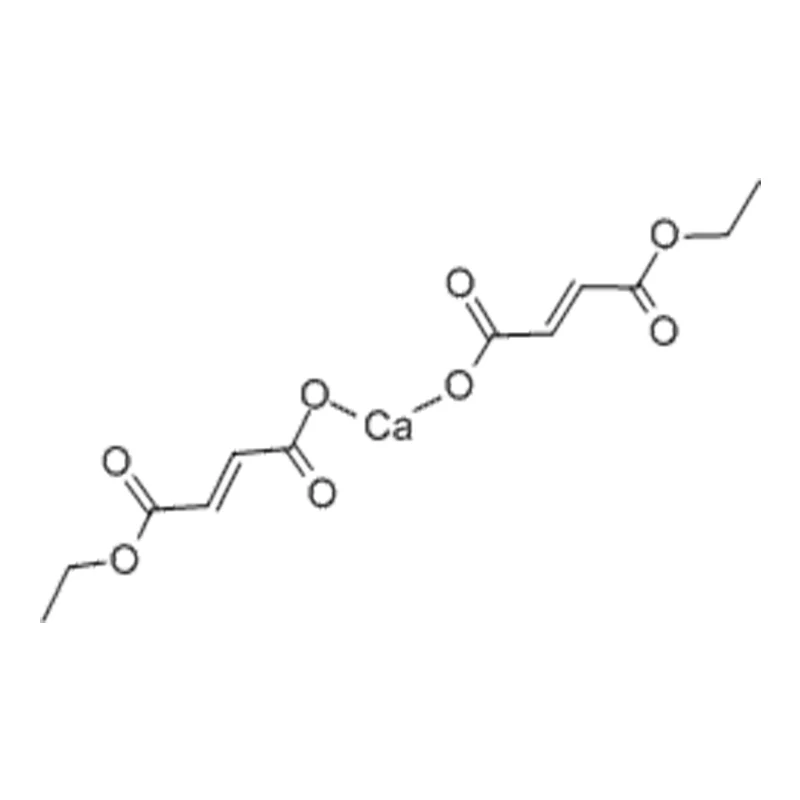
The free monoethyl fumarate (the parent acid) is a sticky, low‑melting semisolid that is difficult to weigh, prone to dimerization, and can cause skin irritation. Fumaric acid monoethyl ester calcium salt transforms this problematic material into a free‑flowing, non‑hygroscopic crystalline powder. Fumaric acid monoethyl ester calcium salt can be accurately dispensed, stored for years at room temperature without degradation, and shipped without special cold‑chain requirements. In chemical reactions, the free monoester is liberated on demand by treating a suspension of Fumaric acid monoethyl ester calcium salt with a dilute mineral acid – or the salt can be used directly in certain transformations (e.g., transesterification, amidation with in‑situ activation). This makes Fumaric acid monoethyl ester calcium salt the preferred form for process chemistry, kilo‑scale synthesis, and academic research.
|
Parameter |
Specification |
|
CAS Number |
62008-22-4 |
|
Molecular Formula |
C₁₂H₁₄CaO₈ |
|
Molecular Weight |
326.31 g/mol |
|
Melting Point |
285 °C (dec.) |
|
Appearance |
White to off-white crystalline powder |
|
Stability |
Stable at room temperature; decomposes above 285 °C |
|
Storage |
Sealed in dry container, room temperature, away from strong acids and bases |
|
Hazard Symbols |
Xi (Irritant) |
|
Risk Codes |
36/37/38 – Irritating to eyes, respiratory system and skin |
|
Safety Statements |
26 – In case of eye contact, rinse with plenty of water and seek medical advice; 36 – Wear suitable protective clothing |
|
WGK Germany |
WGK 1 (slightly hazardous to water) |
|
Advantage |
What It Means for You |
|
Crystalline solid vs. sticky oil |
Easy to weigh, no residue on spatula. No need to melt or scrape. |
|
Non-hygroscopic |
Does not absorb moisture from air. Shelf-stable even in humid environments. |
|
High thermal stability |
Stable at room temperature indefinitely. Decomposes only above 285 °C. |
|
Controlled release of active monoester |
Add acid to generate the free monoester in situ – ideal for one-pot reactions. |
|
Benign calcium counterion |
Calcium is non-toxic, can be removed by filtration as CaSO₄ or CaCO₃, and poses no disposal issues. |
|
Scalable and economical |
Made from low-cost starting materials (fumaric acid, ethanol, calcium hydroxide/carbonate). |
|
Reduced safety hazard |
Much less irritating than the free monoester acid; dust is the main concern. |
A: Suspend 1 eq (by mole of the salt) in a mixture of water and ethyl acetate (1:1). Add 2 eq of dilute HCl (e.g., 1 M) per mole of calcium. Stir until the solid dissolves. Separate the organic layer, dry over Na₂SO₄, and evaporate to obtain the free monoethyl fumarate as a colorless to pale yellow oil. The free acid is now ready for coupling reactions.
A: It is possible but not ideal. If you add a coupling reagent like HATU and a base (DIPEA) to a suspension of the calcium salt in DMF, the carboxylate may be activated but the reaction may be slow due to poor solubility. The preferred method is to first generate the free monoester as described above. For routine lab use, we strongly recommend the two‑step procedure.
Ready to say goodbye to sticky oils and hard‑to‑weigh monoesters? Cosperpharm supplies CAS 62008‑22‑4 as a free‑flowing, stable calcium salt that makes your synthesis cleaner and your process more reproducible. Whether you need 5 grams for a proof‑of‑concept or 50 kilograms for pilot production, we have the inventory and the scale‑up capability.
Address
No. 2 Yangguang 3rd Road, Duodao Chemical Cycle Industrial Park, Jingmen City, Hubei Province, China
Tel

![1-[2,3-Bis[(9Z,12Z)-octadeca-9,12-dien-1-yloxy]propyl]pyrrolidine](https://www.cosperpharma.com/upload/8820/1-2-3-bis-9z-12z-octadeca-9-12-dien-1-yloxy-propyl-pyrrolidine-349384.webp "1-[2,3-Bis[(9Z,12Z)-octadeca-9,12-dien-1-yloxy]propyl]pyrrolidine")
![1,2,4-Triazolo[4,3-a]pyridin-3(2H)-one](https://www.cosperpharma.com/upload/8820/1-2-4-triazolo-4-3-a-pyridin-3-2h-one-440735.webp "1,2,4-Triazolo[4,3-a]pyridin-3(2H)-one")