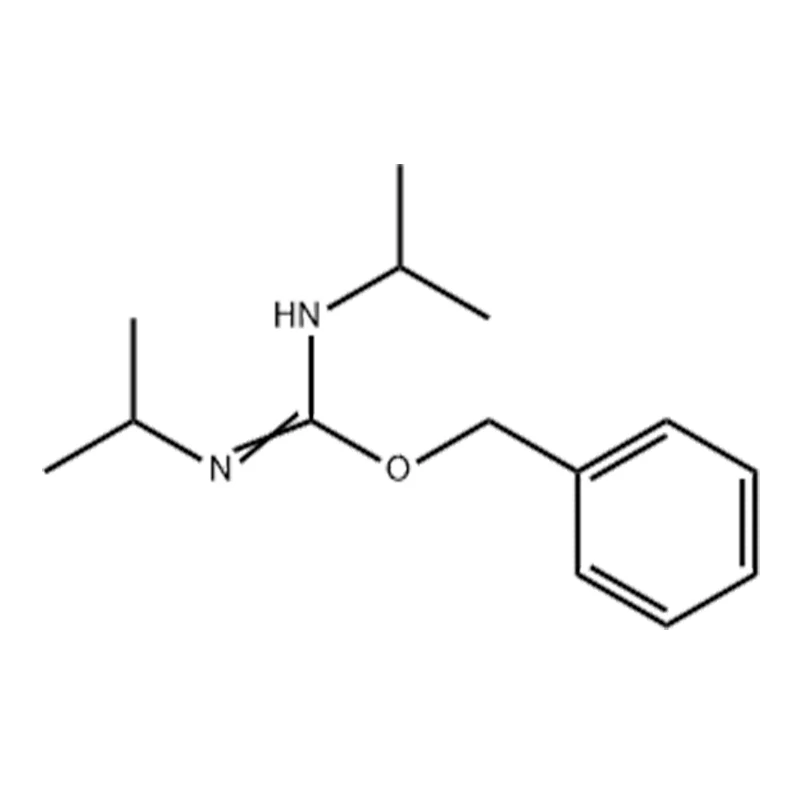
Traditional methods for benzyl ester formation — such as treatment of carboxylic acids with benzyl bromide and a base, or with benzyl alcohol under Mitsunobu conditions — can be plagued by side reactions (elimination, racemization) and/or require harsh conditions. O-Benzyl-N,N'-diisopropylisourea provides a superior alternative, offering a fundamentally different mechanistic path. In the presence of a carboxylic acid, O‑Benzyl‑N,N'‑diisopropylisourea acts as a dehydrating agent via its isourea moiety, facilitating the formation of a reactive O‑acylisourea intermediate that is then attacked by the carboxylate anion to yield the benzyl ester. With O-Benzyl-N,N'-diisopropylisourea, the byproduct, N,N′‑diisopropylurea, is typically soluble in organic solvents, simplifying purification to a simple filtration or aqueous wash. Critically, the reaction proceeds without racemization at α‑chiral centers, making O‑Benzyl‑N,N'‑diisopropylisourea indispensable for the synthesis of chiral molecules, including complex natural products and pharmaceutical intermediates.
|
Parameter |
Specification |
|
CAS Number |
2978-10-1 |
|
IUPAC Name |
O-Benzyl-N,N'-diisopropylisourea |
|
Molecular Formula |
C₁₄H₂₂N₂O |
|
Molecular Weight |
234.34 g/mol |
|
Boiling Point |
105 °C / 1.1 mmHg (lit.) |
|
Flash Point |
186 °C |
|
Specific Gravity (20/20) |
0.96 |
|
Refractive Index |
1.5000 (lit.) |
|
pKa (Predicted) |
9.46 ± 0.50 |
|
Appearance |
Colorless to light yellow to light orange clear liquid |
|
Storage |
2-8℃,protect from light |
|
Purity |
≥97.0% (GC, titration) |
|
Feature |
What It Means for You |
|
Mild conditions |
The esterification proceeds at moderate temperatures (often room temperature to 60 °C), preserving sensitive functional groups. |
|
Racemization-free |
The reaction proceeds with inversion of configuration at the benzylic carbon, making it suitable for chiral molecules without loss of optical purity. |
|
Easy purification |
The N,N'-diisopropylurea byproduct is soluble in common organic solvents and can be removed by filtration or an aqueous workup, avoiding column chromatography in many cases. |
|
High selectivity |
The reagent selectively esterifies carboxylic acids, leaving alcohols, phenols, and amines untouched under standard conditions. |
|
No added base required |
Unlike benzyl halide alkylations that require a stoichiometric base (often leading to side reactions), BDIU acts as both the activating and alkylating agent in one. |
|
Stable liquid |
Easy to handle, dispense, and store. |
BDIU is prepared by the reaction of N,N'-diisopropylcarbodiimide (DIC) with benzyl alcohol. The synthesis is straightforward and scalable, but for routine research applications, Cosperpharm offers the reagent in high purity, ready for immediate use.
Each batch undergoes:
● Gas chromatography (GC) – purity ≥97.0%
● Non‑aqueous titration – purity ≥97.0%
● Refractive index – confirmatory analysis
● ¹H NMR – structural verification
● Appearance – colorless to light yellow to light orange clear liquid
A comprehensive COA, MSDS (with full GHS information), and certificate of origin accompany every shipment.
A: The key difference lies in the amine substituents. BDIU uses isopropyl groups, whereas the dicyclohexyl analogue uses cyclohexyl groups. The N,N'‑diisopropylurea byproduct from BDIU is generally more soluble in organic solvents and easier to remove by filtration or aqueous workup compared to N,N'‑dicyclohexylurea, which can be less soluble and sometimes precipitates. BDIU is therefore often the preferred reagent when purification is a primary concern.
A: A general procedure: dissolve the carboxylic acid (1.0 equiv) in an inert solvent such as toluene, DCM, or THF. Add BDIU (1.1–1.5 equiv) and warm to 40–80 °C for 2–12 hours. Monitor by TLC. Upon completion, cool the mixture, filter off any precipitated urea, and concentrate the filtrate. Purify by flash chromatography or recrystallization. For acid‑sensitive substrates, running the reaction at room temperature for longer periods is also feasible.
Need a reliable benzylating agent that won’t racemize your chiral substrate? Cosperpharm supplies O-Benzyl-N,N'-diisopropylisourea (CAS 2978‑10‑1) with verified purity and full documentation. Whether you need 1 mL for a reaction screen or 1 L for process development, we’re ready to deliver.
Address
No. 2 Yangguang 3rd Road, Duodao Chemical Cycle Industrial Park, Jingmen City, Hubei Province, China
Tel

![1-[2,3-Bis[(9Z,12Z)-octadeca-9,12-dien-1-yloxy]propyl]pyrrolidine](https://www.cosperpharma.com/upload/8820/1-2-3-bis-9z-12z-octadeca-9-12-dien-1-yloxy-propyl-pyrrolidine-349384.webp "1-[2,3-Bis[(9Z,12Z)-octadeca-9,12-dien-1-yloxy]propyl]pyrrolidine")
![1,2,4-Triazolo[4,3-a]pyridin-3(2H)-one](https://www.cosperpharma.com/upload/8820/1-2-4-triazolo-4-3-a-pyridin-3-2h-one-440735.webp "1,2,4-Triazolo[4,3-a]pyridin-3(2H)-one")