
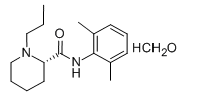
Ropivacaine Hydrochloride is a local anesthetic API and reference standard for quality control. The compound is the anhydrous form of (S)-ropivacaine hydrochloride, with a role as a local anaesthetic . USP specifies that Ropivacaine Hydrochloride Injection contains not less than 90.0% and not more than 110.0% of the labeled amount of ropivacaine hydrochloride (C₁₇H₂₆N₂O·HCl) . Related Compound A (2,6-dimethylaniline hydrochloride) is limited to not more than 0.01% .
|
Parameter |
Specification |
|
Product Name |
Ropivacaine Hydrochloride |
|
CAS Number |
132112-35-7 |
|
Molecular Formula |
C₁₇H₂₇ClN₂O |
|
Molecular Weight |
310.9 g/mol |
|
Storage Condition |
Preserve in single-dose or multiple-dose containers |
Ropivacaine HCl (LEA-103) is an anesthetic that blocks the conduction of impulses on nerve fibers by reversibly inhibiting the influx of sodium ions.
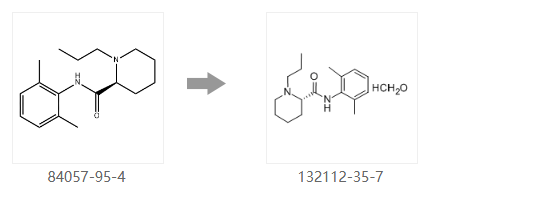
Using (S)-N-(2,6-dimethylphenyl)-1-propyl-2-piperidinecarboxamide as the raw material, the general procedure for synthesizing (S)-N-(2,6-dimethylphenyl)-1-propylpiperidine-2-carboxamide hydrochloride hydrate is as follows: Dissolve approximately 3 g of (S)-N-(2,6-dimethylphenyl)-1-propyl-2-piperidinecarboxamide in 10 mL of deionized water, and slowly add 50 mL of acetone preheated to 60 °C to the solution. Under stirring conditions, concentrated hydrochloric acid is added dropwise to adjust the pH to 2.0. Subsequently, the reaction mixture is heated to reflux until a clear solution is formed. An additional 20 mL of acetone is added to the reaction system, and the precipitated solid product is filtered after cooling to room temperature. The solid is washed three times with cold acetone and dried in a vacuum drying oven at 40 °C for 12 hours to obtain 2.9 g of white crystalline (S)-N-(2,6-dimethylphenyl)-1-propylpiperidine-2-carboxamide hydrochloride hydrate, with a yield of 82%. The water content of the product is determined to be 5.6% by the Karl Fischer method.
Common side effects of ropivacaine hydrochloride include hypotension, nausea, bradycardia, anxiety, and hypoesthesia.
Contact Cosperpharm for Ropivacaine Hydrochloride reference standard and API inquiries.
Address
No. 2 Yangguang 3rd Road, Duodao Chemical Cycle Industrial Park, Jingmen City, Hubei Province, China
Tel