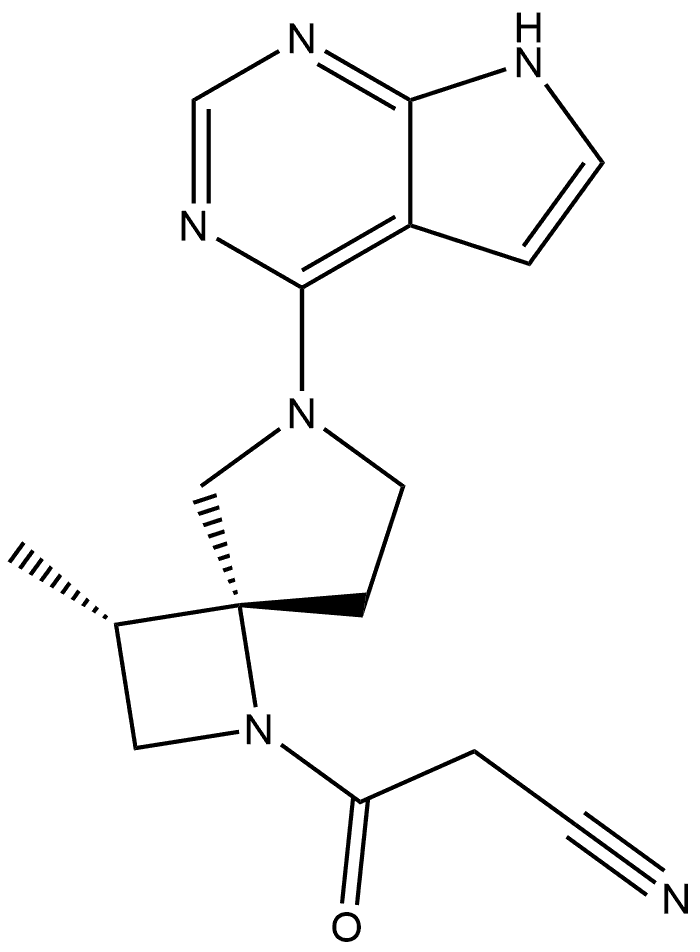
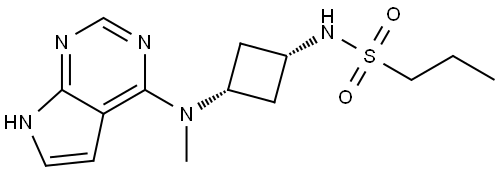
Abrocitinib is a selective Janus kinase 1 (JAK1) inhibitor approved by the U.S. FDA in 2022 for the treatment of moderate-to-severe atopic dermatitis in adults and adolescents who are candidates for systemic therapy . As the active pharmaceutical ingredient in CIBINQO®, Abrocitinib is available in 100 mg and 200 mg tablet strengths for once-daily oral administration . Abrocitinib modulates the JAK-STAT signaling pathway, which is involved in the inflammatory response underlying atopic dermatitis. In analytical and quality control contexts, Abrocitinib serves as the primary reference standard for analytical method development, method validation, and quality control applications for Abbreviated New Drug Applications (ANDA). The well-characterized pharmacological profile of Abrocitinib makes it an essential reference material for research into JAK inhibition, dermatology therapeutics, and the development of next-generation anti-inflammatory agents.
|
Parameter |
Specification |
|
Product Name |
Abrocitinib |
|
CAS Number |
1622902-68-4 |
|
Molecular Formula |
C₁₄H₂₁N₅O₂S |
|
Molecular Weight |
323.41 g/mol |
|
Appearance |
White powder |
|
Density |
1.36 ± 0.1 g/cm3 |
|
Solubility |
DMSO: 100.0 (maximum concentration, mg/mL); 309.2 (maximum concentration, mM) |
|
Storage Condition |
Room temperature |
PF-04965842 (Abrolitinib) is a once-daily oral small-molecule JAK inhibitor that selectively inhibits JAK1. JAK1 inhibitors can participate in regulating various cytokines involved in the pathogenesis of atopic dermatitis.
PF-04965842 (Abrolitinib) is an effective JAK1 inhibitor with IC50 values of 29 nM, 803 nM,>10,000 nM, and 1250 nM against JAK1, JAK2, JAK3, and TYK2, respectively.
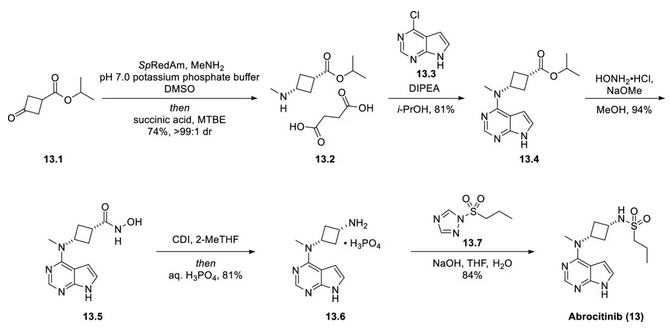
The synthesis of abrocitinib begins with ketostere 13.1, which undergoes an enzymatic reductive amination reaction with methylamine to form amino cyclobutane 13.2; this intermediate is then isolated as a succinate salt at a yield of 74% and with a cis/trans isomer ratio exceeding 99:1. The resulting amine reacts with pyrrolylpyrimidine 13.3 to afford the SNAr product 13.4, which is obtained in an 81% yield. The ester group is subsequently converted to the corresponding hydroxylamine acid 13.5 via a reaction reported in ChemicalBook with a yield of 94%. The hydroxylamine acid is activated using N,N′-carbodiimide (CDI) to facilitate the desired Lossen rearrangement, followed by acidic hydrolysis with phosphoric acid to yield the cis-cyclobutandiamine salt 13.6, which is isolated at a yield of 81%. Finally, the amine undergoes sulfonation with sulfonyltriazole 13.7 to produce abrocitinib (13), with a final isolation yield of 84%.
Looking for Abrocitinib to support your atopic dermatitis drug development, analytical method validation, or JAK inhibitor research? Cosperpharm delivers high-quality material with the documentation you need. Get in touch — we're ready to assist.
Address
No. 2 Yangguang 3rd Road, Duodao Chemical Cycle Industrial Park, Jingmen City, Hubei Province, China
Tel