
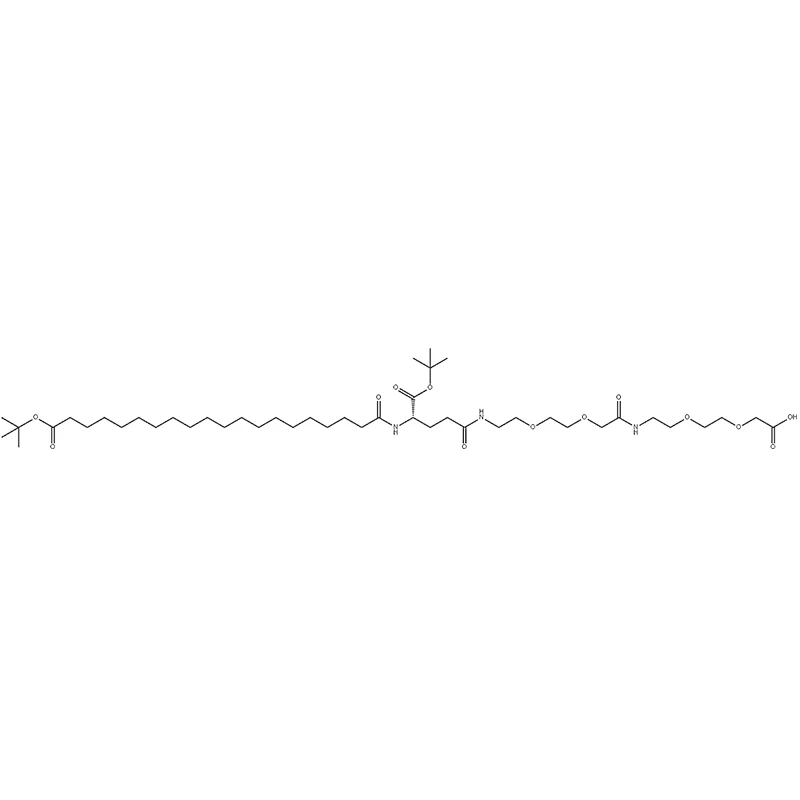
Tirzepatide Side Chain (CAS 1188328-37-1), also referred to as C20-OtBu-Glu(OtBu)-AEEA-AEEA-OH, LY1001, or C20 Fatty Acid Side Chain, is a synthetic protected fatty acid peptide linker. The molecular formula is C₄₅H₈₃N₃O₁₃, with a molecular weight of 874.15 g/mol. As a critical structural component of the blockbuster drug Tirzepatide, Tirzepatide Side Chain plays an irreplaceable role in drug synthesis by precisely attaching a long‑chain fatty acid moiety to the 20th lysine residue of the 39‑amino‑acid peptide backbone.
The structure of Tirzepatide Side Chain is meticulously crafted: the C20 fatty diacid (octadecanedioic acid derivative) contributes hydrophobicity for reversible albumin binding; the γ‑glutamic acid (Glu) acts as a branching linkage hub; and the two tandem AEEA (aminoethoxyethoxyethanol) hydrophilic units—each containing four oxygen and two nitrogen atoms—reduce immunogenicity, enhance solubility, and optimize the spatial orientation of the fatty acid chain. By regulating the activation of GIP and GLP-1 receptors, Tirzepatide Side Chain significantly promotes insulin secretion, suppresses glucagon release, reduces weight, and improves insulin resistance. Compared to traditional GLP‑1 receptor agonists, Tirzepatide Side Chain contributes to a longer half-life and more sustained therapeutic effects, exhibiting superior characteristics in clinical treatment.
Beyond its application in diabetes and obesity therapies, Tirzepatide Side Chain has also shown promising prospects for the treatment of cardiovascular diseases, non‑alcoholic fatty liver disease (NAFLD), and chronic kidney disease (CKD). The same side chain platform is also utilized in the development of the ultra‑long‑acting insulin Icodec, where it substantially reduces dosing frequency to as low as once per week, demonstrating remarkable versatility.

|
Parameter |
Specification |
|
CAS Number |
1188328-37-1 |
|
Molecular Formula |
C₄₅H₈₃N₃O₁₃ |
|
Molecular Weight |
874.15 g/mol |
|
Purity |
≥98% (HPLC) as standard; ≥99% available upon request |
|
Appearance |
White to off-white solid; pale yellow solid |
|
Boiling Point |
953.8 ± 65.0 °C (Predicted) |
|
Density |
1.070 ± 0.06 g/cm³ (Predicted) |
|
pKa |
3.39 ± 0.10 (Predicted) |
|
Canonical SMILES |
C(O)(=O)COCCOCCNC(=O)COCCOCCNC(=O)CCC@HC(OC(C)(C)C)=O |
|
Solubility |
Soluble in organic solvents (DCM, DMF, ethyl acetate); slightly soluble in water |
|
Storage Condition |
-20 ± 5 °C, in inert atmosphere, protected from light and moisture |
|
Stability |
Stable for up to 24 months when stored at -20 °C in sealed, moisture-proof containers |
|
Advantage |
Detail |
|
Production Strength |
GMP-certified campus spanning 100+ mu, 3 multi-purpose workshops, 6 D-grade clean zone production lines, and 150+ reactors (20L–5000L), supporting high/low temp, anaerobic & hydrogenation; kg to ton scale production. |
|
Fast Delivery |
R&D samples: one week; commercial orders: 1–2 months after payment. Express (DHL/FedEx) or air/sea freight available. |
|
Global Partners |
Trusted by 30+ pharmaceutical companies in USA, Europe, India, Brazil, and Southeast Asia; long-term cooperation with generic drug manufacturers, CROs, and impurity standard distributors. |
|
Licensed Exporter |
Valid drug import/export license — no compliance delays. |
|
Dual Quality Grades |
Both research/pharma grade(≥98%)and high-purity impurity grade(≥99%)available to meet diverse customer needs. |
A documented patent synthetic route begins with 20‑(tert‑butoxy)‑20‑oxoicosanoic acid, which is activated using an alkyl chloroformate (e.g., isobutyl chloroformate) to form a mixed anhydride intermediate. This activated intermediate is then reacted with a strong base solution of 1‑tert‑butyl L‑glutamate, forming the amide bond at the γ‑position of the glutamic acid residue. The resulting intermediate is then coupled with a pre‑synthesized dipeptide fragment (AEEA‑AEEA) under standard peptide coupling conditions (e.g., using HATU or EDCI/HOBt with a base such as DIPEA). Final purification by recrystallization or preparative HPLC yields the target Tirzepatide Side Chain with a reported yield of up to 90% and purity ≥98%.
An alternative approach involves initially synthesizing the protected peptide backbone via Fmoc solid‑phase peptide synthesis (SPPS). The side chain C20-OtBu-Glu(OtBu)-AEEA-AEEA-OH is then coupled to the resin‑bound peptide at the 20th lysine residue using standard peptide coupling chemistry (e.g., HATU/DIPEA). After side chain attachment, the peptide is cleaved from the resin under mildly acidic conditions, and the final product is purified by preparative reversed‑phase HPLC (RP‑HPLC) followed by lyophilization. This method efficiently integrates with established peptide synthesis workflows, streamlining the production of the full Tirzepatide drug substance.
Industrial manufacturing of Tirzepatide Side Chain employs optimized liquid‑phase synthesis under controlled conditions to ensure high yield and purity. The process is conducted in stirred‑tank reactors with precise temperature control, inert atmosphere (nitrogen/argon), and rigorous moisture exclusion to prevent degradation. Final purification is achieved through recrystallization and/or preparative HPLC, ensuring the product meets stringent pharmaceutical‑grade specifications for drug substance manufacturing.
A: Tirzepatide Side Chain serves as the protected fatty acid linker that conjugates a C20 eicosanoic diacid to the peptide backbone. By reversibly binding to human serum albumin, it dramatically prolongs the plasma half‑life of the therapeutic peptide from hours to days. This enables once‑weekly subcutaneous dosing for drugs such as Tirzepatide and insulin Icodec, significantly reducing patient injection frequency and improving treatment compliance.
A: The compound is classified with GHS signal word “Warning” due to potential hazards: H302 (Harmful if swallowed), H315 (Causes skin irritation), H319 (Causes serious eye irritation), H335 (May cause respiratory irritation). It is not considered a hazardous material for transport under normal conditions. Standard laboratory safety precautions should be observed: use appropriate PPE (chemical‑resistant gloves, safety goggles, lab coat), work in a well‑ventilated area, avoid generating dust, and wash hands thoroughly after handling. An SDS is available upon request.
We look forward to supporting your research and development needs.If you have any questions regarding Tirzepatide Side Chain (CAS 1188328-37-1) or wish to request a quotation, please do not hesitate to reach out. Our sales and technical support teams are ready to assist you.
Address
No. 2 Yangguang 3rd Road, Duodao Chemical Cycle Industrial Park, Jingmen City, Hubei Province, China
Tel

![1-[2,3-Bis[(9Z,12Z)-octadeca-9,12-dien-1-yloxy]propyl]pyrrolidine](/upload/8820/1-2-3-bis-9z-12z-octadeca-9-12-dien-1-yloxy-propyl-pyrrolidine-349384.webp "1-[2,3-Bis[(9Z,12Z)-octadeca-9,12-dien-1-yloxy]propyl]pyrrolidine")
![1,2,4-Triazolo[4,3-a]pyridin-3(2H)-one](/upload/8820/1-2-4-triazolo-4-3-a-pyridin-3-2h-one-440735.webp "1,2,4-Triazolo[4,3-a]pyridin-3(2H)-one")