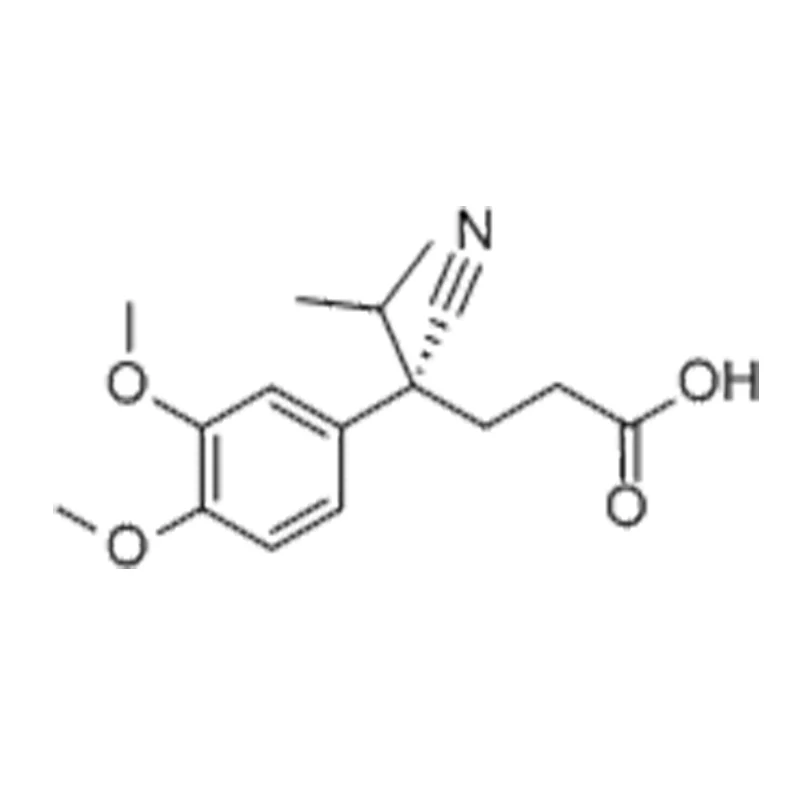
(S)-(-)-Verapamilic Acid (systematic name: (4S)-4-cyano-4-(3,4-dimethoxyphenyl)-5-methylhexanoic acid) serves as the key chiral gateway to the single-enantiomer phenylalkylamine calcium channel blocker S-verapamil hydrochloride. In pharmaceutical manufacturing, (S)-(-)-Verapamilic Acid is the essential advanced intermediate that enables access to enantiomerically pure S-verapamil, as the two enantiomers of racemic verapamil exhibit distinct pharmacodynamics: the (S)-enantiomer shows significantly greater potency for cardiac arrhythmia and hypertension, while the (R)-enantiomer is more effective at alleviating angina.
As a chiral building block,it features a quaternary carbon bearing a nitrile group strategically positioned for selective borane-mediated reduction of a tertiary amide in the final steps of the verapamil synthesis. Using α-methylbenzylamine as the resolving agent, racemic verapamilic acid is efficiently resolved to yield (S)-(-)-Verapamilic Acid with preserved stereochemical integrity at the quaternary carbon center, enabling pilot-plant scale-up of the resolution step for commercial manufacturing. Beyond its established role in calcium channel blocker synthesis, (S)-(-)-Verapamilic Acid is also employed in stereochemical mapping studies, small-molecule reactivity evaluation, and functional-fragment incorporation research for metabolism-modeling applications.
|
Parameter |
Specification |
|
CAS Number |
36622-24-9 |
|
Molecular Formula |
C₁₆H₂₁NO₄ |
|
Molecular Weight |
291.34 g/mol |
|
Purity (HPLC) |
≥98% (custom ≥95% upon request) |
|
Appearance |
Colorless semi-solid to off-white solid |
|
Boiling Point |
448.8 ± 45.0 °C (Predicted) |
|
Density |
1.126 ± 0.06 g/cm³ (Predicted) |
|
pKa |
4.29 ± 0.10 (Predicted) |
|
Solubility |
Soluble in chloroform (slightly), ethanol (slightly, with heating), ethyl acetate, methanol |
|
Storage Condition |
Refrigerated (2–8°C), sealed, under inert atmosphere |
Cosperpharm is your trusted partner for high-quality (S)-(-)-Verapamilic Acid and other chiral pharmaceutical intermediates. Here is why pharmaceutical manufacturers choose us:
Superior chiral purity: We guarantee consistent enantiomeric excess (typically >98% ee) for (S)-(-)-Verapamilic Acid, ensuring that your downstream amide coupling, selective borane-mediated reduction, and final API formation steps are not compromised by incorrect stereochemistry. Our HPLC purity consistently meets ≥98% specifications.
Scalable resolution expertise: The resolution of verapamilic acid using α-methylbenzylamine is demanding — requiring controlled precipitation by acidification at elevated temperature and careful pH management. Our process chemistry team has successfully scaled this resolution to commercial production volumes, delivering high yields while preserving stereochemical integrity at the quaternary carbon center.
Comprehensive documentation support: We provide full documentation including Certificate of Analysis (COA) with chiral purity data, stability studies, material safety data sheets (SDS), and DMF-ready regulatory packages. Our licensed export status ensures smooth customs clearance worldwide.
Flexible volumes, responsive service: Whether you need 1g for route scouting or 50kg for commercial supply, Cosperpharm delivers. We understand R&D timelines and prioritize urgent inquiries.
Cost-effective manufacturing: By integrating synthesis from readily available raw materials and maintaining efficient resolution processes, Cosperpharm delivers competitive pricing without compromising stringent quality standards.
The α-methylbenzylamine resolution process is the industrial standard, delivering reliable scalability. Pilot-plant scale-up of the resolution step has been successfully demonstrated. Unlike asymmetric methods requiring expensive chiral catalysts, this approach scales to commercial volumes without the need for precious metal recovery or catalyst screening.
The quaternary carbon stereocenter is notoriously challenging to construct stereoselectively. (S)-(-)-Verapamilic Acid maintains stereochemical integrity through amide formation, selective reduction, and final API synthesis, giving you confidence in your enantiopure drug product.
The nitrile and carboxylic acid functionalities are positioned for selective borane-mediated reduction of the tertiary amide — a high-purity intermediate ensures these sensitive transformations proceed with minimal by-product formation.
Available from 1g research quantities to 50kg commercial batches, with custom packaging for your specific handling requirements.
Beyond its established role in calcium channel blocker synthesis, (S)-(-)-Verapamilic Acid serves as a valuable building block for metabolism-modeling studies, drug metabolism research, and the development of chiral small-molecule libraries.
A: No. (S)-(-)-Verapamilic Acid is the chiral carboxylic acid intermediate; S-verapamil is the final API after amide formation and borane-mediated reduction. Verapamilic acid establishes the quaternary stereocenter — once set here, the (S)-configuration is preserved through subsequent transformations.
A: The (S)- and (R)-enantiomers of verapamil differ significantly in biological activity. S-verapamil is substantially more potent (approximately 8 to 20 times) in blocking L-type calcium channels and AV node conduction. S-verapamil is more effective for cardiac arrhythmia and hypertension, whereas R-verapamil appears better for angina alleviation. (S)-(-)-Verapamilic Acid enables the manufacture of single-enantiomer S-verapamil formulations.
Ready to source high-quality (S)-(-)-Verapamilic Acid for your verapamil API development, chiral chemistry research, or commercial manufacturing? Contact Cosperpharm,
Address
No. 2 Yangguang 3rd Road, Duodao Chemical Cycle Industrial Park, Jingmen City, Hubei Province, China
Tel

![1-[2,3-Bis[(9Z,12Z)-octadeca-9,12-dien-1-yloxy]propyl]pyrrolidine](https://www.cosperpharma.com/upload/8820/1-2-3-bis-9z-12z-octadeca-9-12-dien-1-yloxy-propyl-pyrrolidine-349384.webp "1-[2,3-Bis[(9Z,12Z)-octadeca-9,12-dien-1-yloxy]propyl]pyrrolidine")
![1,2,4-Triazolo[4,3-a]pyridin-3(2H)-one](https://www.cosperpharma.com/upload/8820/1-2-4-triazolo-4-3-a-pyridin-3-2h-one-440735.webp "1,2,4-Triazolo[4,3-a]pyridin-3(2H)-one")